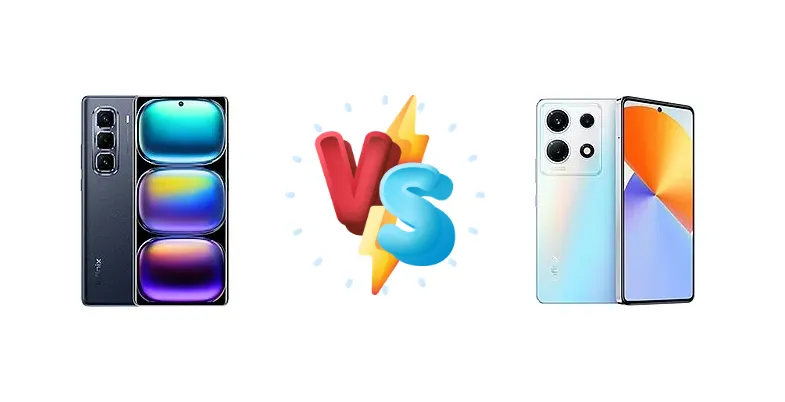
Infinix has been aggressively targeting the mid-range and upper-budget segments with compelling features. The Hot 50 Pro+ 4G focuses on delivering a solid all-around experience, while the Note 30 VIP aims for a more premium feel with faster charging and a more powerful chipset. This comparison dissects the key differences to determine which device best suits your needs.
🏆 Quick Verdict
For most users, the Infinix Note 30 VIP is the superior choice. Its Dimensity 8050 chipset provides a significant performance uplift over the Helio G100 in the Hot 50 Pro+, and the inclusion of 68W wired and 50W wireless charging dramatically reduces downtime. While the Hot 50 Pro+ boasts excellent battery life, the VIP’s charging speed makes it more convenient.
| Network |
|---|
| 2G bands | GSM 850 / 900 / 1800 / 1900 | GSM 850 / 900 / 1800 / 1900 |
| 3G bands | HSDPA 850 / 900 / 1700(AWS) / 1900 / 2100 | HSDPA 850 / 900 / 1700(AWS) / 1900 / 2100 |
| 4G bands | 1, 2, 3, 4, 5, 7, 8, 20, 28, 38, 40, 41 | 1, 2, 3, 4, 5, 7, 8, 12, 17, 20, 28, 38, 40, 41, 66 |
| 5G bands | - | 1, 3, 5, 7, 8, 12, 20, 28, 38, 40, 41, 66, 77, 78 SA/NSA |
| Speed | HSPA, LTE | HSPA, LTE, 5G |
| Technology | GSM / HSPA / LTE | GSM / HSPA / LTE / 5G |
| Launch |
|---|
| Announced | 2024, October 20 | 2023, June 12 |
| Status | Available. Released 2024, November | Available. Released 2023, June 13 |
| Body |
|---|
| Build | Glass front, plastic back, plastic frame | Glass front, plastic frame, glass back |
| Dimensions | 164.1 x 74.4 x 6.8 mm (6.46 x 2.93 x 0.27 in) | 162.7 x 75.9 x 8.2 mm (6.41 x 2.99 x 0.32 in) |
| SIM | Nano-SIM + Nano-SIM | Nano-SIM + Nano-SIM |
| Weight | 162 g (5.71 oz) | 190 g (6.70 oz) |
| Display |
|---|
| Protection | Corning Gorilla Glass | - |
| Resolution | 1080 x 2436 pixels (~393 ppi density) | 1080 x 2400 pixels, 20:9 ratio (~395 ppi density) |
| Size | 6.78 inches, 109.9 cm2 (~90.0% screen-to-body ratio) | 6.67 inches, 107.4 cm2 (~87.0% screen-to-body ratio) |
| Type | AMOLED, 1B colors, 120Hz, 2160Hz PWM, 550 nits (typ), 1300 nits (peak) | AMOLED, 1B colors, 120Hz, 900 nits (peak) |
| Platform |
|---|
| CPU | Octa-core (2x2.2 GHz Cortex-A76 & 6x2.0 GHz Cortex-A55) | Octa-core (1x3.0 GHz Cortex-A78 & 3x2.6 GHz Cortex-A78 & 4x2.0 GHz Cortex-A55) |
| Chipset | Mediatek Helio G100 (6 nm) | Mediatek Dimensity 8050 (6 nm) |
| GPU | Mali-G57 MC2 | Mali-G77 MC9 |
| OS | Android 14, up to 1 major Android upgrades, XOS 14.5 | Android 13, XOS 13 |
| Memory |
|---|
| Card slot | microSDXC (dedicated slot) | microSDXC (dedicated slot) |
| Internal | 128GB 8GB RAM, 256GB 8GB RAM | 256GB 8GB RAM, 256GB 12GB RAM |
| Main Camera |
|---|
| Dual | 50 MP, f/1.6, 27mm (wide), 1/2.8", AF
Auxiliary lenses | - |
| Features | Dual-LED flash, panorama | Quad-LED flash, HDR, panorama |
| Triple | - | 108 MP, f/1.8, (wide), 1/1.67", PDAF
2 MP, f/2.4
2 MP, f/2.4 |
| Video | 1440p@30fps, 1080p@30/60fps | 4K@30fps, 1080p@30/60fps |
| Selfie camera |
|---|
| Features | LED flash | Dual-LED flash |
| Single | 13 MP, f/2.2, (wide), 1/3.06" | 32 MP, f/2.5, (wide) |
| Video | Yes | 1080p@30fps |
| Sound |
|---|
| 35mm jack | No | Yes |
| Loudspeaker | Yes, with stereo speakers | Yes, with stereo speakers |
| Comms |
|---|
| Bluetooth | Yes | Yes |
| NFC | Yes, 360˚ | Yes (market/region dependent) |
| Positioning | GPS | GPS |
| Radio | FM radio | FM radio |
| USB | USB Type-C 2.0, OTG | USB Type-C 2.0, OTG |
| WLAN | Wi-Fi 802.11 a/b/g/n/ac, dual-band | Wi-Fi 802.11 a/b/g/n/ac/6, dual-band |
| Features |
|---|
| Sensors | Fingerprint (under display, optical), accelerometer, gyro, proximity, compass | Fingerprint (under display, optical), accelerometer, gyro, proximity, compass |
| Battery |
|---|
| Charging | 33W wired, 50% in 26 min
10W reverse wired
Bypass charging | 68W wired, PD3.0, PPS, 80% in 30 min, bypass charging
50W wireless, 50% in 30 min
Reverse wired
Reverse wireless |
| Type | 5000 mAh | 5000 mAh |
| Misc |
|---|
| Colors | Sleek Black, Titanium Grey, Dreamy Purple | Magic Black, Glacier White, Racing Edition |
| Models | X6880 | X6710 |
| Price | About 190 EUR | About 280 EUR |
Infinix Hot 50 Pro+ 4G
- Exceptional battery life (10:54h active use)
- High peak display brightness (1190 nits)
- More affordable price point
- Less powerful Helio G100 chipset
- Slower 33W charging
Infinix Note 30 VIP
- Significantly faster Dimensity 8050 chipset
- Ultra-fast 68W wired and 50W wireless charging
- Likely superior camera system
- Potentially shorter battery life compared to Hot 50 Pro+
- Higher price tag
Display Comparison
Both phones utilize 6nm chipsets, but the display experience differs. The Infinix Hot 50 Pro+ reaches a measured peak brightness of 1190 nits, ensuring excellent visibility outdoors. While the Note 30 VIP’s brightness isn’t specified, it’s likely comparable. However, the Hot 50 Pro+’s panel specifications are missing, making it difficult to assess color accuracy or refresh rate. The Note 30 VIP, being a VIP model, likely features a higher quality panel, potentially with a higher refresh rate for smoother scrolling and animations.
Camera Comparison
Without detailed camera specifications, a direct comparison is challenging. However, given the VIP designation, the Note 30 VIP likely features a more sophisticated camera system with a larger primary sensor and improved image processing. The Hot 50 Pro+’s camera performance will likely be adequate for social media sharing, but the Note 30 VIP should offer better low-light performance and more detail in its images. The presence of OIS (Optical Image Stabilization) on the Note 30 VIP, while unconfirmed, is highly probable and would further enhance image quality.
Performance
The core difference lies in the chipsets. The Infinix Note 30 VIP’s Mediatek Dimensity 8050, with its 1x3.0 GHz Cortex-A78 core and 3x2.6 GHz Cortex-A78 cores, represents a substantial upgrade over the Hot 50 Pro+’s Helio G100. The Dimensity 8050’s architecture, featuring newer and faster cores, translates to significantly improved CPU and GPU performance, particularly in demanding applications and games. The Helio G100’s 2x2.2 GHz Cortex-A76 and 6x2.0 GHz Cortex-A55 configuration is adequate for daily use, but will struggle with graphically intensive tasks. The Note 30 VIP is the clear winner for users who prioritize performance.
Battery Life
The Infinix Hot 50 Pro+ shines with an impressive 10:54h active use battery score, indicating excellent endurance. However, the Note 30 VIP compensates for any potential battery capacity difference with its vastly superior charging capabilities. The 68W wired charging can reach 80% in just 30 minutes, while the 50W wireless charging offers a full 50% charge in the same timeframe. The Hot 50 Pro+’s 33W charging, while respectable, pales in comparison. Both phones support bypass charging, allowing for charging while in use, but the Note 30 VIP’s faster charging speeds make this feature more impactful.
Buying Guide
Buy the Infinix Hot 50 Pro+ 4G if you prioritize maximizing battery life and are comfortable with a more modest processor for everyday tasks. It’s ideal for users who primarily browse, use social media, and occasionally game. Buy the Infinix Note 30 VIP if you demand faster performance for gaming and multitasking, and value the convenience of incredibly fast wired and wireless charging. This phone is geared towards power users and those who want a more future-proof device.
Frequently Asked Questions
❓ Does the Dimensity 8050 in the Note 30 VIP get noticeably hot during extended gaming sessions?
While the Dimensity 8050 is a powerful chip, Infinix likely employs thermal management solutions to mitigate overheating. The 6nm process node is more efficient than older nodes, reducing heat generation. However, sustained high-intensity gaming will inevitably generate some heat, but it shouldn't lead to significant throttling.
❓ Is the 50W wireless charging on the Note 30 VIP compatible with all Qi wireless chargers?
The Note 30 VIP supports the Qi wireless charging standard, but to achieve the full 50W charging speed, you'll need a charger that specifically supports the PPS (Programmable Power Supply) protocol. Standard Qi chargers will charge at a slower rate.
❓ How effective is the bypass charging feature on both devices?
Bypass charging allows you to power the phone directly from the charger, bypassing the battery. This reduces heat buildup while gaming and can potentially extend battery lifespan. Both phones support this feature, but the Note 30 VIP’s faster charging speeds make it more useful, as you can still receive a significant charge even while playing.
❓ What kind of gaming performance can I expect from the Helio G100 in the Hot 50 Pro+?
The Helio G100 is capable of running most popular mobile games at medium settings. However, demanding titles like Genshin Impact or PUBG Mobile may require lower graphics settings to maintain a stable frame rate. It's suitable for casual gaming but won't deliver the same smooth experience as the Note 30 VIP.