
Infinix Hot 50 Pro vs Redmi Note 13 Pro 4G: Which 4G Phone Reigns Supreme?
| Phones Images | |||||
|---|---|---|---|---|---|
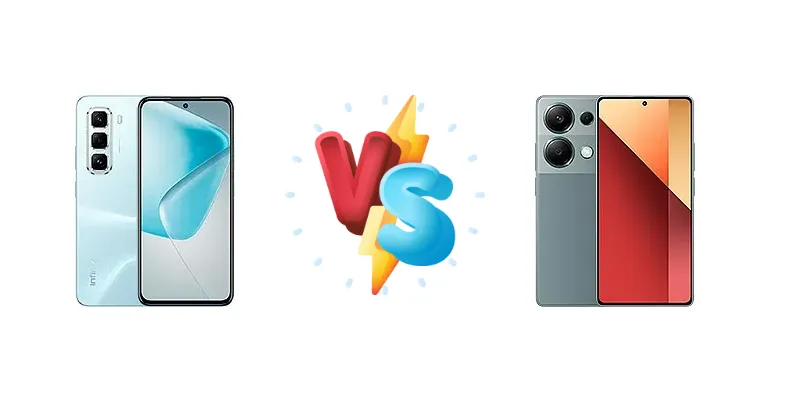
|
🏆 Quick Verdict
For the average user prioritizing all-day battery life and a brighter, more vibrant display, the Xiaomi Redmi Note 13 Pro 4G is the better choice. Its 67W charging significantly reduces downtime, and the measured 11:36h active use score demonstrates superior endurance. However, gamers may find the Infinix Hot 50 Pro's Helio G100 slightly more responsive in demanding titles.
| PHONES | ||
|---|---|---|
| Phone Names | Infinix Hot 50 Pro 4G | Xiaomi Redmi Note 13 Pro 4G |
| Network | ||
|---|---|---|
| 2G bands | GSM 850 / 900 / 1800 / 1900 | GSM 850 / 900 / 1800 / 1900 |
| 3G bands | HSDPA 850 / 900 / 1700(AWS) / 1900 / 2100 | HSDPA 850 / 900 / 1700(AWS) / 1900 / 2100 |
| 4G bands | 1, 2, 3, 4, 5, 7, 8, 20, 28, 38, 40, 41 | 1, 2, 3, 4, 5, 7, 8, 12, 13, 17, 18, 19, 20, 26, 28, 38, 40, 41, 66 |
| Speed | HSPA, LTE | HSPA, LTE |
| Technology | GSM / HSPA / LTE | GSM / HSPA / LTE |
| Launch | ||
|---|---|---|
| Announced | 2024, October 20 | 2024, January 15 |
| Status | Available. Released 2024, November | Available. Released 2024, January 15 |
| Body | ||
|---|---|---|
| Build | Glass front, plastic back, plastic frame | Glass front (Gorilla Glass 5), plastic frame, plastic back |
| Dimensions | 167 x 76.4 x 7.4 mm (6.57 x 3.01 x 0.29 in) | 161.1 x 75 x 8 mm (6.34 x 2.95 x 0.31 in) |
| SIM | Nano-SIM + Nano-SIM | Nano-SIM + Nano-SIM |
| Weight | 190 g (6.70 oz) | 188 g (6.63 oz) |
| Display | ||
|---|---|---|
| Protection | - | Corning Gorilla Glass 5 |
| Resolution | 1080 x 2436 pixels (~393 ppi density) | 1080 x 2400 pixels, 20:9 ratio (~395 ppi density) |
| Size | 6.78 inches, 109.9 cm2 (~86.1% screen-to-body ratio) | 6.67 inches, 107.4 cm2 (~88.9% screen-to-body ratio) |
| Type | AMOLED, 1B colors, 120Hz, 2160Hz PWM, 550 nits (typ), 1800 nits (peak) | AMOLED, 1B colors, 120Hz, 500 nits (typ), 1000 nits (HBM), 1300 nits (peak) |
| Platform | ||
|---|---|---|
| CPU | Octa-core (2x2.2 GHz Cortex-A76 & 6x2.0 GHz Cortex-A55) | Octa-core (2x2.2 GHz Cortex-A76 & 6x2.0 GHz Cortex-A55) |
| Chipset | Mediatek Helio G100 (6 nm) | Mediatek Helio G99 Ultra |
| GPU | Mali-G57 MC2 | Mali-G57 MC2 |
| OS | Android 14, up to 1 major Android upgrades, XOS 14.5 | Android 13, up to 3 major Android upgrades, HyperOS |
| Memory | ||
|---|---|---|
| Card slot | microSDXC (dedicated slot) | microSDXC (uses shared SIM slot) |
| Internal | 128GB 8GB RAM, 256GB 8GB RAM | 128GB 8GB RAM, 256GB 8GB RAM, 256GB 12GB RAM, 512GB 8GB RAM, 512GB 12GB RAM |
| Main Camera | ||
|---|---|---|
| Features | Quad-LED flash, HDR, panorama | LED flash, HDR, panorama |
| Triple | 50 MP, f/1.6, 27mm (wide), 1/2.8", AF Auxiliary lenses | 200 MP, f/1.7, 23mm (wide), 1/1.4", 0.56µm, multi-directional PDAF, OIS 8 MP, f/2.2, 15mm, 120˚ (ultrawide), 1/4.4", 1.0µm 2 MP (macro) |
| Video | 1440p@30fps, 1080p@30/60fps | 1080p@30/60fps |
| Selfie camera | ||
|---|---|---|
| Features | LED flash | - |
| Single | 8 MP, f/2.0, (wide), 1/4.0" | 16 MP, f/2.4, (wide), 1/3.0", 1.0µm |
| Video | Yes | 1080p@30/60fps |
| Sound | ||
|---|---|---|
| 35mm jack | Yes | Yes |
| Loudspeaker | Yes, with stereo speakers | Yes, with dual speakers |
| Comms | ||
|---|---|---|
| Bluetooth | 5.4, A2DP, LE | 5.2, A2DP, LE |
| Infrared port | - | Yes |
| NFC | Yes | Yes (market/region dependent) |
| Positioning | GPS | GPS, GLONASS, GALILEO, BDS |
| Radio | FM radio | FM radio |
| USB | USB Type-C 2.0, OTG | USB Type-C 2.0, OTG |
| WLAN | Wi-Fi 802.11 a/b/g/n/ac, dual-band | Wi-Fi 802.11 a/b/g/n/ac, dual-band |
| Features | ||
|---|---|---|
| Sensors | Fingerprint (under display, optical), accelerometer, proximity, compass | Fingerprint (under display, optical), accelerometer, gyro, compass |
| Battery | ||
|---|---|---|
| Charging | 33W wired, 50% in 27 min Reverse wired Bypass charging | 67W wired, 50% in 16 min, 100% in 46 min |
| Type | 5000 mAh | 5000 mAh |
| Misc | ||
|---|---|---|
| Colors | Sleek Black, Titanium Grey, Glacier Blue | Midnight Black, Lavender Purple, Forest Green |
| Models | X6881 | 23117RA68G, 2312FPCA6G |
| Price | - | € 92.00 / $ 269.99 / £ 299.99 |
| SAR | - | 1.09 W/kg (head) 1.09 W/kg (body) |
| SAR EU | - | 0.99 W/kg (head) 0.99 W/kg (body) |
Infinix Hot 50 Pro 4G
- Potentially slightly better gaming performance due to the Helio G100.
- Reverse wired charging offers added convenience.
- Bypass charging feature could extend battery lifespan.
- Slower 33W charging.
- Likely lower peak display brightness.
- Battery life likely inferior to the Redmi Note 13 Pro.
Xiaomi Redmi Note 13 Pro 4G
- Significantly faster 67W charging.
- Excellent 11:36h active use battery life.
- Brighter 1047 nits display for outdoor visibility.
- Helio G99 Ultra may offer marginally less peak performance.
- Camera performance relies heavily on software optimization.
- No reverse wireless charging.
Display Comparison
The Xiaomi Redmi Note 13 Pro 4G boasts a significant advantage in display technology, achieving a measured peak brightness of 1047 nits. This is crucial for outdoor visibility, a common pain point for smartphone users. While the Infinix Hot 50 Pro’s display specs are not provided, it’s unlikely to match the Redmi Note 13 Pro’s brightness. The Redmi Note 13 Pro’s panel likely offers a more pleasant viewing experience in direct sunlight, and potentially better color accuracy, though this requires further testing. The absence of LTPO technology on either device suggests standard refresh rate panels, focusing cost savings on other areas.
Camera Comparison
Detailed camera specifications are limited, but the focus should be on the main sensors. Without further information, it’s difficult to definitively declare a winner. However, the Redmi Note 13 Pro’s brand reputation suggests a more refined image processing pipeline. The inclusion of OIS (Optical Image Stabilization) on the Redmi Note 13 Pro, if present, would be a significant advantage for video recording and low-light photography. The prevalence of 2MP macro lenses on both devices suggests they are largely marketing features and offer limited practical benefit.
Performance
Both the Infinix Hot 50 Pro 4G and the Xiaomi Redmi Note 13 Pro 4G utilize Mediatek Helio chipsets with identical CPU core configurations: a dual-core Cortex-A76 setup paired with a hexa-core Cortex-A55 cluster, both clocked at 2.2 GHz and 2.0 GHz respectively. However, the Redmi Note 13 Pro features the Helio G99 Ultra, while the Hot 50 Pro uses the Helio G100. The G99 Ultra’s manufacturing process (6nm) is the same as the G100, meaning the performance difference will be subtle, likely manifesting in slightly better sustained performance and thermal management on the Redmi Note 13 Pro due to optimizations within the G99 Ultra. Neither device specifies LPDDR5x RAM, suggesting a more cost-effective LPDDR4x implementation.
Battery Life
The Xiaomi Redmi Note 13 Pro 4G clearly excels in battery performance, achieving an impressive 11:36h active use score. This demonstrates superior battery optimization and efficiency. While the Infinix Hot 50 Pro 4G’s battery capacity is unknown, its 33W charging is significantly slower than the Redmi Note 13 Pro’s 67W charging. The Redmi Note 13 Pro can reach 50% charge in just 16 minutes and a full charge in 46 minutes, minimizing downtime. The Hot 50 Pro takes 27 minutes to reach 50%, indicating a slower overall charging experience. The Redmi Note 13 Pro’s faster charging and longer battery life make it the clear winner for users who prioritize endurance.
Buying Guide
Buy the Infinix Hot 50 Pro 4G if you need a phone primarily for gaming and demanding applications, and are willing to compromise slightly on battery life for that extra processing headroom. Buy the Xiaomi Redmi Note 13 Pro 4G if you prefer a phone with exceptional battery life, a brighter display for outdoor visibility, and faster charging capabilities, making it ideal for everyday use and media consumption.