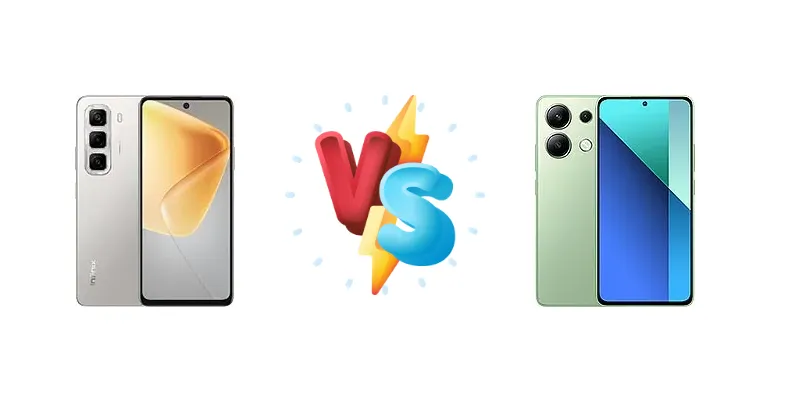
The sub-$200 4G smartphone market is fiercely competitive. The Infinix Hot 50 4G and Xiaomi Redmi Note 13 4G both aim to deliver a compelling experience without breaking the bank. This comparison dives deep into their specifications, focusing on performance, display quality, battery life, and charging to determine which device offers the best overall package.
🏆 Quick Verdict
For the average user prioritizing all-day battery life and a brighter, more visible display, the Xiaomi Redmi Note 13 4G emerges as the winner. Its Snapdragon 685 chipset, coupled with a measured 1313 nits peak brightness, provides a smoother, more enjoyable experience despite the Infinix Hot 50's slightly more powerful CPU cores.
| Network |
|---|
| 2G bands | GSM 850 / 900 / 1800 / 1900 | GSM 850 / 900 / 1800 / 1900 |
| 3G bands | HSDPA 850 / 900 / 1700(AWS) / 1900 / 2100 | HSDPA 850 / 900 / 2100 |
| 4G bands | 1, 2, 3, 4, 5, 7, 8, 20, 28, 38, 41, 40 | 1, 3, 5, 7, 8, 20, 28, 38, 40, 41 |
| Speed | HSPA, LTE | HSPA, LTE |
| Technology | GSM / HSPA / LTE | GSM / HSPA / LTE |
| Launch |
|---|
| Announced | 2024, September 30 | 2024, January 15 |
| Status | Available. Released 2024, October | Available. Released 2024, January 15 |
| Body |
|---|
| Build | Glass front, plastic back, plastic frame | Glass front (Gorilla Glass 3), plastic frame, plastic back |
| Dimensions | 167.9 x 75.6 x 7.7 mm (6.61 x 2.98 x 0.30 in) | 162.3 x 75.6 x 8 mm (6.39 x 2.98 x 0.31 in) |
| SIM | Nano-SIM + Nano-SIM | Nano-SIM + Nano-SIM |
| Weight | 187 g (6.60 oz) | 188.5 g (6.67 oz) |
| Display |
|---|
| Protection | - | Corning Gorilla Glass 3 |
| Resolution | 1080 x 2460 pixels (~396 ppi density) | 1080 x 2400 pixels, 20:9 ratio (~395 ppi density) |
| Size | 6.78 inches, 109.2 cm2 (~86.0% screen-to-body ratio) | 6.67 inches, 107.4 cm2 (~87.5% screen-to-body ratio) |
| Type | IPS LCD, 120Hz, 800 nits (typ) | AMOLED, 120Hz, 960Hz PWM, 1800 nits (peak) |
| Platform |
|---|
| CPU | Octa-core (2x2.2 GHz Cortex-A76 & 6x2.0 GHz Cortex-A55) | Octa-core (4x2.8 GHz Cortex-A73 & 4x1.9 GHz Cortex-A53) |
| Chipset | Mediatek Helio G100 (6 nm) | Qualcomm SM6225 Snapdragon 685 (6 nm) |
| GPU | Mali-G57 MC2 | Adreno 610 |
| OS | Android 14, XOS 14.5 | Android 13, upgradable to Android 15, up to 3 major Android upgrades, HyperOS 2 |
| Memory |
|---|
| Card slot | microSDXC (dedicated slot) | microSDXC (uses shared SIM slot) |
| Internal | 128GB 6GB RAM, 128GB 8GB RAM, 256GB 6GB RAM, 256GB 8GB RAM | 128GB 6GB RAM, 128GB 8GB RAM, 256GB 6GB RAM, 256GB 8GB RAM, 512GB 8GB RAM |
| Main Camera |
|---|
| Features | Dual-LED flash, panorama | LED flash, HDR, panorama |
| Triple | 50 MP, f/1.6, 27mm (wide), 1/2.76", AF
other unspecified cameras | 108 MP, f/1.8, 24mm (wide), 1/1.67", 0.64µm, PDAF
8 MP, f/2.2, 120˚, (ultrawide)
2 MP (macro) |
| Video | 1440p@30fps, 1080p@30/60fps | 1080p@30fps |
| Selfie camera |
|---|
| Features | LED flash | - |
| Single | 8 MP, f/2.0, (wide), 1/4.0" | 16 MP, f/2.4, (wide) |
| Video | Yes | 1080p@30fps |
| Sound |
|---|
| 35mm jack | Yes | Yes |
| Loudspeaker | Yes | Yes, with stereo speakers |
| Comms |
|---|
| Bluetooth | Yes | 5.1, A2DP, LE |
| Infrared port | - | Yes |
| NFC | Yes | Yes (market/region dependent) |
| Positioning | GPS | GPS, GLONASS, GALILEO, BDS |
| Radio | FM radio | Unspecified |
| USB | USB Type-C 2.0, OTG | USB Type-C 2.0, OTG |
| WLAN | Wi-Fi 802.11 a/b/g/n/ac, dual-band | Wi-Fi 802.11 a/b/g/n/ac, dual-band |
| Features |
|---|
| Sensors | Fingerprint (side-mounted), accelerometer, proximity, compass | Fingerprint (under display, optical), accelerometer, gyro, proximity, compass |
| Battery |
|---|
| Charging | 18W wired
Reverse wired
Bypass charging | 33W wired, 50% in 29 min, 100% in 70 min |
| Type | 5000 mAh | 5000 mAh |
| Misc |
|---|
| Colors | Sleek Black, Sage Green, Titanium Grey | Midnight Black, Mint Green, Ice Blue, Ocean Sunset |
| Models | X6882, X6882B | 23129RAA4G, 23124RA7EO, 23129RA5FL |
| Price | - | $ 199.99 / £ 119.99 / € 135.52 |
| SAR | - | 0.98 W/kg (head) 0.49 W/kg (body) |
| SAR EU | - | 0.77 W/kg (head) 0.98 W/kg (body) |
Infinix Hot 50 4G
- Potentially higher peak CPU performance for multitasking.
- Reverse wired charging for topping up other devices.
- Bypass charging allows use while charging.
- Slower charging speed (18W).
- Likely inferior display brightness compared to Redmi Note 13.
Xiaomi Redmi Note 13 4G
- Significantly brighter display (1313 nits).
- Longer battery life (11:52h active use).
- Faster charging (33W).
- CPU may throttle under sustained load.
- Lacks reverse wired charging functionality.
Display Comparison
The Xiaomi Redmi Note 13 4G boasts a significant advantage in display quality, achieving a measured peak brightness of 1313 nits. This is crucial for outdoor use, where the Infinix Hot 50’s display (brightness unspecified) will likely struggle. While the panel technology isn’t specified for either device, the Redmi Note 13’s brightness suggests a more modern IPS LCD panel. Bezels are likely comparable given the price point, and color accuracy is expected to be standard for this segment – neither phone will challenge flagship-level color reproduction.
Camera Comparison
Camera performance is difficult to assess without detailed image samples. However, the Redmi Note 13 4G likely holds an advantage due to Xiaomi’s established image processing algorithms. While both phones likely feature a primary camera, the sensor size is unknown for both. The presence of OIS (Optical Image Stabilization) is also unconfirmed. Focusing on the main sensor is key, as the inclusion of 2MP macro or depth sensors on either device adds little practical value. Image processing will be the deciding factor, and Xiaomi generally delivers more refined results in this price bracket.
Performance
On paper, the Infinix Hot 50 4G’s MediaTek Helio G100, with its 2x2.2 GHz Cortex-A76 and 6x2.0 GHz Cortex-A55 cores, appears to have a CPU advantage over the Xiaomi Redmi Note 13 4G’s Qualcomm Snapdragon 685 (4x2.8 GHz Cortex-A73 & 4x1.9 GHz Cortex-A53). However, the Snapdragon 685 benefits from Qualcomm’s optimized architecture and a 6nm process node, matching the G100’s node size. This translates to better sustained performance and thermal efficiency. The Redmi Note 13’s CPU architecture, while clocked lower, features more powerful Cortex-A73 cores, potentially closing the gap in real-world usage. RAM speed is unspecified for both, but likely LPDDR4X to maintain cost-effectiveness.
Battery Life
The Xiaomi Redmi Note 13 4G shines in battery performance, achieving an active use score of 11 hours and 52 minutes. While the Infinix Hot 50 4G’s battery capacity is unspecified, the Redmi Note 13’s endurance is a significant advantage. Furthermore, the Redmi Note 13 supports 33W wired charging, reaching 50% in 29 minutes and 100% in 70 minutes. The Infinix Hot 50 4G is limited to 18W charging, resulting in a considerably slower charging experience. The Hot 50 does offer bypass charging and reverse wired charging, features absent on the Redmi Note 13, which could be useful for specific users.
Buying Guide
Buy the Infinix Hot 50 4G if you prioritize raw CPU performance for demanding multitasking or light gaming and value the inclusion of reverse wired charging. Buy the Xiaomi Redmi Note 13 4G if you prefer a longer-lasting battery, a significantly brighter display for outdoor visibility, and faster charging speeds, making it ideal for users on the go.
Frequently Asked Questions
❓ Does the Snapdragon 685 in the Redmi Note 13 4G overheat during prolonged gaming sessions?
The Snapdragon 685 is known for its efficiency. While it won't deliver flagship-level gaming performance, its 6nm process and Qualcomm's thermal management typically prevent significant overheating during moderate gaming. Expect some throttling after extended periods, but it shouldn't be a major issue for casual gamers.
❓ Is the 18W charging on the Infinix Hot 50 4G noticeably slower than the 33W charging on the Redmi Note 13 4G?
Yes, the difference is substantial. The Redmi Note 13 4G can reach 50% charge in 29 minutes and 100% in 70 minutes. The Infinix Hot 50 4G, with its 18W charging, will take significantly longer – likely exceeding 2 hours for a full charge. This makes the Redmi Note 13 a better choice for users who frequently need to quickly top up their battery.
❓ How does the Helio G100's CPU performance compare to the Snapdragon 685 for everyday tasks like browsing and social media?
For typical daily usage, the difference in CPU performance between the Helio G100 and Snapdragon 685 will be minimal. Both chipsets are capable of handling browsing, social media, and video playback smoothly. The Snapdragon 685’s efficiency may result in slightly better battery life during these tasks.