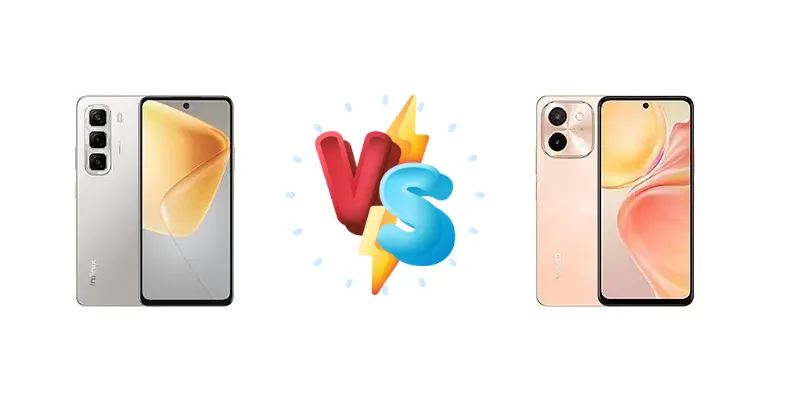
The Infinix Hot 50 4G and vivo Y28 4G represent compelling options in the crowded budget smartphone market. Both aim to deliver essential features at an accessible price point, but they take different approaches. The Hot 50 prioritizes processing power with a newer, more efficient chipset, while the Y28 focuses on rapid charging capabilities. This comparison will dissect their key differences to help you determine which device best suits your needs.
🏆 Quick Verdict
For users prioritizing sustained gaming performance and future-proofing, the Infinix Hot 50 4G emerges as the stronger choice. Its Mediatek Helio G100, built on a 6nm process, offers a noticeable advantage over the vivo Y28’s Helio G85. However, the vivo Y28’s 44W charging is a significant benefit for those who value quick top-ups.
| Network |
|---|
| 2G bands | GSM 850 / 900 / 1800 / 1900 | GSM 850 / 900 / 1800 / 1900 |
| 3G bands | HSDPA 850 / 900 / 1700(AWS) / 1900 / 2100 | HSDPA 850 / 900 / 2100 |
| 4G bands | 1, 2, 3, 4, 5, 7, 8, 20, 28, 38, 41, 40 | 1, 3, 5, 7, 8, 20, 28, 38, 40, 41 |
| Speed | HSPA, LTE | HSPA, LTE |
| Technology | GSM / HSPA / LTE | GSM / HSPA / LTE |
| Launch |
|---|
| Announced | 2024, September 30 | 2024, June 15 |
| Status | Available. Released 2024, October | Available. Released 2024, July |
| Body |
|---|
| Build | Glass front, plastic back, plastic frame | Glass front, plastic frame, plastic back |
| Dimensions | 167.9 x 75.6 x 7.7 mm (6.61 x 2.98 x 0.30 in) | 165.7 x 76 x 8 mm (6.52 x 2.99 x 0.31 in) |
| SIM | Nano-SIM + Nano-SIM | Nano-SIM + Nano-SIM |
| Weight | 187 g (6.60 oz) | 199 g (7.02 oz) |
| Display |
|---|
| Resolution | 1080 x 2460 pixels (~396 ppi density) | 720 x 1608 pixels, 20:9 ratio (~264 ppi density) |
| Size | 6.78 inches, 109.2 cm2 (~86.0% screen-to-body ratio) | 6.68 inches, 107.4 cm2 (~85.3% screen-to-body ratio) |
| Type | IPS LCD, 120Hz, 800 nits (typ) | IPS LCD, 90Hz, 760 nits (typ), 1000 nits (HBM) |
| Platform |
|---|
| CPU | Octa-core (2x2.2 GHz Cortex-A76 & 6x2.0 GHz Cortex-A55) | Octa-core (2x2.0 GHz Cortex-A75 & 6x1.8 GHz Cortex-A55) |
| Chipset | Mediatek Helio G100 (6 nm) | Mediatek Helio G85 (12 nm) |
| GPU | Mali-G57 MC2 | Mali-G52 MC2 |
| OS | Android 14, XOS 14.5 | Android 14, Funtouch 14 |
| Memory |
|---|
| Card slot | microSDXC (dedicated slot) | microSDXC (uses shared SIM slot) |
| Internal | 128GB 6GB RAM, 128GB 8GB RAM, 256GB 6GB RAM, 256GB 8GB RAM | 128GB 4GB RAM, 128GB 6GB RAM, 128GB 8GB RAM, 256GB 8GB RAM |
| Main Camera |
|---|
| Dual | - | 50 MP, f/1.8, (wide), PDAF
Auxiliary lens |
| Features | Dual-LED flash, panorama | LED flash |
| Triple | 50 MP, f/1.6, 27mm (wide), 1/2.76", AF
other unspecified cameras | - |
| Video | 1440p@30fps, 1080p@30/60fps | 1080p@30fps |
| Selfie camera |
|---|
| Features | LED flash | - |
| Single | 8 MP, f/2.0, (wide), 1/4.0" | 8 MP, f/2.1, (wide) |
| Video | Yes | 1080p@30fps |
| Sound |
|---|
| 35mm jack | Yes | Yes |
| Loudspeaker | Yes | Yes, with stereo speakers |
| Comms |
|---|
| Bluetooth | Yes | 5.0, A2DP, LE |
| NFC | Yes | No |
| Positioning | GPS | GPS, GALILEO, GLONASS, BDS, QZSS |
| Radio | FM radio | FM radio |
| USB | USB Type-C 2.0, OTG | USB Type-C 2.0, OTG |
| WLAN | Wi-Fi 802.11 a/b/g/n/ac, dual-band | Wi-Fi 802.11 a/b/g/n, dual-band |
| Features |
|---|
| Sensors | Fingerprint (side-mounted), accelerometer, proximity, compass | Fingerprint (side-mounted), accelerometer, proximity, compass |
| Battery |
|---|
| Charging | 18W wired
Reverse wired
Bypass charging | 44W wired |
| Type | 5000 mAh | 6000 mAh |
| Misc |
|---|
| Colors | Sleek Black, Sage Green, Titanium Grey | Agate Green, Gleaming Orange |
| Models | X6882, X6882B | V2352 |
| Price | - | About 130 EUR |
Infinix Hot 50 4G
- More powerful and efficient Mediatek Helio G100 chipset
- Potentially better thermal management due to 6nm process
- Reverse wired charging offers added versatility
- Slower 18W charging compared to the vivo Y28
- Missing detailed display specifications
vivo Y28 4G
- Significantly faster 44W wired charging
- Potentially longer battery life due to optimized power management
- Competitive price point
- Less powerful Mediatek Helio G85 chipset
- 12nm process may lead to more heat generation
Display Comparison
Neither device boasts a standout display. Both are likely to feature LCD panels, typical for this price bracket. However, detailed specs like resolution and refresh rate are missing. The focus here shifts to internal components. The absence of information on PWM dimming rates makes it difficult to assess potential eye strain, but given the price point, higher frequencies are unlikely.
Camera Comparison
Without detailed camera specifications beyond the chipsets, a direct comparison is limited. Both phones likely feature a multi-camera setup, but the quality will heavily depend on sensor size and image processing algorithms. It’s reasonable to assume both will include a primary sensor, a depth sensor, and potentially a macro lens. The absence of OIS (Optical Image Stabilization) on either device suggests image stabilization will rely on software, which may be less effective in low-light conditions. The focus should be on real-world image samples to assess the actual camera performance.
Performance
The core difference lies in the chipsets. The Infinix Hot 50’s Mediatek Helio G100 (6nm) is a clear upgrade over the vivo Y28’s Helio G85 (12nm). The 6nm process translates to improved power efficiency and reduced heat generation, allowing for potentially longer gaming sessions without throttling. The G100’s CPU configuration – 2x2.2 GHz Cortex-A76 & 6x2.0 GHz Cortex-A55 – also offers a performance edge over the Y28’s 2x2.0 GHz Cortex-A75 & 6x1.8 GHz Cortex-A55. While both are octa-core, the A76 cores in the G100 are more powerful than the A75 cores in the G85. This means faster app loading times and smoother multitasking on the Infinix.
Battery Life
The vivo Y28 4G’s 44W wired charging is its standout feature. This will significantly reduce charging times compared to the Infinix Hot 50’s 18W charging. While battery capacity isn’t specified, the faster charging speed of the Y28 is a major convenience factor. The more efficient 6nm process of the Helio G100 in the Hot 50 *may* partially offset the charging speed difference through improved battery life during typical usage, but the Y28 will still win in terms of quick top-ups.
Buying Guide
Buy the Infinix Hot 50 4G if you need a phone capable of handling demanding mobile games and multitasking without significant slowdowns, and if you appreciate a more modern chipset architecture for potential longevity. Buy the vivo Y28 4G if you prioritize minimizing downtime with incredibly fast charging, and if your usage primarily revolves around social media, calls, and light app usage.
Frequently Asked Questions
❓ Will the Infinix Hot 50 4G handle demanding games like PUBG Mobile at high settings?
The Mediatek Helio G100 is capable of running PUBG Mobile at medium to high settings, but sustained performance will depend on thermal management. The 6nm process should help mitigate throttling, but extended gaming sessions may still result in some frame drops. Expect a smoother experience compared to the Helio G85 in the vivo Y28.
❓ How long does it realistically take to fully charge the vivo Y28 4G from 0%?
With 44W charging, the vivo Y28 4G should be able to charge from 0% to 100% in approximately 60-75 minutes, depending on battery capacity (which is not specified). This is a significant advantage over the Infinix Hot 50’s 18W charging, which will likely take over 2 hours for a full charge.
❓ Does the Infinix Hot 50 4G support bypass charging, and what does that mean?
Yes, the Infinix Hot 50 4G supports bypass charging. This feature allows you to power the phone directly from the charger while still using it, minimizing battery degradation and heat buildup during prolonged use, such as gaming or video streaming.