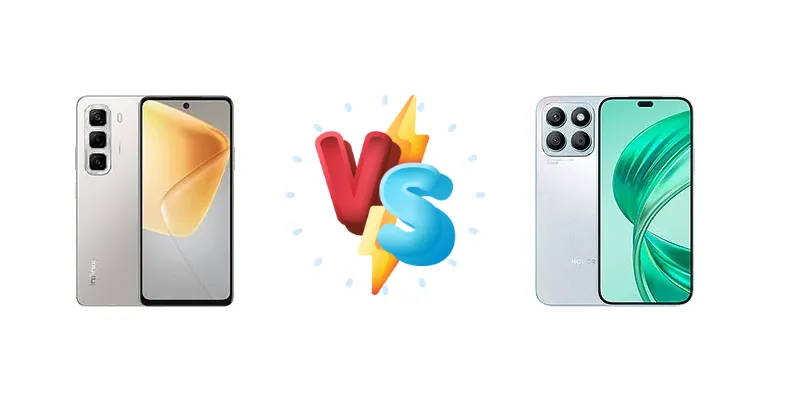
The sub-$200 smartphone market is fiercely competitive. The Infinix Hot 50 4G and Honor X8b represent compelling options, each prioritizing different aspects of the user experience. The Infinix focuses on a more powerful CPU core configuration, while the Honor emphasizes faster charging speeds. This comparison will dissect their key specifications to determine which device delivers the best overall value.
🏆 Quick Verdict
For the average user prioritizing quick top-ups and consistent performance, the Honor X8b emerges as the winner. Its 35W charging significantly reduces downtime, and the Snapdragon 680, while not a performance leader, offers a stable and efficient experience for everyday tasks. The Infinix Hot 50 4G is a strong contender for those who prioritize raw CPU power for occasional demanding tasks.
| Network |
|---|
| 2G bands | GSM 850 / 900 / 1800 / 1900 | GSM 850 / 900 / 1800 / 1900 |
| 3G bands | HSDPA 850 / 900 / 1700(AWS) / 1900 / 2100 | HSDPA 850 / 900 / 1900 / 2100 |
| 4G bands | 1, 2, 3, 4, 5, 7, 8, 20, 28, 38, 41, 40 | LTE |
| Speed | HSPA, LTE | HSPA, LTE |
| Technology | GSM / HSPA / LTE | GSM / HSPA / LTE |
| Launch |
|---|
| Announced | 2024, September 30 | 2023, December 14 |
| Status | Available. Released 2024, October | Available. Released 2023, December 22 |
| Body |
|---|
| Build | Glass front, plastic back, plastic frame | - |
| Dimensions | 167.9 x 75.6 x 7.7 mm (6.61 x 2.98 x 0.30 in) | 161.1 x 74.6 x 6.8 mm (6.34 x 2.94 x 0.27 in) |
| SIM | Nano-SIM + Nano-SIM | Nano-SIM + Nano-SIM |
| Weight | 187 g (6.60 oz) | 166 g (5.86 oz) |
| Display |
|---|
| Resolution | 1080 x 2460 pixels (~396 ppi density) | 1080 x 2412 pixels, 20:9 ratio (~394 ppi density) |
| Size | 6.78 inches, 109.2 cm2 (~86.0% screen-to-body ratio) | 6.7 inches, 108.0 cm2 (~89.9% screen-to-body ratio) |
| Type | IPS LCD, 120Hz, 800 nits (typ) | AMOLED, 90Hz, 1200 nits (HBM), 2000 nits (peak) |
| Platform |
|---|
| CPU | Octa-core (2x2.2 GHz Cortex-A76 & 6x2.0 GHz Cortex-A55) | Octa-core (4x2.4 GHz Kryo 265 Gold & 4x1.9 GHz Kryo 265 Silver) |
| Chipset | Mediatek Helio G100 (6 nm) | Qualcomm SM6225 Snapdragon 680 4G (6 nm) |
| GPU | Mali-G57 MC2 | Adreno 610 |
| OS | Android 14, XOS 14.5 | Android 13, MagicOS 7.2 |
| Memory |
|---|
| Card slot | microSDXC (dedicated slot) | No |
| Internal | 128GB 6GB RAM, 128GB 8GB RAM, 256GB 6GB RAM, 256GB 8GB RAM | 128GB 8GB RAM, 256GB 6GB RAM, 256GB 8GB RAM, 512GB 8GB RAM |
| Main Camera |
|---|
| Features | Dual-LED flash, panorama | LED flash, HDR, panorama |
| Triple | 50 MP, f/1.6, 27mm (wide), 1/2.76", AF
other unspecified cameras | 108 MP, f/1.8, 24mm (wide), 1/1.67", PDAF
5 MP, f/2.2, (ultrawide)
2 MP (macro) |
| Video | 1440p@30fps, 1080p@30/60fps | 1080p@30fps |
| Selfie camera |
|---|
| Features | LED flash | LED flash |
| Single | 8 MP, f/2.0, (wide), 1/4.0" | 50 MP, f/2.1, (wide) |
| Video | Yes | 1080p@30fps |
| Sound |
|---|
| 35mm jack | Yes | No |
| Loudspeaker | Yes | Yes |
| Comms |
|---|
| Bluetooth | Yes | 5.0, A2DP, LE |
| NFC | Yes | No |
| Positioning | GPS | GPS, GLONASS, GALILEO, BDS |
| Radio | FM radio | No |
| USB | USB Type-C 2.0, OTG | USB Type-C 2.0, OTG |
| WLAN | Wi-Fi 802.11 a/b/g/n/ac, dual-band | Wi-Fi 802.11 a/b/g/n/ac, dual-band, Wi-Fi Direct |
| Features |
|---|
| Sensors | Fingerprint (side-mounted), accelerometer, proximity, compass | Fingerprint (side-mounted), accelerometer, compass |
| Battery |
|---|
| Charging | 18W wired
Reverse wired
Bypass charging | 35W wired |
| Type | 5000 mAh | Li-Po 4500 mAh |
| Misc |
|---|
| Colors | Sleek Black, Sage Green, Titanium Grey | Glamorous Green, Titanium Silver, Midnight Black, Blue |
| Models | X6882, X6882B | LLY-LX1, LLY-LX2, LLY-LX3 |
| Price | - | $ 369.00 / € 219.99 |
Infinix Hot 50 4G
- Potentially stronger single-core performance due to Cortex-A76 cores.
- Reverse wired charging for topping up other devices.
- Competitive price point within the budget segment.
- Slower 18W charging.
- Potential for thermal throttling under sustained load.
- Uncertain display quality without further specifications.
Honor X8b
- Significantly faster 35W charging.
- Qualcomm Snapdragon 680 offers efficient and stable performance.
- Potentially better color accuracy based on Honor's brand reputation.
- Lower peak CPU clock speeds compared to the Infinix.
- May lack advanced display features like high refresh rate.
- Camera performance reliant on software optimization.
Display Comparison
Neither device boasts a standout display. Both utilize 6nm chipsets, suggesting similar power efficiency considerations impacting display choices. Without specific display specs (resolution, panel type, brightness), it's difficult to definitively declare a winner. However, Honor's brand history suggests a focus on color accuracy, potentially offering a slightly more pleasing visual experience. The absence of high refresh rates on both devices indicates a cost-saving measure, prioritizing battery life over fluid animations.
Camera Comparison
Without detailed camera specifications beyond the chipsets, a comprehensive comparison is limited. Both phones likely target the budget segment, meaning image processing will be heavily reliant on software algorithms. The absence of OIS on either device suggests a reliance on computational photography for stabilization. The quality of the main sensor will be the most significant factor, but without knowing the sensor size or aperture, it's impossible to determine which phone captures better images. We can assume both will include standard features like HDR and portrait modes.
Performance
The core difference lies in the chipsets. The Infinix Hot 50 4G’s MediaTek Helio G100 features a 2x2.2 GHz Cortex-A76 and 6x2.0 GHz Cortex-A55 configuration. This suggests a focus on burst performance, with the A76 cores handling demanding tasks. Conversely, the Honor X8b’s Qualcomm Snapdragon 680 utilizes 4x2.4 GHz Kryo 265 Gold and 4x1.9 GHz Kryo 265 Silver cores. While the Snapdragon 680 has a slightly lower peak clock speed on its performance cores, Qualcomm’s Kryo architecture is generally more efficient and offers better sustained performance. The 6nm process node is shared, minimizing thermal differences, but the Snapdragon’s architecture likely provides a smoother experience under prolonged load.
Battery Life
The Honor X8b’s 35W wired charging is a clear advantage over the Infinix Hot 50 4G’s 18W charging. This translates to significantly faster top-up times, reducing downtime. While the Infinix offers reverse wired charging, a niche feature, the Honor’s faster charging is more universally beneficial. Without knowing the battery capacity of either device, it’s difficult to assess overall battery life. However, the Snapdragon 680’s efficiency could offset a potentially smaller battery capacity in the Honor X8b.
Buying Guide
Buy the Infinix Hot 50 4G if you frequently engage in tasks that benefit from a strong single-core performance, such as emulators or specific app workloads, and don't mind slower charging. Buy the Honor X8b if you value convenience and rapid charging, and your primary use case revolves around social media, streaming, and general productivity. The X8b is ideal for users who want to minimize 'battery anxiety'.
Frequently Asked Questions
❓ Will the Snapdragon 680 in the Honor X8b struggle with graphically intensive games like PUBG Mobile?
The Snapdragon 680 is capable of running PUBG Mobile, but you'll likely need to stick to medium graphics settings and moderate frame rates for a smooth experience. It's not a gaming powerhouse, but it's sufficient for casual gaming sessions. The Infinix Hot 50's Helio G100 might offer slightly higher frame rates at the same settings, but thermal management could become a concern during extended gameplay.
❓ How long will it take to fully charge the Honor X8b from 0% with the 35W charger?
While the exact 0-100% charging time depends on battery capacity (which isn't specified), the 35W charger should fully charge the Honor X8b in approximately 60-75 minutes. This is a significant improvement over the Infinix Hot 50 4G's 18W charging, which would likely take over 2 hours.
❓ Does the Infinix Hot 50 4G's reverse wired charging work with all devices?
The Infinix Hot 50 4G's reverse wired charging is compatible with most devices that charge via USB-C. However, the charging speed will be limited to the Infinix's output capabilities, meaning it won't be as fast as using the device's original charger. It's best suited for topping up accessories like earbuds or smartwatches.