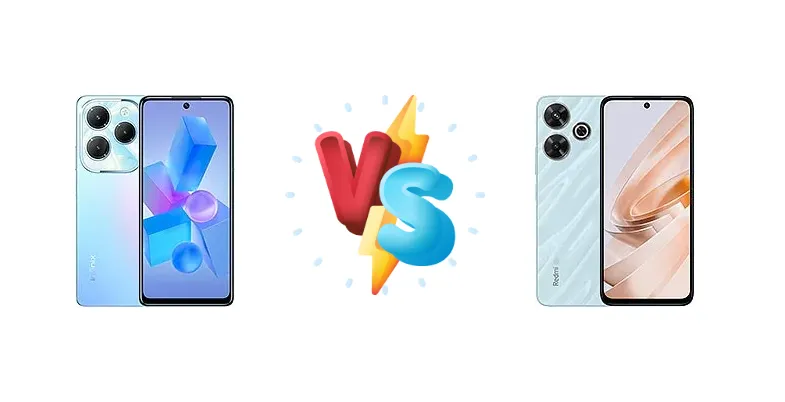
The sub-$200 smartphone market is fiercely competitive, and the Infinix Hot 40 and Xiaomi Redmi Note 13R are two contenders vying for dominance. While both aim to deliver essential features at an accessible price, they take different approaches to achieving this. The Hot 40 leans on MediaTek’s Helio G88, while the Redmi Note 13R adopts Qualcomm’s newer, more efficient Snapdragon 4+ Gen 2. This comparison will dissect their key differences to determine which phone offers the best value.
🏆 Quick Verdict
For the average user prioritizing long-term performance and efficiency, the Xiaomi Redmi Note 13R is the better choice. Its Snapdragon 4+ Gen 2 chipset, built on a 4nm process, provides a noticeable advantage in both sustained performance and power consumption compared to the Infinix Hot 40’s Helio G88.
| Network |
|---|
| 2G bands | GSM 850 / 900 / 1800 / 1900 | GSM 850 / 900 / 1800 / 1900 |
| 3G bands | HSDPA 850 / 900 / 1700(AWS) / 1900 / 2100 | HSDPA 850 / 900 / 2100 |
| 4G bands | 1, 2, 3, 4, 5, 7, 8, 20, 28, 38, 40, 41 | 1, 3, 5, 8, 34, 38, 39, 40, 41 |
| 5G bands | - | 1, 5, 8, 28, 41, 78 SA/NSA |
| Speed | HSPA, LTE | HSPA, LTE, 5G |
| Technology | GSM / HSPA / LTE | GSM / CDMA / HSPA / EVDO / LTE / 5G |
| Launch |
|---|
| Announced | 2023, December 05 | 2024, May 17 |
| Status | Available. Released 2023, December | Available. Released 2024, May 17 |
| Body |
|---|
| Build | Glass front, plastic back, plastic frame | Glass front, plastic frame, glass back |
| Dimensions | 168.6 x 76.6 x 8.3 mm (6.64 x 3.02 x 0.33 in) | 168.6 x 76.3 x 8.2 mm (6.64 x 3.00 x 0.32 in) |
| SIM | Nano-SIM + Nano-SIM | Nano-SIM + Nano-SIM |
| Weight | 196 g (6.91 oz) | 205 g (7.23 oz) |
| Display |
|---|
| Resolution | 1080 x 2460 pixels (~396 ppi density) | 1080 x 2460 pixels (~396 ppi density) |
| Size | 6.78 inches, 109.2 cm2 (~84.5% screen-to-body ratio) | 6.79 inches, 109.5 cm2 (~85.1% screen-to-body ratio) |
| Type | IPS LCD, 90Hz, 500 nits (peak) | IPS LCD, 120Hz, 550 nits |
| Platform |
|---|
| CPU | Octa-core (2x2.0 GHz Cortex-A75 & 6x1.8 GHz Cortex-A55) | Octa-core (2x2.3 GHz Cortex-A78 & 6x1.95 GHz Cortex-A55) |
| Chipset | Mediatek MT6769H Helio G88 (12 nm) | Qualcomm SM4450 Snapdragon 4+ Gen 2 (4 nm) |
| GPU | Mali-G52 MC2 | Adreno 613 |
| OS | Android 13, XOS 13.5 | Android 14, HyperOS |
| Memory |
|---|
| Card slot | microSDXC (dedicated slot) | No |
| Internal | 128GB 8GB RAM, 256GB 8GB RAM | 128GB 6GB RAM, 128GB 8GB RAM, 256GB 8GB RAM, 256GB 12GB RAM, 512GB 12GB RAM |
| Main Camera |
|---|
| Dual | 50 MP, f/1.6, (wide), AF
2 MP (macro)
Auxiliary lens | 50 MP, f/1.8, (wide), 1/2.76", 0.64µm, PDAF
2 MP (macro) |
| Features | Quad-LED flash, HDR, panorama | LED flash, HDR |
| Video | 1440p@30fps, 1080p@30fps | 1080p@30fps |
| Selfie camera |
|---|
| Features | Dual-LED flash | - |
| Single | 32 MP, f/2.2, (wide) | 8 MP, (wide), 1/4.0", 1.12µm |
| Video | 1080p@30fps | 1080p@30fps |
| Sound |
|---|
| 35mm jack | Yes | Yes |
| Loudspeaker | Yes, with stereo speakers | Yes |
| Comms |
|---|
| Bluetooth | Yes | 5.3, A2DP, LE |
| Infrared port | - | Yes |
| NFC | Yes | Yes |
| Positioning | GPS | GPS, GLONASS, GALILEO, BDS |
| Radio | FM radio | No |
| USB | USB Type-C 2.0, OTG | USB Type-C |
| WLAN | Wi-Fi 802.11 a/b/g/n/ac, dual-band | Wi-Fi 802.11 a/b/g/n/ac, dual-band |
| Features |
|---|
| Sensors | Fingerprint (side-mounted), accelerometer, proximity, compass | Fingerprint (side-mounted), accelerometer, compass |
| Battery |
|---|
| Charging | 33W wired, 20-75% in 35 min
Reverse wired | 33W wired |
| Type | 5000 mAh | 5030 mAh |
| Misc |
|---|
| Colors | Palm Blue, Horizon Gold, Starlit Black, Starfall Green | Black, Blue, Silver |
| Models | X6836 | 2406ERN9CC |
| Price | - | About 180 EUR |
Infinix Hot 40
- Potentially faster charging (claimed 20-75% in 35 mins)
- Competitive price point
- Reverse wired charging capability
- Less efficient Helio G88 chipset
- Likely to throttle under sustained load
- Older CPU architecture
Xiaomi Redmi Note 13R
- More efficient Snapdragon 4+ Gen 2 chipset (4nm)
- Superior CPU architecture (Cortex-A78)
- Better sustained performance
- Charging speed is comparable, not faster
- May be slightly more expensive
- No reverse wired charging
Display Comparison
Neither device boasts a standout display. Both are likely to feature LCD panels, common in this price bracket. However, without specific display specs (resolution, brightness, color gamut), the comparison hinges on manufacturing quality. The absence of high refresh rates on either device suggests a focus on power conservation. Bezels are likely to be similar, contributing minimally to differentiation.
Camera Comparison
Without detailed camera specifications, it’s difficult to make a definitive judgment. However, the market segment suggests both phones will rely on primary sensors in the 13-50MP range. The Redmi Note 13R’s more powerful chipset could enable more sophisticated image processing algorithms, potentially leading to better dynamic range and low-light performance. The presence of Optical Image Stabilization (OIS) on either device is unlikely at this price point. The 2MP macro cameras often found on both will offer limited utility.
Performance
The core difference lies in the chipsets. The Xiaomi Redmi Note 13R’s Snapdragon 4+ Gen 2 (4nm) is a significant upgrade over the Infinix Hot 40’s MediaTek Helio G88 (12nm). The 4nm process inherently offers better thermal efficiency, meaning the Redmi Note 13R will likely experience less throttling during extended gaming or demanding tasks. While both CPUs feature an octa-core configuration, the Redmi Note 13R utilizes Cortex-A78 cores (2x2.3 GHz) which are architecturally superior to the Hot 40’s Cortex-A75 cores (2x2.0 GHz), translating to faster single-core performance. This benefits app launch times and overall responsiveness. The Redmi Note 13R will be noticeably smoother for multitasking and more demanding applications.
Battery Life
Both phones feature 33W wired charging, with the Infinix Hot 40 claiming a 20-75% charge in 35 minutes. While the Redmi Note 13R lacks a specific time claim, the Snapdragon 4+ Gen 2’s superior efficiency suggests it may achieve similar charging times with a potentially smaller battery capacity. The actual battery life will depend on usage patterns, but the Redmi Note 13R’s more efficient chipset will likely result in longer screen-on time for comparable tasks.
Buying Guide
Buy the Infinix Hot 40 if you prioritize fast charging speeds and are primarily focused on basic smartphone tasks like social media and light web browsing. Buy the Xiaomi Redmi Note 13R if you value a more modern and efficient chipset for smoother multitasking, improved gaming performance, and potentially longer battery life, even if charging is comparable.
Frequently Asked Questions
❓ Will the Redmi Note 13R handle demanding games like PUBG Mobile smoothly?
The Snapdragon 4+ Gen 2 in the Redmi Note 13R is capable of running PUBG Mobile, but expect to play at medium settings for a consistently smooth experience. The Helio G88 in the Infinix Hot 40 will likely struggle with higher settings and may exhibit more noticeable frame drops.
❓ Does the Infinix Hot 40's reverse wired charging feature work with all devices?
The Infinix Hot 40's reverse wired charging is compatible with most devices that charge via USB-C, but the charging speed will be limited to the phone's output capabilities (likely around 5W-10W). It's best suited for topping up accessories like wireless earbuds or smartwatches.
❓ Is the difference in chipset performance noticeable for everyday tasks?
Yes, the Snapdragon 4+ Gen 2 in the Redmi Note 13R will provide a snappier and more responsive experience for everyday tasks like browsing, social media, and app switching. The difference won't be dramatic, but it will be noticeable compared to the Helio G88.