
Poco M6 Pro 4G vs. Infinix Hot 40: Which Budget Phone Reigns Supreme?
| Phones Images | |||||
|---|---|---|---|---|---|
|
🏆 Quick Verdict
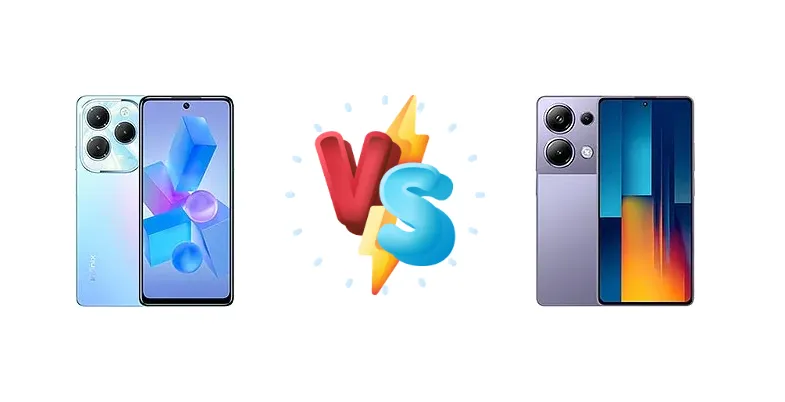
For most users, the Xiaomi Poco M6 Pro 4G emerges as the better choice. Its significantly more powerful Helio G99 Ultra chipset delivers a noticeable performance boost in gaming and demanding applications, and the brighter display enhances outdoor visibility. While the Infinix Hot 40 offers faster charging, the Poco’s overall performance advantage is more impactful.
| PHONES | ||
|---|---|---|
| Phone Names | Infinix Hot 40 | Xiaomi Poco M6 Pro 4G |
| Network | ||
|---|---|---|
| 2G bands | GSM 850 / 900 / 1800 / 1900 | GSM 850 / 900 / 1800 / 1900 |
| 3G bands | HSDPA 850 / 900 / 1700(AWS) / 1900 / 2100 | HSDPA 800 / 850 / 900 / 1700(AWS) / 1900 / 2100 |
| 4G bands | 1, 2, 3, 4, 5, 7, 8, 20, 28, 38, 40, 41 | 1, 2, 3, 4, 5, 7, 8, 12, 13, 17, 18, 19, 20, 26, 28, 38, 40, 41, 66 |
| Speed | HSPA, LTE | HSPA, LTE |
| Technology | GSM / HSPA / LTE | GSM / HSPA / LTE |
| Launch | ||
|---|---|---|
| Announced | 2023, December 05 | 2024, January 11 |
| Status | Available. Released 2023, December | Available. Released 2024, January 12 |
| Body | ||
|---|---|---|
| Build | Glass front, plastic back, plastic frame | Glass front (Gorilla Glass 5), plastic frame |
| Dimensions | 168.6 x 76.6 x 8.3 mm (6.64 x 3.02 x 0.33 in) | 161.1 x 75 x 8 mm (6.34 x 2.95 x 0.31 in) |
| SIM | Nano-SIM + Nano-SIM | Nano-SIM + Nano-SIM |
| Weight | 196 g (6.91 oz) | 179 g (6.31 oz) |
| Display | ||
|---|---|---|
| Protection | - | Corning Gorilla Glass 5 |
| Resolution | 1080 x 2460 pixels (~396 ppi density) | 1080 x 2400 pixels, 20:9 ratio (~395 ppi density) |
| Size | 6.78 inches, 109.2 cm2 (~84.5% screen-to-body ratio) | 6.67 inches, 107.4 cm2 (~88.9% screen-to-body ratio) |
| Type | IPS LCD, 90Hz, 500 nits (peak) | AMOLED, 120Hz, 1000 nits (HBM), 1300 nits (peak) |
| Platform | ||
|---|---|---|
| CPU | Octa-core (2x2.0 GHz Cortex-A75 & 6x1.8 GHz Cortex-A55) | Octa-core (2x2.2 GHz Cortex-A76 & 6x2.0 GHz Cortex-A55) |
| Chipset | Mediatek MT6769H Helio G88 (12 nm) | Mediatek Helio G99 Ultra |
| GPU | Mali-G52 MC2 | Mali-G57 MC2 |
| OS | Android 13, XOS 13.5 | Android 13, MIUI 14, planned upgrade to Android 14, HyperOS |
| Memory | ||
|---|---|---|
| Card slot | microSDXC (dedicated slot) | microSDXC (uses shared SIM slot) |
| Internal | 128GB 8GB RAM, 256GB 8GB RAM | 256GB 8GB RAM, 512GB 12GB RAM |
| Main Camera | ||
|---|---|---|
| Dual | 50 MP, f/1.6, (wide), AF 2 MP (macro) Auxiliary lens | - |
| Features | Quad-LED flash, HDR, panorama | LED flash, HDR, panorama |
| Triple | - | 64 MP, f/1.8, 25mm (wide), 1/2.0", 0.7µm, PDAF, OIS 8 MP, f/2.2, (ultrawide) 2 MP (macro) |
| Video | 1440p@30fps, 1080p@30fps | 1080p@30/60fps, gyro-EIS |
| Selfie camera | ||
|---|---|---|
| Features | Dual-LED flash | - |
| Single | 32 MP, f/2.2, (wide) | 16 MP, f/2.5, (wide) |
| Video | 1080p@30fps | 1080p@30/60fps |
| Sound | ||
|---|---|---|
| 35mm jack | Yes | Yes |
| Loudspeaker | Yes, with stereo speakers | Yes, with dual speakers |
| Comms | ||
|---|---|---|
| Bluetooth | Yes | 5.2, A2DP, LE |
| Infrared port | - | Yes |
| NFC | Yes | Yes (market/region dependent) |
| Positioning | GPS | GPS, GALILEO, GLONASS, BDS |
| Radio | FM radio | FM radio |
| USB | USB Type-C 2.0, OTG | USB Type-C 2.0, OTG |
| WLAN | Wi-Fi 802.11 a/b/g/n/ac, dual-band | Wi-Fi 802.11 a/b/g/n/ac, dual-band |
| Features | ||
|---|---|---|
| Sensors | Fingerprint (side-mounted), accelerometer, proximity, compass | Fingerprint (under display, optical), accelerometer, gyro, compass |
| Battery | ||
|---|---|---|
| Charging | 33W wired, 20-75% in 35 min Reverse wired | 67W wired, 100% in 44 min |
| Type | 5000 mAh | 5000 mAh |
| Misc | ||
|---|---|---|
| Colors | Palm Blue, Horizon Gold, Starlit Black, Starfall Green | Black, Blue, Purple |
| Models | X6836 | 2312FPCA6G |
| Price | - | $ 170.00 |
| SAR | - | 1.09 W/kg (head) 1.09 W/kg (body) |
| SAR EU | - | 0.99 W/kg (head) 0.99 W/kg (body) |
Infinix Hot 40
- Faster 33W charging (20-75% in 35 min)
- Potentially more efficient power management for similar tasks
- Streamlined user experience (based on Infinix's software approach)
- Less powerful Helio G88 chipset
- Likely lower peak display brightness
- Limited performance headroom for demanding games
Xiaomi Poco M6 Pro 4G
- More powerful Helio G99 Ultra chipset
- Significantly brighter 1053 nit display
- Longer battery life (11:46h active use)
- Slower 67W charging (100% in 44 min)
- Potentially more aggressive power consumption
- Xiaomi's MIUI software can be resource intensive
Display Comparison
The Poco M6 Pro 4G boasts a significantly brighter display, reaching a measured peak of 1053 nits. This is a crucial advantage for outdoor use, where the Infinix Hot 40’s display (brightness unspecified) will likely struggle. While both likely utilize IPS LCD panels, the Poco’s higher brightness translates to a more vibrant and readable experience in direct sunlight. Bezels appear comparable based on available imagery, and color accuracy is not specified for either device, suggesting a standard level for this price point.
Camera Comparison
Detailed camera analysis is limited by the provided data. Both phones likely feature a primary camera and supporting lenses, but the specifics are missing. Without sensor size or aperture information, it’s difficult to assess image quality. The inclusion of a 'Photo/Video' designation for the Poco suggests a focus on versatile camera capabilities, but the absence of details prevents a meaningful comparison. We can assume both will offer adequate performance for casual photography, but neither is likely to excel in low-light conditions.
Performance
The core difference lies in the chipsets. The Poco M6 Pro 4G’s Mediatek Helio G99 Ultra, with its 2x2.2 GHz Cortex-A76 cores, represents a clear upgrade over the Infinix Hot 40’s Helio G88. The G99 Ultra’s Cortex-A76 cores are architecturally superior to the G88’s Cortex-A75, offering better single-core performance. This translates to snappier app launches and smoother multitasking. While both phones feature octa-core CPUs, the G99 Ultra’s higher clock speeds and more efficient architecture provide a tangible performance advantage, particularly in gaming. The Poco M6 Pro 4G is likely to maintain higher frame rates and smoother gameplay in demanding titles.
Battery Life
The Poco M6 Pro 4G demonstrates a clear advantage in battery endurance, achieving an active use score of 11 hours and 46 minutes. While the Infinix Hot 40’s battery capacity is not specified, the Poco’s longer runtime suggests a more efficient combination of hardware and software optimization. However, the Infinix Hot 40 counters with 33W wired charging, capable of reaching 20-75% in 35 minutes, while the Poco M6 Pro 4G takes 44 minutes for a full charge. This faster charging speed is beneficial for users who need a quick power boost.
Buying Guide
Buy the Infinix Hot 40 if you prioritize rapid charging and a consistently smooth experience for everyday tasks like social media and web browsing. Its 33W charging gets you from 20-75% in just 35 minutes, ideal for users who frequently top up their battery. Buy the Xiaomi Poco M6 Pro 4G if you’re a mobile gamer or frequently use resource-intensive apps. The Helio G99 Ultra provides a substantial performance uplift, and the brighter display is a boon for multimedia consumption.