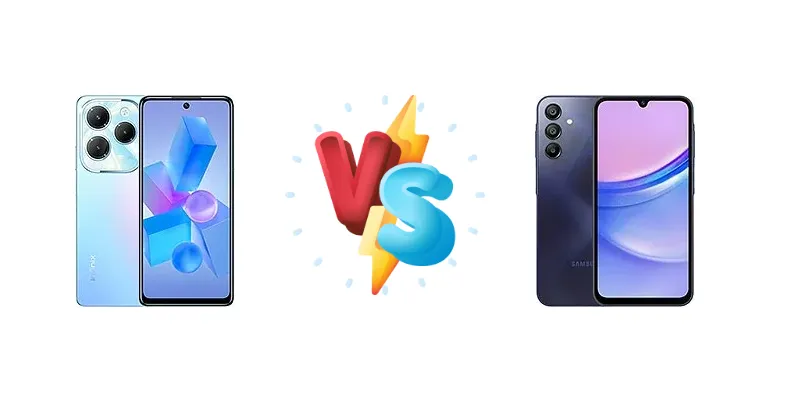
The sub-$200 smartphone market is fiercely competitive. The Infinix Hot 40 and Samsung Galaxy A15 both aim to deliver essential features at an accessible price point, but they take different approaches. The Hot 40 prioritizes rapid charging, while the A15 focuses on maximizing battery life and offering a brighter display. This comparison dissects their key differences to determine which device best suits your needs.
🏆 Quick Verdict
For the average user prioritizing longevity and a more polished software experience, the Samsung Galaxy A15 is the better choice. Its significantly longer battery life (15:28h active use) and brighter 808 nit display outweigh the Infinix Hot 40’s faster 33W charging, especially given the similar processing power.
| Network |
|---|
| 2G bands | GSM 850 / 900 / 1800 / 1900 | GSM 850 / 900 / 1800 / 1900 |
| 3G bands | HSDPA 850 / 900 / 1700(AWS) / 1900 / 2100 | HSDPA 850 / 900 / 2100 |
| 4G bands | 1, 2, 3, 4, 5, 7, 8, 20, 28, 38, 40, 41 | 1, 3, 5, 7, 8, 20, 28, 38, 40, 41 |
| Speed | HSPA, LTE | HSPA, LTE |
| Technology | GSM / HSPA / LTE | GSM / HSPA / LTE |
| Launch |
|---|
| Announced | 2023, December 05 | 2023, December 11 |
| Status | Available. Released 2023, December | Available. Released 2023, December 16 |
| Body |
|---|
| Build | Glass front, plastic back, plastic frame | Glass front, plastic back, plastic frame |
| Dimensions | 168.6 x 76.6 x 8.3 mm (6.64 x 3.02 x 0.33 in) | 160.1 x 76.8 x 8.4 mm (6.30 x 3.02 x 0.33 in) |
| SIM | Nano-SIM + Nano-SIM | · Nano-SIM· Nano-SIM + Nano-SIM |
| Weight | 196 g (6.91 oz) | 200 g (7.05 oz) |
| Display |
|---|
| Resolution | 1080 x 2460 pixels (~396 ppi density) | 1080 x 2340 pixels, 19.5:9 ratio (~396 ppi density) |
| Size | 6.78 inches, 109.2 cm2 (~84.5% screen-to-body ratio) | 6.5 inches, 103.7 cm2 (~84.3% screen-to-body ratio) |
| Type | IPS LCD, 90Hz, 500 nits (peak) | Super AMOLED, 90Hz, 800 nits (HBM) |
| Platform |
|---|
| CPU | Octa-core (2x2.0 GHz Cortex-A75 & 6x1.8 GHz Cortex-A55) | Octa-core (2x2.2 GHz Cortex-A76 & 6x2.0 GHz Cortex-A55) |
| Chipset | Mediatek MT6769H Helio G88 (12 nm) | Mediatek Helio G99 (6 nm) |
| GPU | Mali-G52 MC2 | Mali-G57 MC2 |
| OS | Android 13, XOS 13.5 | Android 14, up to 4 major Android upgrades, One UI 7 |
| Memory |
|---|
| Card slot | microSDXC (dedicated slot) | microSDXC (uses shared SIM slot) |
| Internal | 128GB 8GB RAM, 256GB 8GB RAM | 128GB 4GB RAM, 128GB 6GB RAM, 128GB 8GB RAM, 256GB 6GB RAM, 256GB 8GB RAM |
| Main Camera |
|---|
| Dual | 50 MP, f/1.6, (wide), AF
2 MP (macro)
Auxiliary lens | - |
| Features | Quad-LED flash, HDR, panorama | LED flash, panorama, HDR |
| Triple | - | 50 MP, f/1.8, 26mm (wide), 1/2.8", 0.64µm, PDAF
5 MP, f/2.2, 17mm (ultrawide), 1/5.0", 1.12µm
2 MP (macro) |
| Video | 1440p@30fps, 1080p@30fps | 1080p@30fps |
| Selfie camera |
|---|
| Features | Dual-LED flash | - |
| Single | 32 MP, f/2.2, (wide) | 13 MP, f/2.0, 26mm (wide), 1/3.06", 1.12µm |
| Video | 1080p@30fps | 1080p@30fps |
| Sound |
|---|
| 35mm jack | Yes | Yes |
| Loudspeaker | Yes, with stereo speakers | Yes |
| Comms |
|---|
| Bluetooth | Yes | 5.3, A2DP, LE |
| NFC | Yes | Yes (market/region dependent) |
| Positioning | GPS | GPS, GALILEO, GLONASS, BDS, QZSS |
| Radio | FM radio | FM radio (market/region dependent) |
| USB | USB Type-C 2.0, OTG | USB Type-C 2.0 |
| WLAN | Wi-Fi 802.11 a/b/g/n/ac, dual-band | Wi-Fi 802.11 a/b/g/n/ac, dual-band, Wi-Fi Direct |
| Features |
|---|
| Sensors | Fingerprint (side-mounted), accelerometer, proximity, compass | Fingerprint (side-mounted), accelerometer, compass |
| Battery |
|---|
| Charging | 33W wired, 20-75% in 35 min
Reverse wired | 25W wired |
| Type | 5000 mAh | 5000 mAh |
| Misc |
|---|
| Colors | Palm Blue, Horizon Gold, Starlit Black, Starfall Green | Brave Black, Optimistic Blue, Magical Blue, Personality Yellow |
| Models | X6836 | SM-A155F, SM-A155F/DSN, SM-A155M, SM-A155M/DS, SM-A155P, SM-A155R |
| Price | - | € 168.99 / $ 125.00 / £ 113.00 |
| SAR EU | - | 0.42 W/kg (head) 1.29 W/kg (body) |
Infinix Hot 40
- Faster 33W wired charging
- Potentially lower price point
- Reverse wired charging capability
- Less efficient 12nm chipset
- Likely shorter battery life
- Less refined software experience
Samsung Galaxy A15
- Significantly longer battery life (15:28h)
- Brighter 808 nit display
- More efficient 6nm chipset
- Slower 25W charging
- Potentially higher price
- Samsung’s software bloat (though improving)
Display Comparison
The Samsung Galaxy A15 boasts a significantly brighter display, reaching a measured 808 nits, making it far more usable in direct sunlight compared to the Infinix Hot 40 (brightness unspecified). While both likely utilize LCD panels given their price points, the A15’s higher peak brightness is a tangible benefit. Bezels are comparable, but the A15’s panel is likely to offer slightly better viewing angles and color reproduction, benefiting media consumption. The absence of refresh rate information for both suggests standard 60Hz panels.
Camera Comparison
Without detailed camera specs beyond the main sensors, a direct comparison is difficult. However, given the price bracket, image quality will largely depend on software processing. The A15 likely benefits from Samsung’s established image processing algorithms. The presence of a 2MP macro camera on both devices is largely a marketing tactic, offering limited practical benefit due to the small sensor size and fixed focus. Focusing on the primary sensor’s quality and the overall image processing pipeline is crucial, and Samsung typically delivers a more refined experience.
Performance
Both phones are powered by Mediatek Helio G-series chipsets, but the Galaxy A15’s Helio G99, fabricated on a 6nm process, holds a clear advantage over the Hot 40’s Helio G88 (12nm). The 6nm node translates to improved power efficiency and thermal performance, meaning the G99 can sustain higher clock speeds for longer periods. The A15’s CPU configuration – 2x2.2 GHz Cortex-A76 & 6x2.0 GHz Cortex-A55 – also edges out the Hot 40’s 2x2.0 GHz Cortex-A75 & 6x1.8 GHz Cortex-A55. While both are capable of handling everyday tasks, the A15 will exhibit smoother multitasking and better performance in demanding applications and games.
Battery Life
The Samsung Galaxy A15 shines in battery life, achieving an impressive 15 hours and 28 minutes of active use. While the Infinix Hot 40’s battery capacity is unknown, its 33W charging offers a faster recharge rate (20-75% in 35 minutes) compared to the A15’s 25W charging. However, the A15’s superior battery endurance means users will likely need to charge less frequently, mitigating the advantage of faster charging. The G99’s 6nm efficiency plays a key role in the A15’s extended battery performance.
Buying Guide
Buy the Infinix Hot 40 if you absolutely need the fastest possible charging speeds and frequently find yourself needing to top up your phone throughout the day. Its 33W charging is a clear advantage. Buy the Samsung Galaxy A15 if you value all-day battery life, a brighter and more visible screen outdoors, and the established Samsung ecosystem with its promise of longer software support.
Frequently Asked Questions
❓ Does the Mediatek Helio G99 in the Galaxy A15 get hot during extended gaming sessions?
The Helio G99’s 6nm process is more efficient than the G88’s 12nm, resulting in lower heat generation. While it will warm up during prolonged gaming, it’s less likely to experience significant throttling compared to the Hot 40’s chipset. Samsung’s thermal management is also generally well-optimized.
❓ Is the 33W charging on the Infinix Hot 40 significantly faster in real-world use than the 25W on the A15?
While 33W is numerically faster, the difference isn’t massive. The Hot 40 can charge from 20-75% in 35 minutes. However, the A15’s superior battery life means you’ll likely need to charge less often, diminishing the importance of slightly faster charging speeds.
❓ How does Samsung’s software update policy compare to Infinix’s?
Samsung generally provides longer software support for its A-series devices, typically offering several years of security updates and at least two major Android version upgrades. Infinix’s update commitment is less predictable and often shorter, making the A15 a better choice for users who prioritize long-term software support.