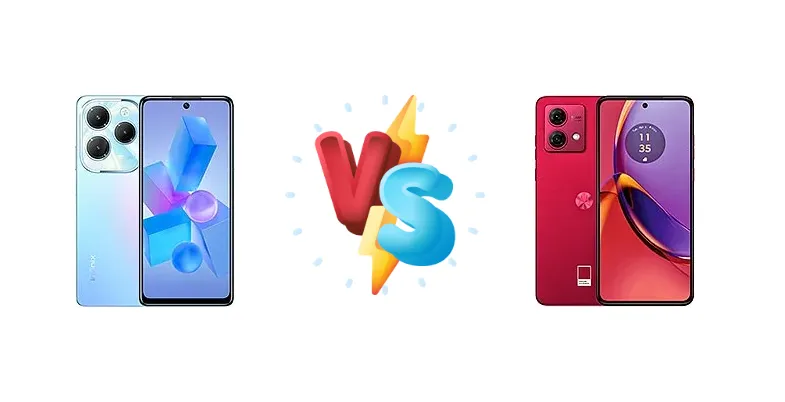
The sub-$200 smartphone market is fiercely competitive, and the Infinix Hot 40 and Motorola Moto G84 represent compelling options for users seeking 5G connectivity without breaking the bank. While both aim for affordability, they take different approaches to achieving it – the Infinix prioritizing fast charging and a media-focused experience, while the Motorola emphasizes battery endurance and a more refined software experience. This comparison dissects their key differences to help you choose the right device.
🏆 Quick Verdict
For the average user prioritizing all-day battery life and a smoother software experience, the Motorola Moto G84 emerges as the better choice. Its Snapdragon 695 chipset, coupled with a measured 12:31h active use battery score, provides a more consistent and reliable performance profile than the Infinix Hot 40’s Helio G88.
| Network |
|---|
| 2G bands | GSM 850 / 900 / 1800 / 1900 | GSM 850 / 900 / 1800 / 1900 |
| 3G bands | HSDPA 850 / 900 / 1700(AWS) / 1900 / 2100 | HSDPA 850 / 900 / 1700(AWS) / 1900 / 2100 - LATAM |
| 4G bands | 1, 2, 3, 4, 5, 7, 8, 20, 28, 38, 40, 41 | 1, 2, 3, 4, 5, 7, 8, 12, 13, 17, 25, 26, 28, 38, 40, 41, 42, 66 - LATAM |
| 5G bands | - | 1, 2, 3, 5, 7, 26, 28, 40, 66, 78 SA/NSA/Sub6 - LATAM |
| Speed | HSPA, LTE | HSPA, LTE, 5G |
| Technology | GSM / HSPA / LTE | GSM / HSPA / LTE / 5G |
| Launch |
|---|
| Announced | 2023, December 05 | 2023, August 24 |
| Status | Available. Released 2023, December | Available. Released 2023, September 08 |
| Body |
|---|
| Build | Glass front, plastic back, plastic frame | Glass front, plastic frame, plastic back or eco leather back |
| Dimensions | 168.6 x 76.6 x 8.3 mm (6.64 x 3.02 x 0.33 in) | 160 x 74.4 x 7.6 mm (6.30 x 2.93 x 0.30 in) |
| SIM | Nano-SIM + Nano-SIM | Nano-SIM + Nano-SIM |
| Weight | 196 g (6.91 oz) | 166.8 g (5.86 oz) |
| Display |
|---|
| Resolution | 1080 x 2460 pixels (~396 ppi density) | 1080 x 2400 pixels, 20:9 ratio (~405 ppi density) |
| Size | 6.78 inches, 109.2 cm2 (~84.5% screen-to-body ratio) | 6.5 inches, 102.0 cm2 (~85.7% screen-to-body ratio) |
| Type | IPS LCD, 90Hz, 500 nits (peak) | P-OLED, 1B colors, 120Hz, 1300 nits (peak) |
| Platform |
|---|
| CPU | Octa-core (2x2.0 GHz Cortex-A75 & 6x1.8 GHz Cortex-A55) | Octa-core (2x2.2 GHz Kryo 660 Gold & 6x1.7 GHz Kryo 660 Silver) |
| Chipset | Mediatek MT6769H Helio G88 (12 nm) | Qualcomm SM6375 Snapdragon 695 5G (6 nm) |
| GPU | Mali-G52 MC2 | Adreno 619 |
| OS | Android 13, XOS 13.5 | Android 13, upgradable to Android 15 |
| Memory |
|---|
| Card slot | microSDXC (dedicated slot) | microSDXC (uses shared SIM slot) |
| Internal | 128GB 8GB RAM, 256GB 8GB RAM | 256GB 8GB RAM, 256GB 12GB RAM |
| Main Camera |
|---|
| Dual | 50 MP, f/1.6, (wide), AF
2 MP (macro)
Auxiliary lens | 50 MP, f/1.9 (wide), 1/1.5", 1.0µm, PDAF, OIS
8 MP, f/2.2, 120˚ (ultrawide), 1/4.0", 1.12µm, AF |
| Features | Quad-LED flash, HDR, panorama | LED flash, HDR, panorama |
| Video | 1440p@30fps, 1080p@30fps | 1080p@30/60fps |
| Selfie camera |
|---|
| Features | Dual-LED flash | - |
| Single | 32 MP, f/2.2, (wide) | 16 MP, f/2.5, (wide), 1.0µm |
| Video | 1080p@30fps | 1080p@30fps |
| Sound |
|---|
| 35mm jack | Yes | Yes |
| Loudspeaker | Yes, with stereo speakers | Yes, with stereo speakers |
| Comms |
|---|
| Bluetooth | Yes | 5.1, A2DP, LE |
| NFC | Yes | Yes (market/region dependent) |
| Positioning | GPS | GPS, GLONASS, GALILEO |
| Radio | FM radio | FM radio (market/region dependent) |
| USB | USB Type-C 2.0, OTG | USB Type-C 2.0 |
| WLAN | Wi-Fi 802.11 a/b/g/n/ac, dual-band | Wi-Fi 802.11 a/b/g/n/ac, dual-band, Wi-Fi Direct |
| Features |
|---|
| Sensors | Fingerprint (side-mounted), accelerometer, proximity, compass | Fingerprint (under display, optical), accelerometer, gyro, proximity, compass |
| Battery |
|---|
| Charging | 33W wired, 20-75% in 35 min
Reverse wired | 30W wired |
| Type | 5000 mAh | Li-Po 5000 mAh |
| Misc |
|---|
| Colors | Palm Blue, Horizon Gold, Starlit Black, Starfall Green | Marshmallow Blue, Midnight Blue, Viva Magenta |
| Models | X6836 | XT2347, XT2347-1, XT2347-2 |
| Price | - | $ 399.00 / £ 189.99 / € 169.00 |
Infinix Hot 40
- Faster 33W charging
- Potentially lower price point
- Reverse wired charging capability
- Less efficient Helio G88 chipset
- Likely lower peak display brightness
- Potentially less refined software experience
Motorola Moto G84
- More efficient Snapdragon 695 chipset
- Significantly better battery life (12:31h active use)
- Brighter 996 nit display
- Slower 30W charging
- Potentially higher price point
- No reverse charging
Display Comparison
The Motorola Moto G84 boasts a significantly brighter display, reaching a measured peak brightness of 996 nits. This is a substantial advantage over what we’d expect from the Infinix Hot 40, making the Moto G84 far more usable outdoors under direct sunlight. While the Infinix Hot 40’s display specs are not provided, the Moto G84’s brightness level suggests a superior viewing experience. The Moto G84’s panel likely benefits from a more efficient backlight system, contributing to its overall power efficiency.
Camera Comparison
Detailed camera specs beyond 'Photo/Video' are absent for both devices. However, given the price point, it’s reasonable to assume both rely on primary sensors in the 50MP range. The Motorola Moto G84 likely benefits from Qualcomm’s image signal processor (ISP), known for its efficient noise reduction and dynamic range optimization. Without further information, it’s difficult to definitively declare a winner, but Motorola’s generally stronger software processing could give it an edge in image quality. The absence of details regarding OIS or aperture sizes makes a precise comparison impossible.
Performance
The core difference lies in the chipsets: the Infinix Hot 40 utilizes the Mediatek MT6769H Helio G88 (12nm), while the Motorola Moto G84 features the Qualcomm SM6375 Snapdragon 695 5G (6nm). The Snapdragon 695, built on a smaller 6nm process, inherently offers better power efficiency and thermal management compared to the 12nm Helio G88. The Snapdragon 695’s Kryo 660 Gold cores, clocked at 2.2 GHz, also provide a slight CPU performance edge over the Helio G88’s 2.0 GHz Cortex-A75 cores. This translates to snappier app launches and smoother multitasking on the Moto G84. While both are octa-core CPUs, the architectural differences and process node give the Snapdragon 695 a clear advantage.
Battery Life
The Motorola Moto G84 shines in battery performance, achieving an impressive 12:31h active use score and an endurance rating of 117 hours. While the Infinix Hot 40’s battery capacity is unknown, its 33W charging is faster than the Moto G84’s 30W. However, the Moto G84’s superior efficiency, stemming from the 6nm Snapdragon 695, allows it to extract significantly more usage from its battery. The Infinix Hot 40 can charge from 20-75% in 35 minutes, a useful feature, but the Moto G84’s longer runtime is more valuable for most users.
Buying Guide
Buy the Infinix Hot 40 if you need the fastest possible charging speeds and frequently consume media, valuing a quick top-up over sustained performance. Buy the Motorola Moto G84 if you prioritize long-lasting battery life, a more polished software experience, and a generally smoother user interface, even if it means slightly slower charging.
Frequently Asked Questions
❓ Does the Snapdragon 695 in the Moto G84 struggle with demanding games like PUBG or Call of Duty?
While the Snapdragon 695 isn't a flagship gaming chip, it's capable of running PUBG and Call of Duty at medium settings with reasonable frame rates. Expect some frame drops during intense action, but it's perfectly playable for casual gaming. The 6nm process helps mitigate thermal throttling, providing more sustained performance than the Helio G88.
❓ How significant is the difference in charging speed between the Infinix Hot 40's 33W and the Moto G84's 30W?
The difference is noticeable, with the Infinix Hot 40 charging from 20-75% in 35 minutes. However, the Moto G84’s superior battery efficiency means you’ll likely need to charge less frequently, diminishing the importance of the slightly faster charging speed. The convenience of a quick top-up is valuable, but the Moto G84’s longer runtime is more impactful for most users.
❓ Is the software experience significantly different between these two phones?
Yes. Motorola generally offers a cleaner, near-stock Android experience with minimal bloatware. Infinix’s UI, while improved in recent iterations, tends to be more heavily customized and includes pre-installed apps. Users who prefer a streamlined and uncluttered interface will likely favor the Moto G84.