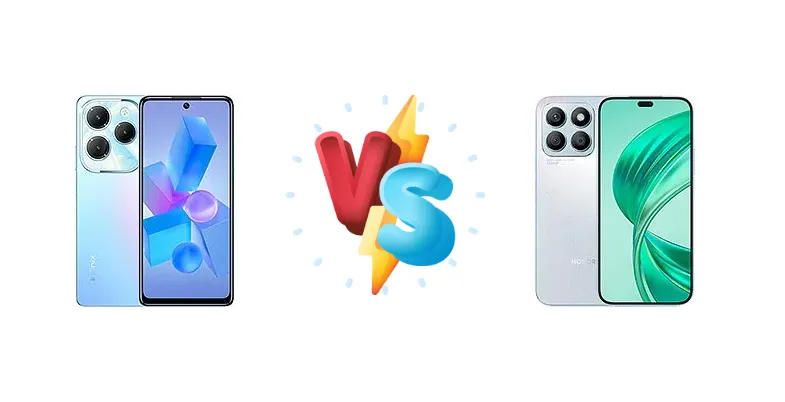
The sub-$200 smartphone market is fiercely competitive. The Infinix Hot 40 and Honor X8b represent compelling options, but cater to slightly different priorities. The Infinix prioritizes rapid charging and a gaming-focused chipset, while the Honor X8b leans towards efficiency with a newer, 6nm Snapdragon processor. This comparison will dissect their strengths and weaknesses to determine which device offers the best overall value.
🏆 Quick Verdict
For the average user prioritizing all-day battery life and consistent performance, the Honor X8b emerges as the winner. Its Snapdragon 680, built on a 6nm process, offers superior efficiency and a smoother experience, despite the Infinix Hot 40’s faster charging capabilities. However, gamers on a tight budget might find the Hot 40’s Helio G88 more appealing.
| Network |
|---|
| 2G bands | GSM 850 / 900 / 1800 / 1900 | GSM 850 / 900 / 1800 / 1900 |
| 3G bands | HSDPA 850 / 900 / 1700(AWS) / 1900 / 2100 | HSDPA 850 / 900 / 1900 / 2100 |
| 4G bands | 1, 2, 3, 4, 5, 7, 8, 20, 28, 38, 40, 41 | LTE |
| Speed | HSPA, LTE | HSPA, LTE |
| Technology | GSM / HSPA / LTE | GSM / HSPA / LTE |
| Launch |
|---|
| Announced | 2023, December 05 | 2023, December 14 |
| Status | Available. Released 2023, December | Available. Released 2023, December 22 |
| Body |
|---|
| Build | Glass front, plastic back, plastic frame | - |
| Dimensions | 168.6 x 76.6 x 8.3 mm (6.64 x 3.02 x 0.33 in) | 161.1 x 74.6 x 6.8 mm (6.34 x 2.94 x 0.27 in) |
| SIM | Nano-SIM + Nano-SIM | Nano-SIM + Nano-SIM |
| Weight | 196 g (6.91 oz) | 166 g (5.86 oz) |
| Display |
|---|
| Resolution | 1080 x 2460 pixels (~396 ppi density) | 1080 x 2412 pixels, 20:9 ratio (~394 ppi density) |
| Size | 6.78 inches, 109.2 cm2 (~84.5% screen-to-body ratio) | 6.7 inches, 108.0 cm2 (~89.9% screen-to-body ratio) |
| Type | IPS LCD, 90Hz, 500 nits (peak) | AMOLED, 90Hz, 1200 nits (HBM), 2000 nits (peak) |
| Platform |
|---|
| CPU | Octa-core (2x2.0 GHz Cortex-A75 & 6x1.8 GHz Cortex-A55) | Octa-core (4x2.4 GHz Kryo 265 Gold & 4x1.9 GHz Kryo 265 Silver) |
| Chipset | Mediatek MT6769H Helio G88 (12 nm) | Qualcomm SM6225 Snapdragon 680 4G (6 nm) |
| GPU | Mali-G52 MC2 | Adreno 610 |
| OS | Android 13, XOS 13.5 | Android 13, MagicOS 7.2 |
| Memory |
|---|
| Card slot | microSDXC (dedicated slot) | No |
| Internal | 128GB 8GB RAM, 256GB 8GB RAM | 128GB 8GB RAM, 256GB 6GB RAM, 256GB 8GB RAM, 512GB 8GB RAM |
| Main Camera |
|---|
| Dual | 50 MP, f/1.6, (wide), AF
2 MP (macro)
Auxiliary lens | - |
| Features | Quad-LED flash, HDR, panorama | LED flash, HDR, panorama |
| Triple | - | 108 MP, f/1.8, 24mm (wide), 1/1.67", PDAF
5 MP, f/2.2, (ultrawide)
2 MP (macro) |
| Video | 1440p@30fps, 1080p@30fps | 1080p@30fps |
| Selfie camera |
|---|
| Features | Dual-LED flash | LED flash |
| Single | 32 MP, f/2.2, (wide) | 50 MP, f/2.1, (wide) |
| Video | 1080p@30fps | 1080p@30fps |
| Sound |
|---|
| 35mm jack | Yes | No |
| Loudspeaker | Yes, with stereo speakers | Yes |
| Comms |
|---|
| Bluetooth | Yes | 5.0, A2DP, LE |
| NFC | Yes | No |
| Positioning | GPS | GPS, GLONASS, GALILEO, BDS |
| Radio | FM radio | No |
| USB | USB Type-C 2.0, OTG | USB Type-C 2.0, OTG |
| WLAN | Wi-Fi 802.11 a/b/g/n/ac, dual-band | Wi-Fi 802.11 a/b/g/n/ac, dual-band, Wi-Fi Direct |
| Features |
|---|
| Sensors | Fingerprint (side-mounted), accelerometer, proximity, compass | Fingerprint (side-mounted), accelerometer, compass |
| Battery |
|---|
| Charging | 33W wired, 20-75% in 35 min
Reverse wired | 35W wired |
| Type | 5000 mAh | Li-Po 4500 mAh |
| Misc |
|---|
| Colors | Palm Blue, Horizon Gold, Starlit Black, Starfall Green | Glamorous Green, Titanium Silver, Midnight Black, Blue |
| Models | X6836 | LLY-LX1, LLY-LX2, LLY-LX3 |
| Price | - | $ 369.00 / € 219.99 |
Infinix Hot 40
- Faster charging (33W)
- Potentially better gaming performance due to higher clocked cores
- More aggressive pricing likely
- Less efficient chipset (12nm)
- Potential for more thermal throttling
- Likely lower battery life
Honor X8b
- More efficient chipset (6nm)
- Better sustained performance
- Potentially better camera image processing
- Slightly slower charging (35W)
- Potentially higher price
- Lower peak CPU clock speeds
Display Comparison
Neither device boasts a standout display. Both likely utilize LCD panels, a common trait in this price bracket. While specific details like peak brightness and color gamut coverage are unavailable, the focus here is on processing power. Display quality will likely be similar, with the user experience being more impacted by the chipset’s ability to render UI elements smoothly.
Camera Comparison
Without detailed camera specs beyond the main sensors, a direct comparison is difficult. Both phones likely feature multi-camera setups with a primary sensor and supporting lenses (potentially macro and depth). The image processing capabilities of the respective chipsets will play a crucial role. Qualcomm’s Snapdragon processors generally offer more sophisticated image signal processing (ISP) capabilities, potentially leading to better dynamic range and noise reduction in the Honor X8b’s photos. The absence of OIS on either device suggests reliance on software stabilization.
Performance
The core difference lies in the chipsets. The Infinix Hot 40’s MediaTek Helio G88 (12nm) features an octa-core configuration with two Cortex-A75 cores clocked at 2.0 GHz, paired with six Cortex-A55 cores at 1.8 GHz. The Honor X8b utilizes the Qualcomm Snapdragon 680 (6nm), with four Kryo 265 Gold cores at 2.4 GHz and four Kryo 265 Silver cores at 1.9 GHz. The Snapdragon 680’s 6nm fabrication process is a significant advantage, offering improved power efficiency and thermal management compared to the Helio G88’s 12nm node. This translates to less throttling during sustained workloads and better battery life. While the Helio G88’s Cortex-A75 cores offer a slight clock speed advantage, the Snapdragon 680’s architecture and process node provide a more consistent and efficient performance profile.
Battery Life
The Infinix Hot 40’s 33W wired charging is its standout feature, promising a 20-75% charge in just 35 minutes. The Honor X8b offers 35W wired charging, a slight improvement on paper. However, the Snapdragon 680’s superior efficiency means the Honor X8b will likely deliver longer real-world battery life despite potentially similar 0-100% charging times. The 6nm process allows for more efficient power usage during everyday tasks, offsetting the slightly slower charging speed.
Buying Guide
Buy the Infinix Hot 40 if you need a phone primarily for casual gaming and value extremely fast charging speeds. Its 33W charging will get you back up and running quickly. Buy the Honor X8b if you prefer a more balanced experience with better power efficiency, a smoother user interface, and a processor designed for sustained performance over extended periods. It’s the better choice for everyday tasks and media consumption.
Frequently Asked Questions
❓ Will the Helio G88 in the Infinix Hot 40 struggle with demanding games like PUBG Mobile?
The Helio G88 can run PUBG Mobile, but you’ll likely need to lower graphics settings to maintain a stable frame rate. The 12nm process and limited thermal headroom mean sustained performance might be an issue, leading to frame drops during extended gaming sessions. The Honor X8b’s Snapdragon 680 offers a more consistent gaming experience, albeit at potentially lower peak settings.
❓ How much of a difference will the 6nm process of the Snapdragon 680 make in daily use?
The 6nm process translates to significantly improved power efficiency. You’ll notice this in the form of longer battery life, less heat generation during tasks like video streaming and web browsing, and a generally smoother user experience. The Honor X8b will feel more responsive and less prone to slowdowns over time compared to the Infinix Hot 40.
❓ Is the 33W charging on the Infinix Hot 40 significantly faster than the 35W on the Honor X8b?
While 35W is nominally faster, the difference in charging speed will likely be minimal in real-world scenarios. The Infinix Hot 40’s charging circuitry and battery optimization may allow it to reach 20-75% slightly quicker, but the Honor X8b’s efficiency will mean less time plugged in overall due to longer battery life.