
Infinix Hot 40 Pro vs Xiaomi Redmi Note 13 Pro 4G: A Deep Dive into Battery, Display, and Performance
| Phones Images | |||||
|---|---|---|---|---|---|
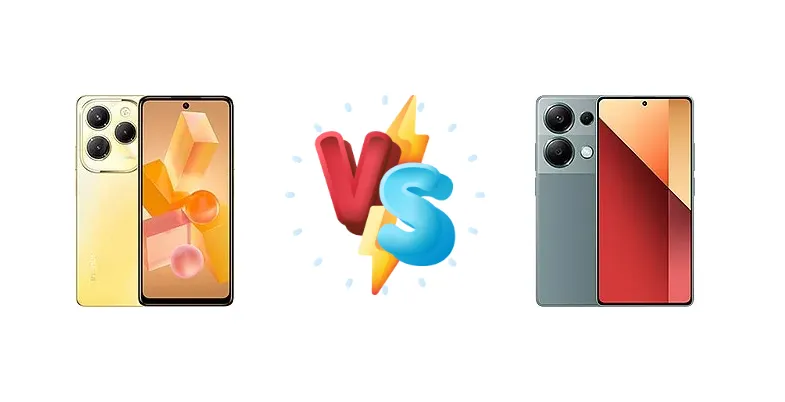
|
🏆 Quick Verdict
For the average user prioritizing longevity, the Infinix Hot 40 Pro is the better choice, offering 12:56 hours of active use. However, if minimizing downtime is critical, the Redmi Note 13 Pro 4G’s 67W charging, capable of reaching 50% in just 16 minutes, provides a significant advantage.
| PHONES | ||
|---|---|---|
| Phone Names | Infinix Hot 40 Pro | Xiaomi Redmi Note 13 Pro 4G |
| Network | ||
|---|---|---|
| 2G bands | GSM 850 / 900 / 1800 / 1900 | GSM 850 / 900 / 1800 / 1900 |
| 3G bands | HSDPA 850 / 900 / 1700(AWS) / 1900 / 2100 | HSDPA 850 / 900 / 1700(AWS) / 1900 / 2100 |
| 4G bands | 1, 2, 3, 4, 5, 7, 8, 20, 28, 38, 40, 41 | 1, 2, 3, 4, 5, 7, 8, 12, 13, 17, 18, 19, 20, 26, 28, 38, 40, 41, 66 |
| Speed | HSPA, LTE | HSPA, LTE |
| Technology | GSM / HSPA / LTE | GSM / HSPA / LTE |
| Launch | ||
|---|---|---|
| Announced | 2023, December 05 | 2024, January 15 |
| Status | Available. Released 2023, December | Available. Released 2024, January 15 |
| Body | ||
|---|---|---|
| Build | Glass front, plastic back, plastic frame | Glass front (Gorilla Glass 5), plastic frame, plastic back |
| Dimensions | 168.6 x 76.6 x 8.3 mm (6.64 x 3.02 x 0.33 in) | 161.1 x 75 x 8 mm (6.34 x 2.95 x 0.31 in) |
| SIM | Nano-SIM + Nano-SIM | Nano-SIM + Nano-SIM |
| Weight | 199 g (7.02 oz) | 188 g (6.63 oz) |
| Display | ||
|---|---|---|
| Protection | - | Corning Gorilla Glass 5 |
| Resolution | 1080 x 2460 pixels (~396 ppi density) | 1080 x 2400 pixels, 20:9 ratio (~395 ppi density) |
| Size | 6.78 inches, 109.2 cm2 (~84.5% screen-to-body ratio) | 6.67 inches, 107.4 cm2 (~88.9% screen-to-body ratio) |
| Type | IPS LCD, 120Hz, 500 nits (peak) | AMOLED, 1B colors, 120Hz, 500 nits (typ), 1000 nits (HBM), 1300 nits (peak) |
| Platform | ||
|---|---|---|
| CPU | Octa-core (2x2.2 GHz Cortex-A76 & 6x2.0 GHz Cortex-A55) | Octa-core (2x2.2 GHz Cortex-A76 & 6x2.0 GHz Cortex-A55) |
| Chipset | Mediatek Helio G99 (6 nm) | Mediatek Helio G99 Ultra |
| GPU | Mali-G57 MC2 | Mali-G57 MC2 |
| OS | Android 13, XOS 13.5 | Android 13, up to 3 major Android upgrades, HyperOS |
| Memory | ||
|---|---|---|
| Card slot | microSDXC (dedicated slot) | microSDXC (uses shared SIM slot) |
| Internal | 128GB 8GB RAM, 256GB 8GB RAM, 256GB 12GB RAM | 128GB 8GB RAM, 256GB 8GB RAM, 256GB 12GB RAM, 512GB 8GB RAM, 512GB 12GB RAM |
| Main Camera | ||
|---|---|---|
| Dual | 108 MP, f/1.8, (wide), 1/1.67", 0.64µm, AF 2 MP (macro) Auxiliary lens | - |
| Features | Quad-LED flash, HDR, panorama | LED flash, HDR, panorama |
| Triple | - | 200 MP, f/1.7, 23mm (wide), 1/1.4", 0.56µm, multi-directional PDAF, OIS 8 MP, f/2.2, 15mm, 120˚ (ultrawide), 1/4.4", 1.0µm 2 MP (macro) |
| Video | 1440p@30fps, 1080p@30fps | 1080p@30/60fps |
| Selfie camera | ||
|---|---|---|
| Features | Dual-LED flash | - |
| Single | 32 MP, f/2.2, (wide), 1/3.15", 0.7µm | 16 MP, f/2.4, (wide), 1/3.0", 1.0µm |
| Video | 1080p@30fps | 1080p@30/60fps |
| Sound | ||
|---|---|---|
| 35mm jack | Yes | Yes |
| Loudspeaker | Yes, with stereo speakers | Yes, with dual speakers |
| Comms | ||
|---|---|---|
| Bluetooth | Yes | 5.2, A2DP, LE |
| Infrared port | - | Yes |
| NFC | Yes | Yes (market/region dependent) |
| Positioning | GPS | GPS, GLONASS, GALILEO, BDS |
| Radio | FM radio | FM radio |
| USB | USB Type-C 2.0, OTG | USB Type-C 2.0, OTG |
| WLAN | Wi-Fi 802.11 a/b/g/n/ac, dual-band | Wi-Fi 802.11 a/b/g/n/ac, dual-band |
| Features | ||
|---|---|---|
| Sensors | Fingerprint (side-mounted), accelerometer, gyro, proximity, compass | Fingerprint (under display, optical), accelerometer, gyro, compass |
| Battery | ||
|---|---|---|
| Charging | 33W wired, 20-75% in 35 min Reverse wired | 67W wired, 50% in 16 min, 100% in 46 min |
| Type | 5000 mAh | 5000 mAh |
| Misc | ||
|---|---|---|
| Colors | Palm Blue, Horizon Gold, Starlit Black, Starfall Green, Free Fire | Midnight Black, Lavender Purple, Forest Green |
| Models | X6837 | 23117RA68G, 2312FPCA6G |
| Price | £ 179.95 / € 226.31 | € 92.00 / $ 269.99 / £ 299.99 |
| SAR | - | 1.09 W/kg (head) 1.09 W/kg (body) |
| SAR EU | - | 0.99 W/kg (head) 0.99 W/kg (body) |
Infinix Hot 40 Pro
- Exceptional battery life (12:56h active use)
- Respectable contrast ratio (1822:1)
- Reverse wired charging capability
- Lower peak display brightness (534 nits)
- Slower charging speed (33W)
Xiaomi Redmi Note 13 Pro 4G
- Significantly brighter display (1047 nits)
- Ultra-fast 67W charging (50% in 16 min)
- Potentially optimized Helio G99 'Ultra' variant
- Shorter battery life (11:36h active use)
- Limited camera specification details
Display Comparison
The Xiaomi Redmi Note 13 Pro 4G boasts a significantly brighter display, reaching a measured 1047 nits compared to the Infinix Hot 40 Pro’s 534 nits. This translates to superior visibility outdoors under direct sunlight. While both utilize similar panel technology, the Redmi’s higher peak brightness is a clear advantage. The Infinix, however, offers a respectable 1822:1 contrast ratio, suggesting good black levels, though the difference in real-world impact is likely subtle given the brightness disparity. Bezels and color accuracy are not specified, so a direct comparison is impossible, but both phones likely target similar color profiles for the mid-range segment.
Camera Comparison
Both phones feature capable camera systems, but detailed specifications are limited to 'Photo / Video' capabilities. Without sensor size, aperture, or OIS details, a direct comparison is challenging. However, the Redmi Note 13 Pro 4G’s brand reputation suggests a more refined image processing pipeline. The inclusion of a 2MP macro camera on both devices is largely a marketing tactic, offering limited practical benefit due to the small sensor size and low resolution. Focusing on the main sensor’s capabilities will be more impactful for most users.
Performance
Both devices are powered by the Mediatek Helio G99 chipset, featuring an octa-core CPU configuration with the same core arrangement (2x2.2 GHz Cortex-A76 & 6x2.0 GHz Cortex-A55). However, the Redmi Note 13 Pro 4G utilizes the 'Ultra' variant of the G99. While Mediatek doesn’t explicitly detail the differences, the 'Ultra' designation often implies slightly higher clock speeds or optimizations. In practice, the performance difference is likely minimal for everyday tasks. Thermal management will be crucial; the G99 is known to throttle under sustained load, and the Redmi’s potentially slightly more efficient 'Ultra' variant might offer a marginal advantage. RAM speed and storage type are not specified, limiting a deeper analysis.
Battery Life
The Infinix Hot 40 Pro shines in battery endurance, achieving an impressive 12:56 hours of active use. This is a notable advantage over the Redmi Note 13 Pro 4G’s 11:36 hours. However, the Redmi counters with significantly faster charging: 67W wired, capable of reaching 50% charge in just 16 minutes and 100% in 46 minutes. The Infinix’s 33W charging takes 35 minutes to reach 20-75%, implying a longer overall charging time. The Infinix’s larger battery capacity (not specified, but implied by the longer runtime) combined with the efficient Helio G99 chipset delivers superior longevity, while the Redmi prioritizes quick top-ups.
Buying Guide
Buy the Infinix Hot 40 Pro if you need all-day battery life and prioritize minimizing time spent tethered to a charger. It’s ideal for users who frequently travel or heavily utilize their phones throughout the day. Buy the Xiaomi Redmi Note 13 Pro 4G if you prefer the convenience of incredibly fast charging and don’t mind potentially topping up your battery more frequently. This phone is best for users who want a quick power boost when they have limited time.