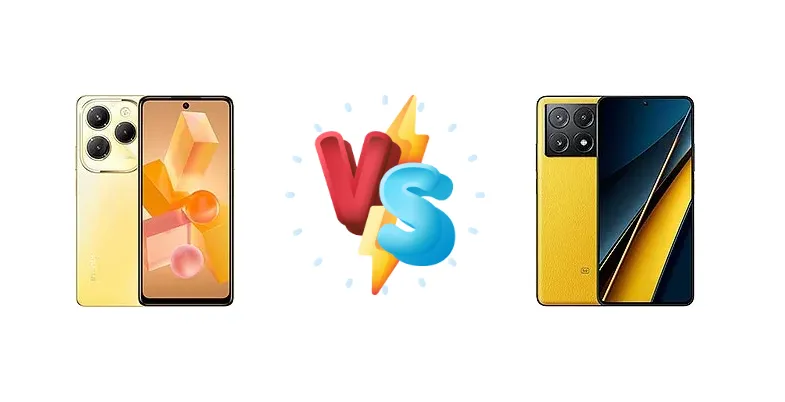
The sub-$300 smartphone market is fiercely competitive, and the Infinix Hot 40 Pro and Xiaomi Poco X6 Pro represent compelling options. The Hot 40 Pro prioritizes all-day battery life and efficient performance, while the Poco X6 Pro aims for a more premium experience with a significantly more powerful chipset. This comparison dissects their strengths and weaknesses to determine which device best suits your needs.
🏆 Quick Verdict
For the average user prioritizing raw performance and future-proofing, the Xiaomi Poco X6 Pro is the clear winner. Its Dimensity 8300 Ultra chipset offers a substantial leap in processing power. However, the Infinix Hot 40 Pro provides excellent battery life and faster charging at a lower price point, making it ideal for budget-conscious users.
| Network |
|---|
| 2G bands | GSM 850 / 900 / 1800 / 1900 | GSM 850 / 900 / 1800 / 1900 |
| 3G bands | HSDPA 850 / 900 / 1700(AWS) / 1900 / 2100 | HSDPA 850 / 900 / 1700(AWS) / 1900 / 2100 |
| 4G bands | 1, 2, 3, 4, 5, 7, 8, 20, 28, 38, 40, 41 | 1, 2, 3, 4, 5, 7, 8, 18, 19, 20, 28, 38, 40, 41, 48, 66 |
| 5G bands | - | 1, 2, 3, 5, 7, 8, 20, 28, 38, 40, 41, 48, 77, 78 SA/NSA/Sub6 |
| Speed | HSPA, LTE | HSPA, LTE, 5G |
| Technology | GSM / HSPA / LTE | GSM / HSPA / LTE / 5G |
| Launch |
|---|
| Announced | 2023, December 05 | 2024, January 11 |
| Status | Available. Released 2023, December | Available. Released 2024, January 12 |
| Body |
|---|
| Build | Glass front, plastic back, plastic frame | Glass front (Gorilla Glass 5), plastic frame, plastic back or silicone polymer back (eco leather) |
| Dimensions | 168.6 x 76.6 x 8.3 mm (6.64 x 3.02 x 0.33 in) | 160.5 x 74.3 x 8.3 mm (6.32 x 2.93 x 0.33 in) |
| SIM | Nano-SIM + Nano-SIM | Nano-SIM + Nano-SIM |
| Weight | 199 g (7.02 oz) | 186 g or 190 g (6.56 oz) |
| Display |
|---|
| Protection | - | Corning Gorilla Glass 5 |
| Resolution | 1080 x 2460 pixels (~396 ppi density) | 1220 x 2712 pixels, 20:9 ratio (~446 ppi density) |
| Size | 6.78 inches, 109.2 cm2 (~84.5% screen-to-body ratio) | 6.67 inches, 107.4 cm2 (~90.1% screen-to-body ratio) |
| Type | IPS LCD, 120Hz, 500 nits (peak) | AMOLED, 68B colors, 120Hz, 1920Hz PWM, HDR10+, Dolby Vision, 500 nits (typ), 1200 nits (HBM), 1800 nits (peak) |
| Platform |
|---|
| CPU | Octa-core (2x2.2 GHz Cortex-A76 & 6x2.0 GHz Cortex-A55) | Octa-core (1x3.35 GHz Cortex-A715 & 3x3.20 GHz Cortex-A715 & 4x2.20 GHz Cortex-A510) |
| Chipset | Mediatek Helio G99 (6 nm) | Mediatek Dimensity 8300 Ultra (4 nm) |
| GPU | Mali-G57 MC2 | Mali G615-MC6 |
| OS | Android 13, XOS 13.5 | Android 14, up to 3 major Android upgrades, HyperOS |
| Memory |
|---|
| Card slot | microSDXC (dedicated slot) | No |
| Internal | 128GB 8GB RAM, 256GB 8GB RAM, 256GB 12GB RAM | 256GB 8GB RAM, 256GB 12GB RAM, 512GB 12GB RAM |
| Main Camera |
|---|
| Dual | 108 MP, f/1.8, (wide), 1/1.67", 0.64µm, AF
2 MP (macro)
Auxiliary lens | - |
| Features | Quad-LED flash, HDR, panorama | LED flash, HDR, panorama |
| Triple | - | 64 MP, f/1.7, 25mm (wide), 1/2.0", 0.7µm, PDAF, OIS
8 MP, f/2.2, 120˚ (ultrawide), 1/4.0", 1.12µm
2 MP (macro) |
| Video | 1440p@30fps, 1080p@30fps | 4K@24/30fps, 1080p@30/60fps, gyro-EIS |
| Selfie camera |
|---|
| Features | Dual-LED flash | HDR, panorama |
| Single | 32 MP, f/2.2, (wide), 1/3.15", 0.7µm | 16 MP, f/2.4, (wide), 1/3.06", 1.0µm |
| Video | 1080p@30fps | 1080p@30/60fps |
| Sound |
|---|
| 35mm jack | Yes | No |
| Loudspeaker | Yes, with stereo speakers | Yes, with dual speakers |
| Comms |
|---|
| Bluetooth | Yes | 5.4, A2DP, LE, aptX HD |
| Infrared port | - | Yes |
| NFC | Yes | Yes (market/region dependent) |
| Positioning | GPS | GPS, GALILEO, GLONASS, QZSS, BDS (B1I+B1c) |
| Radio | FM radio | No |
| USB | USB Type-C 2.0, OTG | USB Type-C 2.0, OTG |
| WLAN | Wi-Fi 802.11 a/b/g/n/ac, dual-band | Wi-Fi 802.11 a/b/g/n/ac/6, dual-band, Wi-Fi Direct |
| Features |
|---|
| Sensors | Fingerprint (side-mounted), accelerometer, gyro, proximity, compass | Fingerprint (under display, optical), accelerometer, gyro, compass |
| Battery |
|---|
| Charging | 33W wired, 20-75% in 35 min
Reverse wired | 67W wired, QC2.0, PD3.0, 100% in 45 min |
| Type | 5000 mAh | 5000 mAh |
| Misc |
|---|
| Colors | Palm Blue, Horizon Gold, Starlit Black, Starfall Green, Free Fire | Black, Yellow, Gray |
| Models | X6837 | 2311DRK48G, 2311DRK48I |
| Price | £ 179.95 / € 226.31 | € 195.30 / $ 209.79 / £ 274.99 / ₹ 21,999 |
| SAR EU | - | 0.99 W/kg (head) 1.00 W/kg (body) |
Infinix Hot 40 Pro
- Exceptional battery life (12:56h active use)
- Faster charging than many competitors in its price range
- More affordable price point
- Less powerful chipset compared to the Poco X6 Pro
- Lower peak display brightness
Xiaomi Poco X6 Pro
- Significantly faster performance with Dimensity 8300 Ultra
- Brighter display for better outdoor visibility
- Faster 67W wired charging
- Shorter battery life compared to the Infinix Hot 40 Pro
- Higher price tag
Display Comparison
The Poco X6 Pro boasts a significantly brighter display, reaching 1148 nits compared to the Infinix Hot 40 Pro’s 534 nits. This translates to superior visibility outdoors under direct sunlight. While both devices feature standard LCD panels, the higher brightness of the Poco X6 Pro is a major advantage. The Infinix Hot 40 Pro offers a respectable 1822:1 contrast ratio, but the difference in peak brightness is the defining factor. Neither device specifies refresh rates, but the X6 Pro is widely known to have a 120Hz display, offering a smoother scrolling experience.
Camera Comparison
Both phones offer photo and video capabilities, but detailed camera specs are limited. Without specific sensor information, it’s difficult to make a definitive judgment. However, the Poco X6 Pro’s more powerful ISP (Image Signal Processor) within the Dimensity 8300 Ultra chipset likely provides superior image processing capabilities. The Hot 40 Pro will likely perform adequately in well-lit conditions, but the X6 Pro should excel in low-light scenarios and offer more detailed images. It's safe to assume the X6 Pro will have better video stabilization and dynamic range.
Performance
The performance gap between these two phones is substantial. The Poco X6 Pro’s Mediatek Dimensity 8300 Ultra (4nm) is a powerhouse, featuring an octa-core configuration with a prime Cortex-A715 core clocked at 3.35 GHz. This is a significant upgrade over the Infinix Hot 40 Pro’s Mediatek Helio G99 (6nm), which utilizes older Cortex-A76 cores peaking at 2.2 GHz. The 4nm process node of the Dimensity 8300 Ultra also contributes to better thermal efficiency, reducing the likelihood of performance throttling during extended gaming sessions. The Poco X6 Pro will handle demanding games and applications with ease, while the Hot 40 Pro will be more suited for casual gaming and everyday tasks.
Battery Life
The Infinix Hot 40 Pro edges out the Poco X6 Pro in battery endurance, achieving an active use score of 12:56h versus 11:46h. While the Poco X6 Pro’s more efficient chipset partially offsets the smaller battery capacity, the Hot 40 Pro’s optimization for battery life is evident. Furthermore, the Hot 40 Pro supports 33W wired charging, achieving a 20-75% charge in 35 minutes, while the Poco X6 Pro boasts a significantly faster 67W wired charging, reaching 100% in 45 minutes. The Poco X6 Pro’s faster charging is a significant convenience factor, despite the Hot 40 Pro’s longer overall runtime.
Buying Guide
Buy the Infinix Hot 40 Pro if you need a phone that reliably lasts a full day on a single charge and offers decent performance for everyday tasks and light gaming. It’s the perfect choice for users who prioritize battery life and value. Buy the Xiaomi Poco X6 Pro if you prefer a smoother, more responsive experience for demanding games, multitasking, and content creation. It’s geared towards users who want a near-flagship experience without the flagship price.
Frequently Asked Questions
❓ Does the Dimensity 8300 Ultra in the Poco X6 Pro get hot during prolonged gaming sessions?
While the Dimensity 8300 Ultra is a powerful chip, its 4nm process node and efficient thermal design help mitigate overheating. However, extended gaming at maximum settings will inevitably generate heat. The Poco X6 Pro includes thermal management features to prevent significant throttling, but some performance reduction may occur during very long sessions.
❓ Is the 33W charging on the Infinix Hot 40 Pro slow compared to the 67W on the Poco X6 Pro?
While 67W is faster, 33W is still a respectable charging speed. The Infinix Hot 40 Pro can charge from 20-75% in 35 minutes, which is sufficient for most users. The Poco X6 Pro’s 67W charging is undoubtedly more convenient, but the difference isn’t drastic enough to be a dealbreaker for everyone.
❓ Can the Infinix Hot 40 Pro handle demanding games like Genshin Impact or Call of Duty Mobile?
The Helio G99 in the Infinix Hot 40 Pro can run these games, but you’ll likely need to lower the graphics settings to achieve a smooth frame rate. It’s not designed for maximum settings, but it’s capable of providing a playable experience for casual gamers.
❓ Does the Poco X6 Pro support features like 5G connectivity?
Yes, the MediaTek Dimensity 8300 Ultra supports 5G connectivity, allowing for faster download and streaming speeds where available. The Infinix Hot 40 Pro's 4G connectivity is slower, but sufficient for most users.