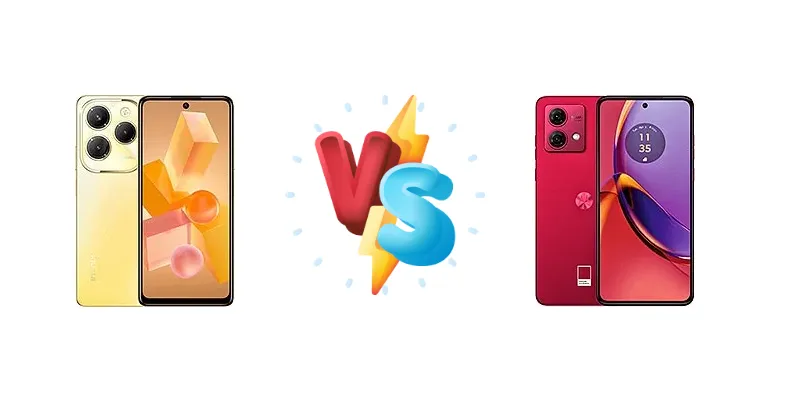
The sub-$200 smartphone market is fiercely competitive, and the Infinix Hot 40 Pro and Motorola Moto G84 are two strong contenders vying for your attention. Both offer 5G connectivity and focus on delivering a solid all-around experience, but they take different approaches to achieve it. This comparison dives deep into their specifications and performance to determine which device reigns supreme.
🏆 Quick Verdict
For the average user prioritizing sustained performance and a brighter display, the Infinix Hot 40 Pro emerges as the winner. Its Mediatek Helio G99 chipset and higher peak brightness offer a more responsive experience, while the slightly longer battery life is a bonus. However, the Moto G84’s cleaner software experience is a compelling alternative.
| Network |
|---|
| 2G bands | GSM 850 / 900 / 1800 / 1900 | GSM 850 / 900 / 1800 / 1900 |
| 3G bands | HSDPA 850 / 900 / 1700(AWS) / 1900 / 2100 | HSDPA 850 / 900 / 1700(AWS) / 1900 / 2100 - LATAM |
| 4G bands | 1, 2, 3, 4, 5, 7, 8, 20, 28, 38, 40, 41 | 1, 2, 3, 4, 5, 7, 8, 12, 13, 17, 25, 26, 28, 38, 40, 41, 42, 66 - LATAM |
| 5G bands | - | 1, 2, 3, 5, 7, 26, 28, 40, 66, 78 SA/NSA/Sub6 - LATAM |
| Speed | HSPA, LTE | HSPA, LTE, 5G |
| Technology | GSM / HSPA / LTE | GSM / HSPA / LTE / 5G |
| Launch |
|---|
| Announced | 2023, December 05 | 2023, August 24 |
| Status | Available. Released 2023, December | Available. Released 2023, September 08 |
| Body |
|---|
| Build | Glass front, plastic back, plastic frame | Glass front, plastic frame, plastic back or eco leather back |
| Dimensions | 168.6 x 76.6 x 8.3 mm (6.64 x 3.02 x 0.33 in) | 160 x 74.4 x 7.6 mm (6.30 x 2.93 x 0.30 in) |
| SIM | Nano-SIM + Nano-SIM | Nano-SIM + Nano-SIM |
| Weight | 199 g (7.02 oz) | 166.8 g (5.86 oz) |
| Display |
|---|
| Resolution | 1080 x 2460 pixels (~396 ppi density) | 1080 x 2400 pixels, 20:9 ratio (~405 ppi density) |
| Size | 6.78 inches, 109.2 cm2 (~84.5% screen-to-body ratio) | 6.5 inches, 102.0 cm2 (~85.7% screen-to-body ratio) |
| Type | IPS LCD, 120Hz, 500 nits (peak) | P-OLED, 1B colors, 120Hz, 1300 nits (peak) |
| Platform |
|---|
| CPU | Octa-core (2x2.2 GHz Cortex-A76 & 6x2.0 GHz Cortex-A55) | Octa-core (2x2.2 GHz Kryo 660 Gold & 6x1.7 GHz Kryo 660 Silver) |
| Chipset | Mediatek Helio G99 (6 nm) | Qualcomm SM6375 Snapdragon 695 5G (6 nm) |
| GPU | Mali-G57 MC2 | Adreno 619 |
| OS | Android 13, XOS 13.5 | Android 13, upgradable to Android 15 |
| Memory |
|---|
| Card slot | microSDXC (dedicated slot) | microSDXC (uses shared SIM slot) |
| Internal | 128GB 8GB RAM, 256GB 8GB RAM, 256GB 12GB RAM | 256GB 8GB RAM, 256GB 12GB RAM |
| Main Camera |
|---|
| Dual | 108 MP, f/1.8, (wide), 1/1.67", 0.64µm, AF
2 MP (macro)
Auxiliary lens | 50 MP, f/1.9 (wide), 1/1.5", 1.0µm, PDAF, OIS
8 MP, f/2.2, 120˚ (ultrawide), 1/4.0", 1.12µm, AF |
| Features | Quad-LED flash, HDR, panorama | LED flash, HDR, panorama |
| Video | 1440p@30fps, 1080p@30fps | 1080p@30/60fps |
| Selfie camera |
|---|
| Features | Dual-LED flash | - |
| Single | 32 MP, f/2.2, (wide), 1/3.15", 0.7µm | 16 MP, f/2.5, (wide), 1.0µm |
| Video | 1080p@30fps | 1080p@30fps |
| Sound |
|---|
| 35mm jack | Yes | Yes |
| Loudspeaker | Yes, with stereo speakers | Yes, with stereo speakers |
| Comms |
|---|
| Bluetooth | Yes | 5.1, A2DP, LE |
| NFC | Yes | Yes (market/region dependent) |
| Positioning | GPS | GPS, GLONASS, GALILEO |
| Radio | FM radio | FM radio (market/region dependent) |
| USB | USB Type-C 2.0, OTG | USB Type-C 2.0 |
| WLAN | Wi-Fi 802.11 a/b/g/n/ac, dual-band | Wi-Fi 802.11 a/b/g/n/ac, dual-band, Wi-Fi Direct |
| Features |
|---|
| Sensors | Fingerprint (side-mounted), accelerometer, gyro, proximity, compass | Fingerprint (under display, optical), accelerometer, gyro, proximity, compass |
| Battery |
|---|
| Charging | 33W wired, 20-75% in 35 min
Reverse wired | 30W wired |
| Type | 5000 mAh | Li-Po 5000 mAh |
| Misc |
|---|
| Colors | Palm Blue, Horizon Gold, Starlit Black, Starfall Green, Free Fire | Marshmallow Blue, Midnight Blue, Viva Magenta |
| Models | X6837 | XT2347, XT2347-1, XT2347-2 |
| Price | £ 179.95 / € 226.31 | $ 399.00 / £ 189.99 / € 169.00 |
Infinix Hot 40 Pro
- Slightly better CPU performance with the Helio G99
- Faster 33W charging
- Higher contrast ratio for potentially better image quality
- Lower peak display brightness
- Potential for more software bloatware (typical of Infinix)
Motorola Moto G84
- Significantly brighter display for outdoor use
- Cleaner, near-stock Android experience
- Established brand reputation
- Slightly lower CPU performance
- Slower 30W charging
Display Comparison
The Motorola Moto G84 boasts a significantly brighter display, reaching 996 nits compared to the Infinix Hot 40 Pro’s 534 nits. This makes the Moto G84 far more usable in direct sunlight. However, the Infinix counters with a 1822:1 contrast ratio, suggesting deeper blacks and a more vibrant image, though this is less noticeable in everyday use. Both displays utilize a 6.5-inch form factor, but the difference in peak brightness is a key differentiator for outdoor visibility. The lack of refresh rate information for both devices means we can't assess smoothness.
Camera Comparison
Both devices feature photo and video capabilities, but detailed sensor information is absent. Without knowing megapixel counts or sensor sizes, a direct comparison is difficult. However, the absence of any mention of advanced features like OIS on either phone suggests a focus on basic photography. The image processing style will likely be the biggest differentiator, with Infinix often leaning towards more saturated colors and Motorola aiming for a more natural look. The lack of detail makes it hard to assess which phone will deliver superior image quality.
Performance
Both phones employ 6nm chipsets, but the architectures differ. The Infinix Hot 40 Pro utilizes the Mediatek Helio G99 with its Cortex-A76 cores clocked at 2.2 GHz, offering a performance edge in CPU-intensive tasks compared to the Motorola Moto G84’s Snapdragon 695 5G and its Kryo 660 Gold cores, also clocked at 2.2 GHz. While both have an octa-core configuration, the G99’s core design generally translates to better single-core performance. The Snapdragon 695 focuses more on 5G connectivity and efficiency, potentially offering better power management during prolonged network usage. Neither chipset is a gaming powerhouse, but the G99 will likely handle graphically demanding titles with slightly higher frame rates.
Battery Life
The Infinix Hot 40 Pro achieves an active use battery score of 12:56h, slightly surpassing the Motorola Moto G84’s 12:31h. While the difference is marginal, it suggests the Helio G99’s efficiency, despite its higher performance, is comparable to the Snapdragon 695. The Infinix also boasts 33W wired charging, allowing a 20-75% charge in 35 minutes, while the Moto G84 is limited to 30W. The Moto G84’s older endurance rating of 117h is less useful than the measured active use score, as it doesn’t reflect real-world usage patterns. The Infinix’s faster charging is a practical advantage for users who need to quickly top up their battery.
Buying Guide
Buy the Infinix Hot 40 Pro if you need a phone that can handle demanding apps and games without significant slowdown, and if a bright, easily visible screen is crucial for your outdoor usage. Buy the Motorola Moto G84 if you prefer a near-stock Android experience with minimal bloatware and value a more established brand reputation, even if it means a slight compromise in raw processing power.
Frequently Asked Questions
❓ Does the Mediatek Helio G99 in the Infinix Hot 40 Pro throttle under sustained gaming loads?
While the Helio G99 is a capable chipset, it's not a flagship processor. Expect some degree of thermal throttling during extended gaming sessions, particularly with graphically demanding titles. However, the 6nm process node helps mitigate this compared to older, larger-node chipsets. The phone's thermal design will also play a crucial role.
❓ How does Motorola's software support compare to Infinix, and will the Moto G84 receive timely updates?
Motorola generally provides more consistent and timely software updates than Infinix, though it's still not on par with Google or Samsung. The Moto G84 is likely to receive at least one major Android version update and several security patches. Infinix's update schedule is less predictable, and updates may be delayed or unavailable for certain regions.
❓ Is the 30W charging on the Moto G84 significantly slower than the 33W on the Infinix Hot 40 Pro in real-world use?
The difference of 3W isn't massive, but the Infinix Hot 40 Pro's 33W charging will shave off approximately 10-15 minutes from a full charge compared to the Moto G84. The 35-minute 20-75% charge claim for the Infinix is a tangible benefit for users who frequently need to quickly top up their battery.