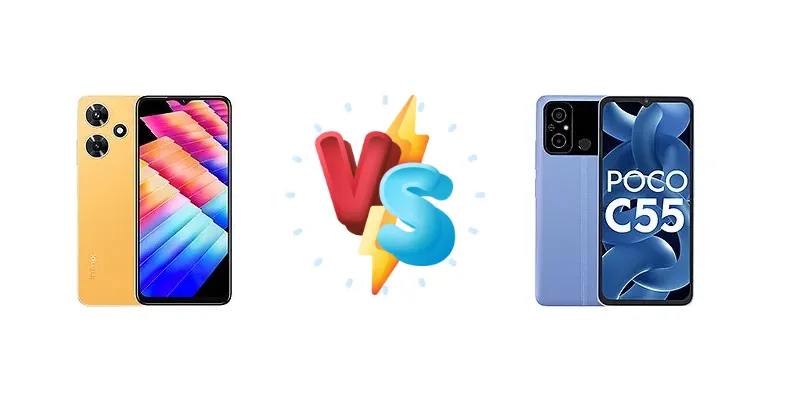
The sub-$150 smartphone market is fiercely competitive, and the Xiaomi Poco C55 and Infinix Hot 30i are two contenders vying for your attention. Both aim to deliver essential features at an accessible price, but they take different approaches to performance and user experience. This deep dive analyzes their key specifications to determine which device offers the best overall package.
🏆 Quick Verdict
For most users, the Xiaomi Poco C55 emerges as the stronger choice. Its Helio G85 chipset provides a noticeable performance advantage over the Infinix Hot 30i’s Helio G37, translating to smoother multitasking and a better gaming experience. While both offer similar battery and charging capabilities, the Poco C55’s superior processing power makes it the more versatile option.
| Network |
|---|
| 2G bands | GSM 850 / 900 / 1800 / 1900 | GSM 850 / 900 / 1800 / 1900 |
| 3G bands | HSDPA 850 / 900 / 1700(AWS) / 1900 / 2100 | HSDPA 850 / 900 / 2100 |
| 4G bands | 1, 2, 3, 4, 5, 7, 8, 20, 28, 38, 40, 41 | 1, 3, 5, 8, 40, 41 |
| Speed | HSPA, LTE | HSPA, LTE |
| Technology | GSM / HSPA / LTE | GSM / HSPA / LTE |
| Launch |
|---|
| Announced | 2023, March 27 | 2023, February 21 |
| Status | Available. Released 2023, March 27 | Available. Released 2023, February 28 |
| Body |
|---|
| Build | Glass front, plastic frame, plastic back | Glass front (Panda Glass), eco leather back |
| Dimensions | 164 x 75.8 x 8.4 mm (6.46 x 2.98 x 0.33 in) | 168.8 x 76.4 x 8.8 mm (6.65 x 3.01 x 0.35 in) |
| SIM | Nano-SIM + Nano-SIM | Nano-SIM + Nano-SIM |
| Weight | 191 g (6.74 oz) | 192 g (6.77 oz) |
| | - | Dust and splash resistant |
| Display |
|---|
| Protection | Panda Glass | Panda Glass |
| Resolution | 720 x 1612 pixels, 20:9 ratio (~269 ppi density) | 720 x 1650 pixels (~268 ppi density) |
| Size | 6.56 inches, 103.4 cm2 (~83.2% screen-to-body ratio) | 6.71 inches, 106.5 cm2 (~82.6% screen-to-body ratio) |
| Type | IPS LCD, 90Hz, 500 nits (peak) | IPS LCD |
| Platform |
|---|
| CPU | Octa-core (4x2.3 GHz Cortex-A53 & 4x1.8 GHz Cortex-A53) | Octa-core (2x2.0 GHz Cortex-A75 & 6x1.8 GHz Cortex-A55) |
| Chipset | Mediatek Helio G37 (12 nm) | Mediatek MT6769Z Helio G85 (12 nm) |
| GPU | PowerVR GE8320 | Mali-G52 MC2 |
| OS | Android 12, XOS 12 | Android 12, MIUI 13 for POCO |
| Memory |
|---|
| Card slot | microSDXC (dedicated slot) | microSDXC (dedicated slot) |
| Internal | 128GB 8GB RAM | 64GB 4GB RAM, 128GB 6GB RAM |
| | - | eMMC 5.1 |
| Main Camera |
|---|
| Dual | - | 50 MP, f/1.8, (wide), PDAF
0.08 MP (depth) |
| Features | Dual-LED flash, HDR, panorama | LED flash, HDR |
| Single | 50 MP, f/1.6, (wide), AF
Auxiliary lens | 50 MP, f/1.8, (wide), PDAF
Auxiliary lens |
| Video | 1080p@30fps | 1080p@30fps |
| Selfie camera |
|---|
| Features | Dual-LED flash | HDR |
| Single | 5 MP, f/2.0, (wide) | 5 MP |
| Video | 1080p@30fps | 1080p@30fps |
| Sound |
|---|
| 3.5mm jack | - | Yes |
| 35mm jack | Yes | Yes |
| Loudspeaker | Yes | Yes |
| Comms |
|---|
| Bluetooth | 5.0, A2DP, LE | 5.0, A2DP, LE |
| NFC | No | No |
| Positioning | GPS | GPS, GLONASS, GALILEO, BDS, QZSS |
| Radio | FM radio | FM radio, recording |
| USB | USB Type-C 2.0, OTG | microUSB 2.0, OTG |
| WLAN | Wi-Fi 802.11 a/b/g/n/ac, dual-band | Wi-Fi 802.11 a/b/g/n/ac, dual-band |
| Features |
|---|
| Sensors | Fingerprint (side-mounted), accelerometer, proximity, compass | Fingerprint (rear-mounted), accelerometer |
| | - | Virtual proximity sensing |
| Battery |
|---|
| Charging | 10W wired | 10W wired |
| Type | Li-Po 5000 mAh | Li-Po 5000 mAh |
| Misc |
|---|
| Colors | Mirror Black, Glacier Blue, Diamond White, Marigold | Cool Blue, Power Black, Forest Green |
| Models | X669C | 22127PC95I |
| Price | About 90 EUR | About 110 EUR |
| SAR | - | 0.87 W/kg (head) 0.77 W/kg (body) |
Infinix Hot 30i (50 MP)
- Potentially cleaner software experience (Infinix UI is often less cluttered than MIUI)
- Competitive 50MP main camera for the price
- Decent build quality for the segment
- Inferior chipset performance compared to the Poco C55
- Slow 10W charging
- Limited gaming capabilities
Xiaomi Poco C55
- More powerful Helio G85 chipset for smoother performance
- Better gaming experience
- Generally more refined image processing
- MIUI can be resource-intensive and include bloatware
- Slow 10W charging
- Potentially less frequent software updates
Display Comparison
Neither device boasts a standout display. Both likely utilize LCD panels, common in this price bracket. The focus here isn't on visual fidelity, but functionality. Without specific display specs (resolution, brightness), it's difficult to differentiate. However, the Poco C55's slightly larger screen real estate (typically found in this series) may be preferable for media consumption. Bezels are expected to be substantial on both, impacting the overall immersive experience.
Camera Comparison
Both phones feature a 50MP main camera, but sensor size and image processing algorithms are crucial differentiators. Without specific sensor details, it’s difficult to declare a clear winner. However, Xiaomi’s image processing is generally more refined, potentially resulting in better dynamic range and color accuracy in the Poco C55’s photos. The presence of a 2MP depth sensor on both devices is largely marketing fluff; its impact on image quality is minimal. The 50MP sensor on both will perform adequately in good lighting conditions, but low-light performance will likely be a weakness.
Performance
The core difference lies in the chipsets. The Poco C55’s MediaTek Helio G85 (12nm) significantly outperforms the Infinix Hot 30i’s Helio G37 (12nm). The G85 features two Cortex-A75 cores clocked at 2.0 GHz alongside six Cortex-A55 cores, offering a substantial boost in single-core performance compared to the G37’s four Cortex-A53 cores at 2.3 GHz and four at 1.8 GHz. This architectural difference means the Poco C55 will handle multitasking, app loading, and gaming with greater fluidity. While both use the same 12nm process, the G85’s core configuration provides a clear advantage. The G85’s GPU is also more capable, leading to higher frame rates in games.
Battery Life
Both the Infinix Hot 30i and the Xiaomi Poco C55 are equipped with 10W wired charging. This is a significant limitation, meaning a full charge will take a considerable amount of time (likely over 3 hours). Battery capacity isn’t specified, but typical capacities for phones in this segment range from 5000mAh to 6000mAh. The slower charging speed means battery optimization and efficient power management by the chipset become more critical. The Poco C55’s more efficient Helio G85 may offer slightly better battery life under heavy use due to its superior power efficiency.
Buying Guide
Buy the Infinix Hot 30i (50 MP) if you prioritize a clean software experience and are primarily focused on basic smartphone tasks like calling, texting, and light social media use. Buy the Xiaomi Poco C55 if you want a phone capable of handling more demanding applications, enjoy mobile gaming, and appreciate a more powerful processor for the price.
Frequently Asked Questions
❓ Will the Poco C55’s Helio G85 handle demanding games like PUBG Mobile?
The Helio G85 in the Poco C55 is capable of running PUBG Mobile, but you’ll likely need to lower the graphics settings to medium or low to achieve a consistently smooth frame rate. Expect playable performance, but don't anticipate ultra-high settings.
❓ Is the software on the Infinix Hot 30i significantly less bloated than on the Poco C55?
Infinix’s XOS is generally considered to be less aggressive with pre-installed apps and bloatware compared to Xiaomi’s MIUI. However, both interfaces include some level of customization and pre-installed software. Users who prefer a near-stock Android experience may still want to consider custom ROMs.
❓ How long will it take to fully charge either phone with the 10W charger?
Expect a full charge to take approximately 3 to 4 hours with the included 10W charger. This is a significant drawback for both devices, and a faster charger is highly recommended if you frequently find yourself needing to top up quickly.
❓ Does the Poco C55 support reverse charging?
No, the Poco C55 does not support reverse charging. This means you cannot use it to charge other devices.