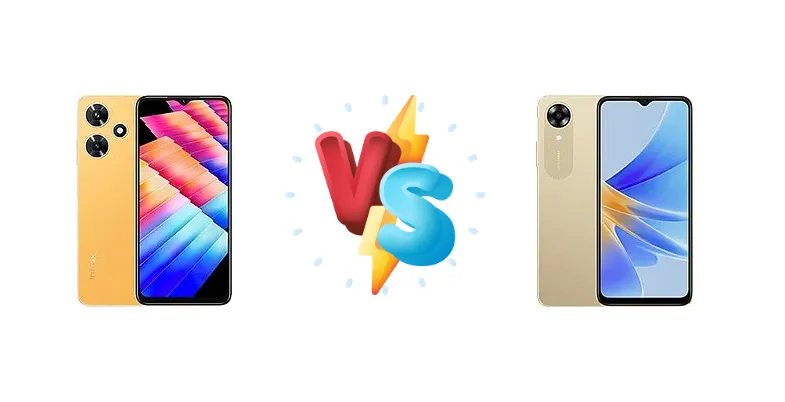
The Infinix Hot 30i and Oppo A17k represent the fiercely competitive sub-$150 smartphone market. Both devices aim to deliver essential smartphone functionality at an accessible price point, but subtle differences in their core hardware – specifically the chipset – dictate their performance characteristics. This comparison dissects those differences to help you choose the best option for your needs.
🏆 Quick Verdict
For the average user prioritizing consistent performance in everyday tasks, the Infinix Hot 30i emerges as the slightly better choice. While both utilize Mediatek Helio G37 and G35 chips with identical CPU core configurations, the G37 generally offers a small performance edge, making the Hot 30i more responsive.
| Network |
|---|
| 2G bands | GSM 850 / 900 / 1800 / 1900 | GSM 850 / 900 / 1800 / 1900 |
| 3G bands | HSDPA 850 / 900 / 1700(AWS) / 1900 / 2100 | HSDPA 850 / 900 / 2100 |
| 4G bands | 1, 2, 3, 4, 5, 7, 8, 20, 28, 38, 40, 41 | 1, 3, 5, 8, 38, 40, 41 |
| Speed | HSPA, LTE | HSPA, LTE |
| Technology | GSM / HSPA / LTE | GSM / HSPA / LTE |
| Launch |
|---|
| Announced | 2023, March 27 | 2022, October 13 |
| Status | Available. Released 2023, March 27 | Available. Released 2022, October 18 |
| Body |
|---|
| Build | Glass front, plastic frame, plastic back | - |
| Dimensions | 164 x 75.8 x 8.4 mm (6.46 x 2.98 x 0.33 in) | 164.2 x 75.6 x 8.3 mm (6.46 x 2.98 x 0.33 in) |
| SIM | Nano-SIM + Nano-SIM | Nano-SIM + Nano-SIM |
| Weight | 191 g (6.74 oz) | 189 g (6.67 oz) |
| | - | IPX4 water resistance |
| Display |
|---|
| Protection | Panda Glass | Panda Glass |
| Resolution | 720 x 1612 pixels, 20:9 ratio (~269 ppi density) | 720 x 1612 pixels, 20:9 ratio (~269 ppi density) |
| Size | 6.56 inches, 103.4 cm2 (~83.2% screen-to-body ratio) | 6.56 inches, 103.4 cm2 (~83.3% screen-to-body ratio) |
| Type | IPS LCD, 90Hz, 500 nits (peak) | IPS LCD, 480 nits (typ), 600 nits (HBM) |
| Platform |
|---|
| CPU | Octa-core (4x2.3 GHz Cortex-A53 & 4x1.8 GHz Cortex-A53) | Octa-core (4x2.3 GHz Cortex-A53 & 4x1.8 GHz Cortex-A53) |
| Chipset | Mediatek Helio G37 (12 nm) | Mediatek MT6765 Helio G35 (12 nm) |
| GPU | PowerVR GE8320 | PowerVR GE8320 |
| OS | Android 12, XOS 12 | Android 12, ColorOS 12.1 |
| Memory |
|---|
| Card slot | microSDXC (dedicated slot) | microSDXC |
| Internal | 128GB 8GB RAM | 64GB 3GB RAM |
| | - | eMMC 5.1 |
| Main Camera |
|---|
| Features | Dual-LED flash, HDR, panorama | LED flash, panorama |
| Single | 50 MP, f/1.6, (wide), AF
Auxiliary lens | 8 MP, f/2.0, (wide), AF |
| Video | 1080p@30fps | 1080p@30fps |
| Selfie camera |
|---|
| Features | Dual-LED flash | - |
| Single | 5 MP, f/2.0, (wide) | 5 MP, f/2.2, (wide) |
| Video | 1080p@30fps | 1080p@30fps |
| Sound |
|---|
| 3.5mm jack | - | Yes |
| 35mm jack | Yes | Yes |
| Loudspeaker | Yes | Yes |
| Comms |
|---|
| Bluetooth | 5.0, A2DP, LE | 5.3, A2DP, LE, aptX HD |
| NFC | No | No |
| Positioning | GPS | GPS, GLONASS, BDS, GALILEO |
| Radio | FM radio | Unspecified |
| USB | USB Type-C 2.0, OTG | microUSB 2.0, OTG |
| WLAN | Wi-Fi 802.11 a/b/g/n/ac, dual-band | Wi-Fi 802.11 a/b/g/n/ac, dual-band |
| Features |
|---|
| Sensors | Fingerprint (side-mounted), accelerometer, proximity, compass | Fingerprint (side-mounted), accelerometer, proximity, compass |
| Battery |
|---|
| Charging | 10W wired | - |
| Type | Li-Po 5000 mAh | Li-Po 5000 mAh |
| Misc |
|---|
| Colors | Mirror Black, Glacier Blue, Diamond White, Marigold | Navy Blue, Gold |
| Models | X669C | CPH2471 |
| Price | About 90 EUR | About 130 EUR |
Infinix Hot 30i (50 MP)
- Slightly better performance due to Helio G37 chipset
- Potentially improved image processing with G37's ISP
- 50MP main camera offers detail in good lighting
- Slow 10W charging
- Likely limited low-light camera performance
Oppo A17k
- Clean and streamlined software experience (typical of Oppo)
- 50MP main camera offers detail in good lighting
- Affordable price point
- Helio G35 chipset offers slightly lower performance
- Slow 10W charging
Display Comparison
Neither Infinix nor Oppo provide display specifications beyond resolution. Given the price bracket, both likely employ LCD panels. The absence of details like peak brightness or color gamut suggests a focus on cost reduction. Bezels are expected to be noticeable on both devices. Color accuracy will likely be standard for this segment, prioritizing vibrancy over absolute fidelity. The user experience will be similar on both, with neither offering features like high refresh rates or HDR support.
Camera Comparison
Both phones boast a 50 MP main camera, but the image quality will depend heavily on sensor size and image processing algorithms, which are not specified. The 50MP resolution suggests a potential for detailed images in good lighting conditions. However, the lack of Optical Image Stabilization (OIS) on either device means low-light performance will likely be limited. The inclusion of a 2MP secondary camera on both devices is largely for marketing purposes and offers minimal practical benefit. Image processing will likely differ between the two, with Oppo traditionally favoring more saturated colors and Infinix aiming for a more natural look. The G37's ISP in the Hot 30i may offer slightly faster processing and better noise reduction.
Performance
Both the Infinix Hot 30i and Oppo A17k are powered by octa-core processors utilizing the same Cortex-A53 core configuration (4x2.3 GHz & 4x1.8 GHz). However, the Infinix Hot 30i features the Mediatek Helio G37 (12 nm), while the Oppo A17k uses the Helio G35 (12 nm). While the CPU cores are identical, the G37 generally offers a slightly higher GPU clock speed and improved image signal processing capabilities. This translates to marginally better performance in graphics-intensive tasks and potentially faster image processing. Both devices will likely struggle with demanding games at high settings, but the G37 in the Hot 30i should provide a smoother experience overall. RAM configurations are not specified, but both will likely ship with 3-4GB, impacting multitasking capabilities.
Battery Life
Battery capacity is not specified for either device. However, given the price point, both are likely to feature batteries in the 4000-5000 mAh range. The Infinix Hot 30i includes 10W wired charging, which is relatively slow. The Oppo A17k's charging speed is also likely to be around 10W. Expect a full charge to take approximately 2-3 hours. Battery life will depend heavily on usage patterns, but both devices should comfortably last a full day with moderate use. The lack of fast charging is a common trade-off in this price segment.
Buying Guide
Buy the Infinix Hot 30i (50 MP) if you need a phone that can handle multitasking and light gaming without significant slowdowns. It's ideal for users who frequently switch between apps or enjoy casual mobile games. Buy the Oppo A17k if you prioritize a clean, streamlined software experience and are primarily focused on basic communication and media consumption, and are willing to accept slightly slower performance.
Frequently Asked Questions
❓ Will the Infinix Hot 30i handle popular games like PUBG Mobile or Call of Duty?
While the Helio G37 is capable of running these games, expect to play at low to medium settings with reduced frame rates for a smooth experience. The limited RAM and GPU power will prevent optimal performance at higher settings. The Oppo A17k will likely struggle even more with these titles.
❓ Is the 50MP camera on either phone a significant upgrade over a standard 13MP camera?
In good lighting conditions, the 50MP sensor can capture more detail. However, the quality of the lens, sensor size, and image processing algorithms are equally important. In low light, the larger sensor *can* help, but the lack of OIS will limit its effectiveness. Don't expect DSLR-like quality.
❓ How does the software experience differ between Infinix and Oppo?
Oppo's ColorOS is generally known for its clean interface and user-friendly features. Infinix's XOS, while improving, often includes more pre-installed apps (bloatware). This can impact performance and storage space. Oppo typically provides more consistent software updates.
❓ What type of charging port do these phones use?
Both the Infinix Hot 30i and Oppo A17k are expected to use a USB Micro-USB port for charging and data transfer, which is standard for phones in this price range. This is slower and less convenient than USB-C.