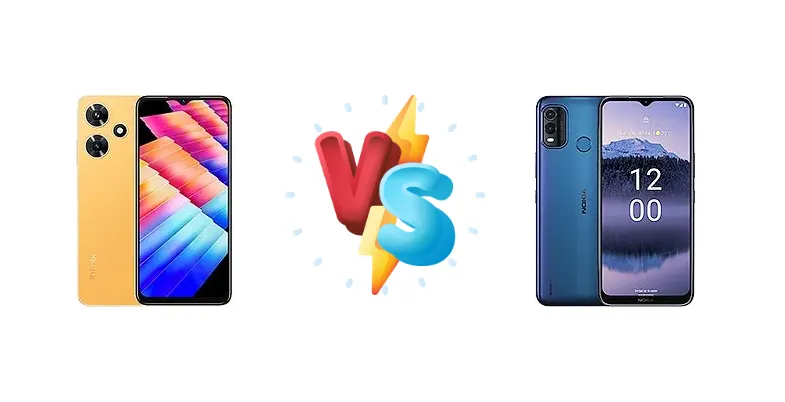
The sub-$150 smartphone market is fiercely competitive. Both the Infinix Hot 30i and Nokia G11 Plus aim to deliver essential smartphone functionality at an accessible price. However, they take different approaches to achieving this, with the Infinix prioritizing processing power and the Nokia focusing on a clean software experience. This comparison dissects their key differences to help you choose the right device.
🏆 Quick Verdict
For most users, the Infinix Hot 30i emerges as the stronger choice. Its Mediatek Helio G37 chipset, while not a powerhouse, offers a noticeable performance edge over the Unisoc T606 in the Nokia G11 Plus, making it better suited for gaming and multitasking. Both phones share the same slow 10W charging, but the Infinix’s CPU architecture provides a smoother overall experience.
| Network |
|---|
| 2G bands | GSM 850 / 900 / 1800 / 1900 | GSM 850 / 900 / 1800 / 1900 |
| 3G bands | HSDPA 850 / 900 / 1700(AWS) / 1900 / 2100 | HSDPA 850 / 900 / 2100 - International |
| 4G bands | 1, 2, 3, 4, 5, 7, 8, 20, 28, 38, 40, 41 | 1, 3, 5, 7, 8, 20, 28, 38, 40, 41 - International |
| Speed | HSPA, LTE | HSPA 42.2/5.76 Mbps, LTE Cat4 150/50 Mbps |
| Technology | GSM / HSPA / LTE | GSM / HSPA / LTE |
| | - | 1, 3, 5, 8, 40, 41 - India |
| Launch |
|---|
| Announced | 2023, March 27 | 2022, June 29 |
| Status | Available. Released 2023, March 27 | Available. Released 2022, July 20 |
| Body |
|---|
| Build | Glass front, plastic frame, plastic back | Glass front, plastic frame, plastic back |
| Dimensions | 164 x 75.8 x 8.4 mm (6.46 x 2.98 x 0.33 in) | 164.8 x 75.9 x 8.6 mm (6.49 x 2.99 x 0.34 in) |
| SIM | Nano-SIM + Nano-SIM | · Nano-SIM· Nano-SIM + Nano-SIM |
| Weight | 191 g (6.74 oz) | 192 g (6.77 oz) |
| | - | Splash protection |
| Display |
|---|
| Protection | Panda Glass | - |
| Resolution | 720 x 1612 pixels, 20:9 ratio (~269 ppi density) | 720 x 1600 pixels, 20:9 ratio (~269 ppi density) |
| Size | 6.56 inches, 103.4 cm2 (~83.2% screen-to-body ratio) | 6.52 inches, 102.6 cm2 (~82.1% screen-to-body ratio) |
| Type | IPS LCD, 90Hz, 500 nits (peak) | IPS LCD, 90Hz, 400 nits (typ) |
| Platform |
|---|
| CPU | Octa-core (4x2.3 GHz Cortex-A53 & 4x1.8 GHz Cortex-A53) | Octa-core (2x1.6 GHz Cortex-A75 & 6x1.6 GHz Cortex-A55) |
| Chipset | Mediatek Helio G37 (12 nm) | Unisoc T606 (12 nm) |
| GPU | PowerVR GE8320 | Mali-G57 MP1 |
| OS | Android 12, XOS 12 | Android 12, upgradable to Android 13 |
| Memory |
|---|
| Card slot | microSDXC (dedicated slot) | microSDXC (dedicated slot) |
| Internal | 128GB 8GB RAM | 32GB 3GB RAM, 64GB 3GB RAM, 64GB 4GB RAM, 128GB 3GB RAM |
| | - | eMMC 5.1 |
| Main Camera |
|---|
| Dual | - | 50 MP, f/1.8, (wide), 1/2.67", PDAF
Auxiliary lens |
| Features | Dual-LED flash, HDR, panorama | LED flash |
| Single | 50 MP, f/1.6, (wide), AF
Auxiliary lens | 8 MP, f/2.0, (wide), 1/4.0" |
| Video | 1080p@30fps | 1080p@30fps |
| Selfie camera |
|---|
| Features | Dual-LED flash | - |
| Single | 5 MP, f/2.0, (wide) | 8 MP, f/2.0, (wide), 1/4.0" |
| Video | 1080p@30fps | 1080p@30fps |
| Sound |
|---|
| 3.5mm jack | - | Yes |
| 35mm jack | Yes | Yes |
| Loudspeaker | Yes | Yes |
| Comms |
|---|
| Bluetooth | 5.0, A2DP, LE | 5.0, A2DP, LE |
| NFC | No | No |
| Positioning | GPS | GPS |
| Radio | FM radio | FM radio |
| USB | USB Type-C 2.0, OTG | USB Type-C 2.0, OTG |
| WLAN | Wi-Fi 802.11 a/b/g/n/ac, dual-band | Wi-Fi 802.11 a/b/g/n/ac, dual-band, Wi-Fi Direct |
| Features |
|---|
| Sensors | Fingerprint (side-mounted), accelerometer, proximity, compass | Fingerprint (rear-mounted), accelerometer, proximity |
| Battery |
|---|
| Charging | 10W wired | 10W wired |
| Type | Li-Po 5000 mAh | Li-Ion 5000 mAh |
| Misc |
|---|
| Colors | Mirror Black, Glacier Blue, Diamond White, Marigold | Lake Blue, Charcoal Grey |
| Models | X669C | - |
| Price | About 90 EUR | About 130 EUR |
Infinix Hot 30i (50 MP)
- More powerful processor for smoother multitasking.
- Potentially better gaming performance.
- Likely more vibrant image processing.
- Slow 10W charging.
- Software experience may be less clean than Nokia.
Nokia G11 Plus
- Clean, near-stock Android experience.
- Potentially slightly better battery life due to chipset efficiency.
- Simpler user interface.
- Less powerful processor.
- Slower performance in demanding tasks.
- Potentially less vibrant camera output.
Display Comparison
Neither device boasts a standout display. Both likely utilize LCD panels, common in this price bracket. While specific details like peak brightness and color gamut are unavailable, the focus here is on processing power, not visual fidelity. Bezels are expected to be relatively thick on both, and color accuracy will likely be standard for budget phones. The absence of high refresh rates is also expected.
Camera Comparison
Both phones feature a 50MP main camera, but sensor size and image processing algorithms will dictate image quality. Without specific sensor details, it’s difficult to declare a clear winner. However, Infinix often employs more aggressive image processing, potentially resulting in more vibrant, albeit less natural, photos. The Nokia G11 Plus is likely to lean towards a more realistic color profile. The presence of lower-resolution auxiliary cameras on both devices is largely inconsequential; their contribution to overall image quality is minimal.
Performance
The core difference lies in the chipsets. The Infinix Hot 30i’s Mediatek Helio G37, built on a 12nm process, features an octa-core configuration with a split design: four Cortex-A53 cores clocked at 2.3 GHz and four at 1.8 GHz. This contrasts with the Nokia G11 Plus’s Unisoc T606, also 12nm, but with a different core arrangement – two Cortex-A75 cores at 1.6 GHz and six Cortex-A55 cores at 1.6 GHz. The A75 cores in the Unisoc offer higher single-core performance, but the G37’s higher clock speeds and more numerous cores provide a potential advantage in multi-threaded tasks and gaming. The G37’s GPU is also likely to be more capable, leading to a smoother gaming experience.
Battery Life
Both the Infinix Hot 30i and Nokia G11 Plus are equipped with 10W wired charging, a significant drawback in today’s market. Expect a lengthy charge time – likely exceeding 3 hours for a full 0-100% charge. Battery capacity is not specified, but both will likely hover around the 5000mAh mark, offering all-day battery life with moderate usage. The more efficient chipset in the Nokia G11 Plus *might* translate to slightly longer battery life, but the difference will likely be marginal.
Buying Guide
Buy the Infinix Hot 30i (50 MP) if you need a phone capable of handling moderate gaming and multitasking without significant lag. It’s ideal for users who prioritize responsiveness and a slightly more modern chipset. Buy the Nokia G11 Plus if you prefer a cleaner, near-stock Android experience and value simplicity over raw performance. It’s a good option for basic communication and light usage.
Frequently Asked Questions
❓ Will the Infinix Hot 30i handle popular games like PUBG Mobile or Call of Duty?
The Mediatek Helio G37 in the Infinix Hot 30i can run PUBG Mobile and Call of Duty, but expect to play at lower graphics settings (Medium or Low) to maintain a stable frame rate. It won't deliver a flagship gaming experience, but it's capable of casual gaming.
❓ Is the Nokia G11 Plus a good choice for someone who primarily uses their phone for calls, texts, and social media?
Yes, the Nokia G11 Plus is well-suited for basic smartphone tasks. Its Unisoc T606 chipset is sufficient for everyday communication and social media browsing. The clean Android experience also contributes to a smooth and uncluttered user experience for these core functions.
❓ How long will it take to fully charge either the Infinix Hot 30i or Nokia G11 Plus with the included 10W charger?
Expect a full charge from 0-100% to take approximately 3 to 4 hours with the 10W charger on both devices. This is a significant drawback compared to phones with faster charging capabilities.
❓ Does either phone have a dedicated microSD card slot for expandable storage?
While not explicitly stated in the provided specifications, both Infinix and Nokia typically include a dedicated microSD card slot in their budget offerings. It's highly probable that both the Hot 30i and G11 Plus support expandable storage up to 512GB or 1TB.