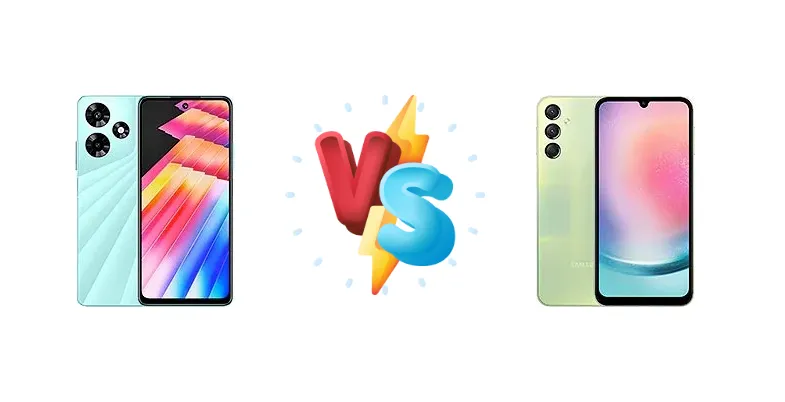
The sub-$200 smartphone market is fiercely competitive, and the Infinix Hot 30 and Samsung Galaxy A24 4G are two strong contenders. The Hot 30 prioritizes rapid charging and a gaming-focused chipset, while the A24 4G counters with a brighter display and Samsung’s established brand reputation. This comparison dissects their key differences to help you choose the right device.
🏆 Quick Verdict
For the average user prioritizing gaming and fast charging, the Infinix Hot 30 emerges as the winner. Its Helio G88 chipset, coupled with 33W charging, offers a more compelling experience for mobile gamers than the Galaxy A24 4G’s Helio G99 and slower 25W charging, despite the A24's brighter screen.
| Network |
|---|
| 2G bands | GSM 850 / 900 / 1800 / 1900 | GSM 850 / 900 / 1800 / 1900 |
| 3G bands | HSDPA 850 / 900 / 1700(AWS) / 1900 / 2100 | HSDPA 850 / 900 / 2100 |
| 4G bands | 1, 2, 3, 4, 5, 7, 8, 20, 28, 38, 40, 41 | 1, 3, 5, 7, 8, 20, 28, 38, 40, 41 |
| Speed | HSPA, LTE | HSPA, LTE |
| Technology | GSM / HSPA / LTE | GSM / HSPA / LTE |
| Launch |
|---|
| Announced | 2023, March 31 | 2023, April 19 |
| Status | Available. Released 2023, March 31 | Available. Released 2023, May 05 |
| Body |
|---|
| Build | Glass front, plastic frame, plastic back | Glass front, plastic frame, plastic back |
| Dimensions | 168.7 x 76.6 x 8.4 mm (6.64 x 3.02 x 0.33 in) | 162.1 x 77.6 x 8.3 mm (6.38 x 3.06 x 0.33 in) |
| SIM | Nano-SIM + Nano-SIM | · Nano-SIM· Nano-SIM + Nano-SIM |
| Weight | 196 g (6.91 oz) | 195 g (6.88 oz) |
| Display |
|---|
| Resolution | 1080 x 2460 pixels (~396 ppi density) | 1080 x 2340 pixels, 19.5:9 ratio (~396 ppi density) |
| Size | 6.78 inches, 109.2 cm2 (~84.5% screen-to-body ratio) | 6.5 inches, 103.7 cm2 (~82.4% screen-to-body ratio) |
| Type | IPS LCD, 90Hz, 500 nits (typ), 600 nits (peak) | Super AMOLED, 90Hz, 1000 nits (peak) |
| Platform |
|---|
| CPU | Octa-core (2x2.0 GHz Cortex-A75 & 6x1.8 GHz Cortex-A55) | Octa-core (2x2.2 GHz Cortex-A76 & 6x2.0 GHz Cortex-A55) |
| Chipset | Mediatek MT6769H Helio G88 (12 nm) | Mediatek Helio G99 (6 nm) |
| GPU | Mali-G52 MC2 | Mali-G57 MC2 |
| OS | Android 13, XOS 12.6 | Android 13, up to 4 major Android upgrades, One UI 6 |
| Memory |
|---|
| Card slot | microSDXC (dedicated slot) | microSDXC (dedicated slot) |
| Internal | 128GB 4GB RAM, 128GB 8GB RAM, 256GB 8GB RAM | 128GB 4GB RAM, 128GB 6GB RAM, 128GB 8GB RAM |
| Main Camera |
|---|
| Dual | 50 MP, f/1.6, (wide), 1/2.55", AF
0.08 MP, (depth) | - |
| Features | Quad-LED flash, HDR, panorama | LED flash, panorama, HDR |
| Single | 50 MP, f/1.6, (wide), 1/2.55", AF
Auxiliary lens | - |
| Triple | - | 50 MP, f/1.8, 27mm (wide), 1/2.76", 0.64µm, PDAF, OIS
5 MP, f/2.2, 17mm, 123˚ (ultrawide), 1/5.0", 1.12µm
2 MP (macro) |
| Video | 1440p@30fps, 1080p@30fps | 1080p@30fps, gyro-EIS |
| Selfie camera |
|---|
| Features | Dual-LED flash | - |
| Single | 8 MP, f/2.5, (wide) | 13 MP, f/2.2, 25mm (wide), 1/3.06", 1.12µm |
| Video | 1080p@30fps | 1080p@30fps |
| Sound |
|---|
| 3.5mm jack | Yes | - |
| 35mm jack | Yes | Yes |
| Loudspeaker | Yes, with stereo speakers | Yes |
| | 24-bit/192kHz audio | - |
| Comms |
|---|
| Bluetooth | Yes | 5.3, A2DP, LE |
| NFC | Yes | Yes (market/region dependent) |
| Positioning | GPS | GPS, GLONASS, GALILEO, BDS, QZSS |
| Radio | FM radio | Unspecified |
| USB | USB Type-C 2.0, OTG | USB Type-C 2.0 |
| WLAN | Wi-Fi 802.11 a/b/g/n/ac, dual-band | Wi-Fi 802.11 a/b/g/n/ac, dual-band, Wi-Fi Direct |
| Features |
|---|
| Sensors | Fingerprint (side-mounted), accelerometer, proximity, compass | Fingerprint (side-mounted), accelerometer, gyro, compass |
| Battery |
|---|
| Charging | 33W wired, 55% in 30 min | 25W wired |
| Type | 5000 mAh | Li-Po 5000 mAh |
| Misc |
|---|
| Colors | Racing Black, Surfing Green, Sonic White, Free Fire | Black, Lime Green, Blue gradient, Dark red |
| Models | X6831 | SM-A245F, SM-A245F/DS, SM-A245F/DSN, SM-A245M, SM-A245M/DS, SM-A245N |
| Price | - | About 150 EUR |
| SAR EU | - | 0.41 W/kg (head) 1.30 W/kg (body) |
Infinix Hot 30
- Faster 33W charging for quick top-ups
- Gaming-focused chipset (Helio G88)
- Potentially better value for money
- Likely lower display brightness
- Less established brand reputation
Samsung Galaxy A24 4G
- Brighter 1012 nit display for outdoor use
- Samsung’s software and ecosystem
- More thermally efficient chipset (Helio G99)
- Slower 25W charging
- Potentially higher price
Display Comparison
The Samsung Galaxy A24 4G boasts a significantly brighter display, reaching a measured 1012 nits. This is a substantial advantage for outdoor visibility compared to the Infinix Hot 30, which lacks published brightness data but is expected to be lower. While the Hot 30’s panel specifics are unknown, the A24’s brightness makes it the clear winner for users who frequently use their phones outdoors. The A24’s panel technology isn’t specified as LTPO, meaning it lacks the variable refresh rate benefits found in higher-end devices, but its brightness is the defining feature.
Camera Comparison
Detailed camera specs beyond 'Photo/Video' are absent for the Galaxy A24 4G, but Samsung typically emphasizes image processing. The A24 likely features a more refined software algorithm for color accuracy and dynamic range. The Infinix Hot 30’s camera capabilities are similarly undefined, making a direct comparison difficult. Without sensor size or aperture information, it’s reasonable to assume the A24 4G, leveraging Samsung’s camera expertise, will deliver more consistent and visually appealing results, especially in challenging lighting conditions. The prevalence of 2MP macro lenses on both devices suggests limited utility for detailed close-up photography.
Performance
Both phones utilize MediaTek Helio chipsets, but the Galaxy A24 4G’s Helio G99, fabricated on a 6nm process, holds a theoretical advantage over the Hot 30’s 12nm Helio G88. The G99’s CPU features 2x2.2 GHz Cortex-A76 cores versus the G88’s 2x2.0 GHz Cortex-A75 cores, indicating faster single-core performance. However, the real-world difference may be less pronounced due to software optimization and RAM management. The 6nm process of the G99 also implies better thermal efficiency, potentially leading to sustained performance during extended gaming sessions. The Hot 30’s focus on gaming suggests software tweaks to maximize the G88’s potential, but the A24 4G has a hardware edge.
Battery Life
The Samsung Galaxy A24 4G has an endurance rating of 141 hours, indicating solid battery life. However, the Infinix Hot 30 compensates with significantly faster 33W wired charging, achieving 55% charge in just 30 minutes. The A24 4G’s 25W charging is slower. While the A24 4G may last longer on a single charge, the Hot 30’s rapid charging minimizes downtime, making it more convenient for users who frequently top up their battery. The actual battery capacity of the Hot 30 is not specified, but the faster charging is a key differentiator.
Buying Guide
Buy the Infinix Hot 30 if you need a phone primarily for gaming and value fast charging speeds. Its chipset is optimized for gaming, and the 33W charging will keep you in the action longer. Buy the Samsung Galaxy A24 4G if you prioritize a brighter, more visible display in direct sunlight and prefer the Samsung ecosystem and software experience, even if it means sacrificing some gaming performance and charging speed.
Frequently Asked Questions
❓ Does the Helio G99 in the Samsung Galaxy A24 4G overheat during prolonged gaming sessions?
The Helio G99’s 6nm process is designed for improved thermal efficiency compared to older chipsets. While some heat generation is inevitable during gaming, the G99 is less prone to throttling than the G88, offering more sustained performance. However, sustained performance will still depend on the phone's cooling solution and ambient temperature.
❓ Is the 33W charging on the Infinix Hot 30 compatible with Power Delivery (PD) chargers?
Infinix does not explicitly state PD compatibility for the Hot 30’s 33W charging. While it may work with some PD chargers, it’s best to use the included charger for optimal and safe charging speeds. Using a non-compatible charger could result in slower charging or potential damage.
❓ How significant is the difference in gaming performance between the Helio G88 and Helio G99?
The Helio G99 offers a moderate performance uplift over the G88, primarily due to its newer CPU cores and more efficient manufacturing process. Expect slightly faster frame rates and smoother gameplay in demanding titles on the A24 4G, but the difference won’t be dramatic. Software optimization plays a crucial role, and the Hot 30 may close the gap with dedicated gaming features.
❓ What is the typical screen-on time I can expect from the Samsung Galaxy A24 4G?
With its 141-hour endurance rating, the Samsung Galaxy A24 4G should comfortably provide a full day of moderate to heavy use. Expect around 6-8 hours of screen-on time with typical usage patterns, including browsing, social media, and video streaming. However, gaming and other demanding tasks will reduce battery life.