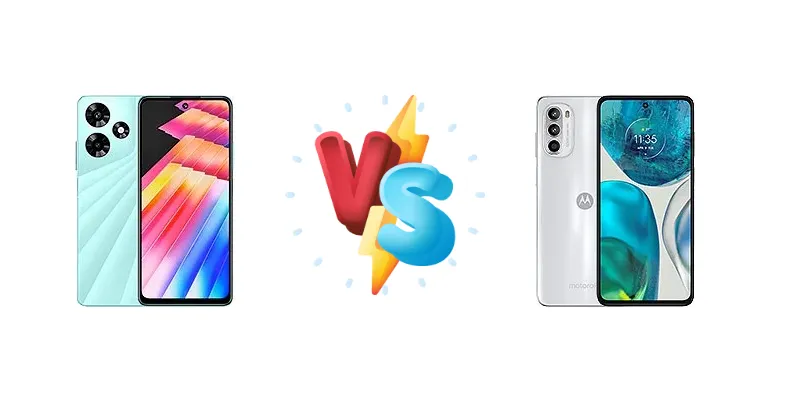
The sub-$200 smartphone market is fiercely competitive. The Infinix Hot 30 and Motorola Moto G52 represent compelling options, but cater to slightly different priorities. The Hot 30 emphasizes rapid charging and a gaming-focused chipset, while the Moto G52 leans towards efficiency with a more modern fabrication process. This comparison will dissect their key differences to help you choose the right device.
🏆 Quick Verdict
For the average user prioritizing sustained performance and efficiency, the Motorola Moto G52 emerges as the better choice. Its Snapdragon 680, built on a 6nm process, offers a more balanced experience than the Infinix Hot 30’s Helio G88, despite the latter’s faster charging.
| Network |
|---|
| 2G bands | GSM 850 / 900 / 1800 / 1900 | GSM 850 / 900 / 1800 / 1900 |
| 3G bands | HSDPA 850 / 900 / 1700(AWS) / 1900 / 2100 | HSDPA 850 / 900 / 1700(AWS) / 1900 / 2100 |
| 4G bands | 1, 2, 3, 4, 5, 7, 8, 20, 28, 38, 40, 41 | LTE |
| Speed | HSPA, LTE | HSPA, LTE |
| Technology | GSM / HSPA / LTE | GSM / HSPA / LTE |
| Launch |
|---|
| Announced | 2023, March 31 | 2022, April 12 |
| Status | Available. Released 2023, March 31 | Available. Released 2022, April 20 |
| Body |
|---|
| Build | Glass front, plastic frame, plastic back | - |
| Dimensions | 168.7 x 76.6 x 8.4 mm (6.64 x 3.02 x 0.33 in) | 160.1 x 74.5 x 8 mm (6.30 x 2.93 x 0.31 in) |
| SIM | Nano-SIM + Nano-SIM | Nano-SIM + Nano-SIM |
| Weight | 196 g (6.91 oz) | 169 g (5.96 oz) |
| | - | Water-repellent design |
| Display |
|---|
| Resolution | 1080 x 2460 pixels (~396 ppi density) | 1080 x 2400 pixels, 20:9 ratio (~402 ppi density) |
| Size | 6.78 inches, 109.2 cm2 (~84.5% screen-to-body ratio) | 6.6 inches, 103.6 cm2 (~86.9% screen-to-body ratio) |
| Type | IPS LCD, 90Hz, 500 nits (typ), 600 nits (peak) | AMOLED, 90Hz |
| Platform |
|---|
| CPU | Octa-core (2x2.0 GHz Cortex-A75 & 6x1.8 GHz Cortex-A55) | Octa-core (4x2.4 GHz Kryo 265 Gold & 4x1.9 GHz Kryo 265 Silver) |
| Chipset | Mediatek MT6769H Helio G88 (12 nm) | Qualcomm SM6225 Snapdragon 680 4G (6 nm) |
| GPU | Mali-G52 MC2 | Adreno 610 |
| OS | Android 13, XOS 12.6 | Android 12, planned upgrade to Android 13 |
| Memory |
|---|
| Card slot | microSDXC (dedicated slot) | microSDXC (uses shared SIM slot) |
| Internal | 128GB 4GB RAM, 128GB 8GB RAM, 256GB 8GB RAM | 64GB 4GB RAM, 128GB 4GB RAM, 128GB 6GB RAM, 256GB 6GB RAM |
| Main Camera |
|---|
| Dual | 50 MP, f/1.6, (wide), 1/2.55", AF
0.08 MP, (depth) | - |
| Features | Quad-LED flash, HDR, panorama | LED flash, HDR, panorama |
| Single | 50 MP, f/1.6, (wide), 1/2.55", AF
Auxiliary lens | - |
| Triple | - | 50 MP, f/1.8 (wide), 1/2.76", 0.64µm, PDAF
8 MP, f/2.2, 118˚ (ultrawide), 1/4.0", 1.12µm
2 MP (macro) |
| Video | 1440p@30fps, 1080p@30fps | 1080p@30fps |
| Selfie camera |
|---|
| Features | Dual-LED flash | - |
| Single | 8 MP, f/2.5, (wide) | 16 MP, f/2.5, (wide), 1.0µm |
| Video | 1080p@30fps | 1080p@30fps |
| Sound |
|---|
| 3.5mm jack | Yes | Yes |
| 35mm jack | Yes | Yes |
| Loudspeaker | Yes, with stereo speakers | Yes, with stereo speakers |
| | 24-bit/192kHz audio | - |
| Comms |
|---|
| Bluetooth | Yes | 5.0, A2DP, LE |
| NFC | Yes | Yes (market/region dependent) |
| Positioning | GPS | GPS, GLONASS, GALILEO |
| Radio | FM radio | Unspecified |
| USB | USB Type-C 2.0, OTG | USB Type-C 2.0 |
| WLAN | Wi-Fi 802.11 a/b/g/n/ac, dual-band | Wi-Fi 802.11 a/b/g/n/ac, dual-band, Wi-Fi Direct |
| Features |
|---|
| Sensors | Fingerprint (side-mounted), accelerometer, proximity, compass | Fingerprint (side-mounted), accelerometer, gyro, proximity, compass |
| Battery |
|---|
| Charging | 33W wired, 55% in 30 min | 30W wired |
| Type | 5000 mAh | Li-Po 5000 mAh |
| Misc |
|---|
| Colors | Racing Black, Surfing Green, Sonic White, Free Fire | Charcoal Gray, Porcelain White |
| Models | X6831 | XT2221-1, XT2221-2 |
| Price | - | About 470 EUR |
Infinix Hot 30
- Faster 33W charging for quicker top-ups
- Potentially better peak performance in short bursts due to higher clocked cores
- Aggressive pricing may make it more accessible
- Less efficient 12nm process leads to higher heat and potential throttling
- Helio G88 chipset may struggle with sustained performance
- Image processing may not be as refined as the Snapdragon 680
Motorola Moto G52
- More efficient 6nm Snapdragon 680 chipset for better battery life and thermal management
- Smoother overall performance due to optimized architecture
- Potentially better image processing capabilities
- Slower 30W charging compared to the Infinix Hot 30
- May be slightly more expensive
- Peak performance may be lower than the Hot 30 in short bursts
Display Comparison
Neither device boasts a standout display. Specifications are missing for both, so we must rely on market positioning. Given the price point, both likely feature 6.5-6.6 inch LCD panels with FHD+ resolution. The Moto G52, being a slightly more premium offering within the budget segment, *may* have slightly better color accuracy. However, without specific data on color gamut coverage or peak brightness, it's difficult to definitively state a winner. Bezels are expected to be comparable on both.
Camera Comparison
Without detailed camera specifications, a direct comparison is challenging. However, both phones likely feature a primary camera around the 50MP mark, accompanied by depth and macro sensors (the usefulness of the latter is questionable). The Snapdragon 680’s ISP (Image Signal Processor) generally offers superior image processing capabilities, potentially resulting in better dynamic range and low-light performance on the Moto G52. The Infinix Hot 30 may rely more heavily on software enhancements to compensate for any hardware limitations.
Performance
The core difference lies in the chipsets. The Motorola Moto G52’s Qualcomm Snapdragon 680 (6nm) utilizes Kryo 265 Gold cores clocked at 2.4 GHz, offering a theoretical performance advantage over the Infinix Hot 30’s MediaTek Helio G88 (12nm) with its 2.0 GHz Cortex-A75 cores. The 6nm fabrication process of the Snapdragon 680 is crucial; it translates to significantly improved power efficiency and reduced heat generation. This means the Moto G52 is less likely to throttle under sustained load, making it better for longer gaming sessions or multitasking. While the Helio G88’s Cortex-A75 cores offer a higher clock speed, the architectural advantages and process node of the Snapdragon 680 provide a more consistent experience.
Battery Life
The Infinix Hot 30’s 33W charging is a clear advantage over the Moto G52’s 30W charging. Infinix claims 55% charge in 30 minutes, suggesting a significantly faster top-up time. However, battery capacity is unknown for both devices. The Snapdragon 680’s superior power efficiency could offset a potentially smaller battery in the Moto G52, resulting in comparable real-world battery life. The faster charging of the Hot 30 is ideal for users who frequently need a quick power boost, while the Moto G52 prioritizes efficiency.
Buying Guide
Buy the Infinix Hot 30 if you need the fastest possible charging speeds and frequently engage in casual gaming where short bursts of performance are more important than sustained output. Buy the Motorola Moto G52 if you prefer a more efficient processor that delivers smoother everyday performance, better thermal management, and a potentially longer software support lifecycle, even if it means slightly slower charging.
Frequently Asked Questions
❓ Will the Helio G88 in the Infinix Hot 30 overheat during prolonged gaming sessions?
The MediaTek Helio G88, built on a 12nm process, is prone to thermal throttling under sustained load. While it can handle casual gaming, extended gaming sessions with demanding titles may result in noticeable performance drops as the phone attempts to manage heat. The Motorola Moto G52’s Snapdragon 680, with its 6nm process, is significantly better equipped to handle prolonged gaming without significant throttling.
❓ How much faster is the charging on the Infinix Hot 30 compared to the Motorola Moto G52 in real-world use?
Infinix claims 55% charge in 30 minutes with the 33W charger. While Motorola doesn't provide specific numbers, the 30W charger will likely take closer to 45-60 minutes to reach the same charge level. This makes the Hot 30 ideal for users who frequently need a quick power boost, even if it's just for a short period.
❓ Does the Snapdragon 680 in the Moto G52 support advanced features like 5G?
No, the Snapdragon 680 is a 4G-only chipset. Both the Infinix Hot 30 and Motorola Moto G52 are limited to 4G connectivity. If 5G is a priority, these are not the phones for you.
❓ Which phone is likely to receive more software updates and security patches?
Motorola generally provides a more consistent and longer software support lifecycle than Infinix. While neither brand is known for extensive updates, Motorola typically offers at least one major Android update and several years of security patches, providing a more secure and up-to-date user experience.