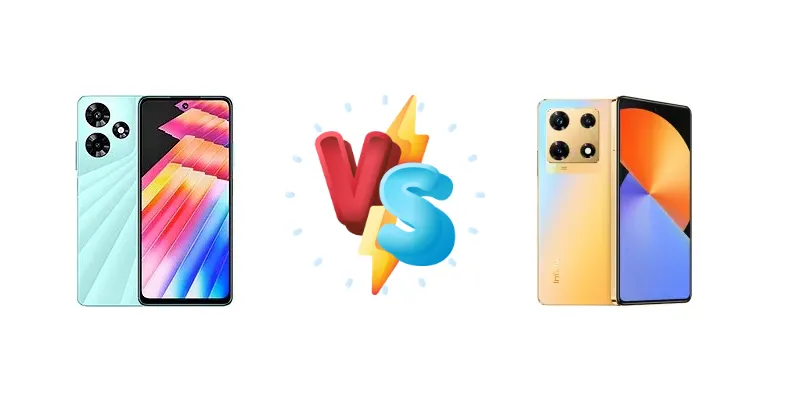
The Infinix Hot series and Note series are known for delivering impressive features at affordable prices. But which one is right for you? We're pitting the Infinix Hot 30 against the Infinix Note 30 Pro to see which phone offers the best value and performance.
🏆 Quick Verdict
The Infinix Note 30 Pro clearly takes the lead with its faster chipset, significantly quicker charging, and added wireless charging capabilities. While the Hot 30 is a solid budget option, the Note 30 Pro's upgrades make it the superior choice for most users seeking a balance of features and performance.
| Network |
|---|
| 2G bands | GSM 850 / 900 / 1800 / 1900 | GSM 850 / 900 / 1800 / 1900 |
| 3G bands | HSDPA 850 / 900 / 1700(AWS) / 1900 / 2100 | HSDPA 850 / 900 / 1700(AWS) / 1900 / 2100 |
| 4G bands | 1, 2, 3, 4, 5, 7, 8, 20, 28, 38, 40, 41 | 1, 2, 3, 4, 5, 7, 8, 12, 17, 20, 28, 38, 40, 41, 66 |
| Speed | HSPA, LTE | HSPA, LTE |
| Technology | GSM / HSPA / LTE | GSM / HSPA / LTE |
| Launch |
|---|
| Announced | 2023, March 31 | 2023, May 22 |
| Status | Available. Released 2023, March 31 | Available. Released 2023, May 22 |
| Body |
|---|
| Build | Glass front, plastic frame, plastic back | Glass front, plastic frame, glass back |
| Dimensions | 168.7 x 76.6 x 8.4 mm (6.64 x 3.02 x 0.33 in) | 162.7 x 76 x 8.2 mm (6.41 x 2.99 x 0.32 in) |
| SIM | Nano-SIM + Nano-SIM | Nano-SIM + Nano-SIM |
| Weight | 196 g (6.91 oz) | 203 g (7.16 oz) |
| | - | IP53 |
| Display |
|---|
| Resolution | 1080 x 2460 pixels (~396 ppi density) | 1080 x 2400 pixels, 20:9 ratio (~395 ppi density) |
| Size | 6.78 inches, 109.2 cm2 (~84.5% screen-to-body ratio) | 6.67 inches, 107.4 cm2 (~86.9% screen-to-body ratio) |
| Type | IPS LCD, 90Hz, 500 nits (typ), 600 nits (peak) | AMOLED, 1B colors, 120Hz, 900 nits (peak) |
| | - | * the display diagonal size and resolution is unconfirmed |
| Platform |
|---|
| CPU | Octa-core (2x2.0 GHz Cortex-A75 & 6x1.8 GHz Cortex-A55) | Octa-core (2x2.2 GHz Cortex-A76 & 6x2.0 GHz Cortex-A55) |
| Chipset | Mediatek MT6769H Helio G88 (12 nm) | Mediatek Helio G99 (6 nm) |
| GPU | Mali-G52 MC2 | Mali-G57 MC2 |
| OS | Android 13, XOS 12.6 | Android 13, XOS 13 |
| Memory |
|---|
| Card slot | microSDXC (dedicated slot) | microSDXC (dedicated slot) |
| Internal | 128GB 4GB RAM, 128GB 8GB RAM, 256GB 8GB RAM | 256GB 8GB RAM |
| Main Camera |
|---|
| Dual | 50 MP, f/1.6, (wide), 1/2.55", AF
0.08 MP, (depth) | - |
| Features | Quad-LED flash, HDR, panorama | Quad-LED flash, HDR, panorama |
| Single | 50 MP, f/1.6, (wide), 1/2.55", AF
Auxiliary lens | - |
| Triple | - | 108 MP, (wide), 1/1.67", PDAF
2 MP (macro)
Auxiliary lens |
| Video | 1440p@30fps, 1080p@30fps | 1440p@30fps, 1080p@30fps |
| Selfie camera |
|---|
| Features | Dual-LED flash | LED flash, HDR |
| Single | 8 MP, f/2.5, (wide) | 32 MP, f/2.0, (wide), 1/2.8" |
| Video | 1080p@30fps | 1080p@30fps |
| Sound |
|---|
| 3.5mm jack | Yes | Yes |
| 35mm jack | Yes | Yes |
| Loudspeaker | Yes, with stereo speakers | Yes, with dual speakers |
| | 24-bit/192kHz audio | Sound by JBL
24-bit/192kHz audio |
| Comms |
|---|
| Bluetooth | Yes | Yes |
| NFC | Yes | Yes (market/region dependent) |
| Positioning | GPS | GPS |
| Radio | FM radio | FM radio |
| USB | USB Type-C 2.0, OTG | USB Type-C 2.0, OTG |
| WLAN | Wi-Fi 802.11 a/b/g/n/ac, dual-band | Wi-Fi 802.11 a/b/g/n/ac, dual-band, Wi-Fi Direct |
| Features |
|---|
| Sensors | Fingerprint (side-mounted), accelerometer, proximity, compass | Fingerprint (side-mounted), accelerometer, gyro, proximity, compass |
| Battery |
|---|
| Charging | 33W wired, 55% in 30 min | 68W wired, PD3.0, 80% in 30 min
15W wireless
Reverse wireless |
| Type | 5000 mAh | 5000 mAh |
| Misc |
|---|
| Colors | Racing Black, Surfing Green, Sonic White, Free Fire | Magic Black, Variable Gold |
| Models | X6831 | X678B |
Infinix Hot 30
- More affordable
- Reliable performance for everyday tasks
- Decent battery life
- Good value for money
- Slower performance compared to Note 30 Pro
- Slower charging speeds
- Less premium design
- Potentially lower quality display
Infinix Note 30 Pro
- Faster performance
- Significantly faster charging (wired & wireless)
- Potentially better display
- Premium design
- Reverse wireless charging
- More expensive
- May be overkill for basic users
- Wireless charging can drain battery faster
Display Comparison
Both phones likely feature AMOLED displays, but the Note 30 Pro is expected to have a slightly higher refresh rate (120Hz vs potentially 90Hz on the Hot 30) and potentially better color accuracy and brightness. The Note 30 Pro may also have a slightly larger screen size.
Camera Comparison
While both phones likely offer a triple-camera setup, the Note 30 Pro is expected to have a higher resolution main sensor and potentially better image processing capabilities. Expect improved low-light performance and more detailed photos from the Note 30 Pro. Both likely feature a macro and depth sensor.
Performance
The Note 30 Pro's Mediatek Helio G99 chipset (6nm) offers a significant performance advantage over the Hot 30's Helio G88 (12nm). Expect smoother multitasking, faster app loading times, and better gaming performance on the Note 30 Pro. The G99's newer architecture and smaller fabrication process contribute to improved efficiency.
Battery Life
Both phones likely have a 5000mAh battery. However, the Note 30 Pro's 68W wired charging is a game-changer, charging to 80% in just 30 minutes, compared to the Hot 30's 33W charging. The Note 30 Pro also boasts 15W wireless charging and reverse wireless charging, adding further convenience.
Buying Guide
The Infinix Hot 30 is ideal for users on a tight budget who prioritize essential features and a reliable experience. The Infinix Note 30 Pro is perfect for those who want a smoother performance, faster charging, and extra features like wireless charging and a potentially better display, even if it means spending a bit more.
Frequently Asked Questions
❓ Is the Infinix Note 30 Pro worth the extra money?
If you value performance, fast charging, and wireless charging, then yes, the Note 30 Pro is worth the extra investment. However, if you're on a strict budget and only need a phone for basic tasks, the Hot 30 is a capable alternative.
❓ Which phone has better gaming performance?
The Infinix Note 30 Pro's Helio G99 chipset provides significantly better gaming performance than the Hot 30's Helio G88. You'll experience smoother frame rates and less lag on the Note 30 Pro.