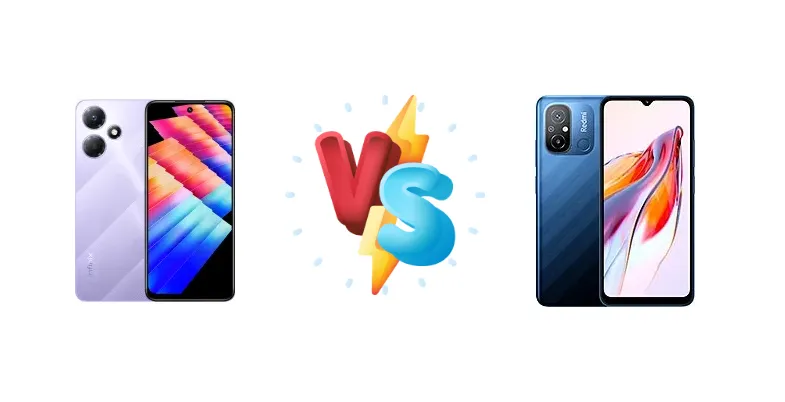
The sub-$150 smartphone market is fiercely competitive, and the Infinix Hot 30 Play NFC and Xiaomi Redmi 12C are two contenders vying for dominance. While both aim to deliver essential smartphone functionality at an accessible price, they take different approaches to achieving this. The Hot 30 Play NFC emphasizes faster charging and NFC connectivity, while the Redmi 12C focuses on a slightly more powerful chipset. This comparison will dissect their key differences to help you choose the right device.
🏆 Quick Verdict
For the average user prioritizing responsiveness and future-proofing, the Xiaomi Redmi 12C emerges as the better choice. Its Helio G85 chipset, featuring Cortex-A75 cores, provides a noticeable performance edge over the Infinix Hot 30 Play NFC’s Helio G37, making it more capable for multitasking and demanding apps. However, the Infinix’s 18W charging is a significant advantage for those who value quick top-ups.
| Network |
|---|
| 2G bands | GSM 850 / 900 / 1800 / 1900 | GSM 850 / 900 / 1800 / 1900 |
| 3G bands | HSDPA 850 / 900 / 1700(AWS) / 1900 / 2100 | HSDPA 850 / 900 / 2100 |
| 4G bands | 1, 2, 3, 4, 5, 7, 8, 20, 28, 38, 40, 41 | 1, 3, 5, 7, 8, 20, 28, 38, 40, 41 - International |
| Speed | HSPA, LTE | HSPA, LTE |
| Technology | GSM / HSPA / LTE | GSM / CDMA / HSPA / EVDO / LTE |
| | - | CDMA2000 1xEV-DO |
| Launch |
|---|
| Announced | 2023, May 22 | 2022, December 31 |
| Status | Available. Released 2023, May 22 | Available. Released 2023, January 01 |
| Body |
|---|
| Build | Glass front, plastic frame, plastic back | - |
| Dimensions | 170.6 x 77.5 x 8.6 mm (6.72 x 3.05 x 0.34 in) | 168.8 x 76.4 x 8.8 mm (6.65 x 3.01 x 0.35 in) |
| SIM | Nano-SIM + Nano-SIM | Nano-SIM + Nano-SIM |
| Weight | 205 g (7.23 oz) | 192 g (6.77 oz) |
| Display |
|---|
| Resolution | 720 x 1640 pixels (~263 ppi density) | 720 x 1650 pixels (~268 ppi density) |
| Size | 6.82 inches, 110.5 cm2 (~83.5% screen-to-body ratio) | 6.71 inches, 106.5 cm2 (~82.6% screen-to-body ratio) |
| Type | IPS LCD, 90Hz, 500 nits (peak) | IPS LCD, 500 nits (typ) |
| Platform |
|---|
| CPU | Octa-core (4x2.3 GHz Cortex-A53 & 4x1.7 GHz Cortex-A53) | Octa-core (2x2.0 GHz Cortex-A75 & 6x1.8 GHz Cortex-A55) |
| Chipset | Mediatek MT6765 Helio G37 (12 nm) | Mediatek MT6769Z Helio G85 (12 nm) |
| GPU | PowerVR GE8320 | Mali-G52 MC2 |
| OS | Android 13, XOS 12.6 | Android 12, MIUI 13 |
| Memory |
|---|
| Card slot | microSDXC (dedicated slot) | microSDXC (dedicated slot) |
| Internal | 128GB 4GB RAM, 128GB 8GB RAM | 32GB 2GB RAM, 32GB 3GB RAM, 32GB 4GB RAM, 64GB 3GB RAM, 64GB 4GB RAM, 128GB 3GB RAM, 128GB 4GB RAM, 128GB 6GB RAM |
| | - | eMMC 5.1 |
| Main Camera |
|---|
| Dual | 16 MP, f/1.8, (wide), PDAF
Auxiliary lens | 50 MP, (wide), PDAF
0.08 MP (depth) |
| Features | Dual-LED flash, HDR, panorama | LED flash, HDR |
| Single | - | 50 MP, f/1.8, (wide), 1/2.76", PDAF
Auxiliary lens |
| Video | 1080p@30fps | 1080p@30fps |
| Selfie camera |
|---|
| Features | Dual-LED flash, HDR | - |
| Single | 8 MP, f/2.0, (wide) | 5 MP, f/2.2, (wide) |
| Video | 1080p@30fps | 1080p@30fps |
| Sound |
|---|
| 3.5mm jack | - | Yes |
| 35mm jack | Yes | Yes |
| Loudspeaker | Yes | Yes |
| Comms |
|---|
| Bluetooth | Yes | 5.1, A2DP, LE |
| NFC | Yes | Yes (market/region dependent) |
| Positioning | GPS | GPS, GLONASS, BDS, GALILEO |
| Radio | FM radio | FM radio |
| USB | USB Type-C 2.0, OTG | microUSB 2.0 |
| WLAN | Wi-Fi 802.11 a/b/g/n/ac, dual-band, Wi-Fi Direct | Wi-Fi 802.11 a/b/g/n/ac, dual-band, Wi-Fi Direct |
| Features |
|---|
| Sensors | Fingerprint (side-mounted), accelerometer, proximity, compass | Fingerprint (rear-mounted), accelerometer |
| | - | Virtual proximity sensing |
| Battery |
|---|
| Charging | 18W wired | 10W wired |
| Type | 6000 mAh | Li-Po 5000 mAh |
| Misc |
|---|
| Colors | Mirage Black, Blade White, Bora Purple | Graphite Gray, Ocean Blue, Mint Green, Lavender Purple |
| Models | X6835B, X6835 | 22120RN86G, 22120RN86I, 22126RN91Y, 2212ARNC4L |
| Price | - | £ 132.99 / € 107.41 |
| SAR | - | 1.08 W/kg (head) 0.64 W/kg (body) |
| SAR EU | - | 0.98 W/kg (head) 0.99 W/kg (body) |
Infinix Hot 30 Play NFC
- Faster 18W charging for quicker top-ups
- NFC support for contactless payments
- Potentially longer battery life due to efficient chipset
- Less powerful chipset compared to the Redmi 12C
- Older CPU core architecture (Cortex-A53)
Xiaomi Redmi 12C
- More powerful Helio G85 chipset with Cortex-A75 cores
- Superior CPU performance for multitasking and app responsiveness
- Potentially better image processing capabilities
- Slower 10W charging
- Lacks NFC connectivity
Display Comparison
Neither device boasts a standout display. Both utilize 12nm chipsets, suggesting similar power constraints impacting display capabilities. While specific display specs (resolution, panel type) are missing, the focus here is on performance. The absence of high refresh rates on either device indicates a prioritization of battery life over visual fluidity. Bezels are likely comparable, typical of this price segment.
Camera Comparison
Both phones likely feature similar camera setups geared towards basic photography. Without specific sensor details, it’s safe to assume both rely on a primary sensor paired with auxiliary lenses (often 2MP macro/depth sensors of limited utility). Image processing will likely be the differentiating factor, with Xiaomi’s software generally offering more refined results. The Redmi 12C’s slightly more powerful chipset could also contribute to faster image processing times. Focusing on the primary sensor’s megapixel count is crucial, as auxiliary sensors add little value.
Performance
The core difference lies in the chipsets. The Xiaomi Redmi 12C’s MediaTek Helio G85 (12nm) features a dual-core Cortex-A75 setup clocked at 2.0 GHz, paired with six Cortex-A55 cores at 1.8 GHz. This architecture provides a significant uplift in single-core performance compared to the Infinix Hot 30 Play NFC’s Helio G37 (12nm) which uses four Cortex-A53 cores at 2.3 GHz and four Cortex-A53 cores at 1.7 GHz. The A75 cores in the G85 are demonstrably more efficient and powerful than the older A53 cores, resulting in snappier app launches and smoother multitasking. While the G37’s higher clock speed on the A53 cores might offer a slight advantage in sustained, multi-threaded workloads, the G85’s architecture is superior for typical smartphone usage.
Battery Life
The Infinix Hot 30 Play NFC’s 18W charging is a clear advantage over the Redmi 12C’s 10W charging. This translates to significantly faster top-up times, a crucial benefit for users who frequently find themselves with low battery. While battery capacity isn’t specified, the faster charging speed of the Infinix mitigates the impact of a potentially smaller battery. The Redmi 12C will require more time plugged in to achieve a full charge, making the Infinix a better choice for those who prioritize convenience.
Buying Guide
Buy the Infinix Hot 30 Play NFC if you absolutely need NFC for mobile payments and prioritize faster 18W charging over raw processing power. This phone is ideal for users who primarily use social media, messaging apps, and light web browsing. Buy the Xiaomi Redmi 12C if you want a more responsive experience for everyday tasks, occasional gaming, and appreciate a chipset with more modern CPU core architecture. It’s the better option for users who anticipate using their phone for more than just basic communication.
Frequently Asked Questions
❓ Will the Redmi 12C struggle with popular games like PUBG Mobile or Call of Duty?
The Helio G85 in the Redmi 12C is capable of running PUBG Mobile and Call of Duty, but you’ll likely need to lower graphics settings to achieve a smooth frame rate. Expect medium settings to be the sweet spot for a playable experience. The Hot 30 Play NFC’s Helio G37 will likely require even more aggressive settings adjustments.
❓ Is the lack of NFC on the Redmi 12C a dealbreaker in 2024?
That depends on your usage. If you frequently use mobile payment systems like Google Pay or rely on NFC for quick pairing with accessories, the lack of NFC on the Redmi 12C is a significant drawback. However, if you rarely use these features, it won’t impact your experience.
❓ How long will it take to fully charge the Infinix Hot 30 Play NFC from 0%?
With 18W charging, a full charge from 0% on the Infinix Hot 30 Play NFC should take approximately 2-3 hours, depending on battery capacity. This is considerably faster than the Redmi 12C’s 10W charging, which could take 4+ hours.
❓ Does the Redmi 12C support VoLTE and VoWiFi for improved call quality?
The Redmi 12C generally supports VoLTE (Voice over LTE) and VoWiFi (Voice over Wi-Fi) depending on the carrier and region. It's best to check with your mobile carrier to confirm compatibility in your area for optimal call quality.