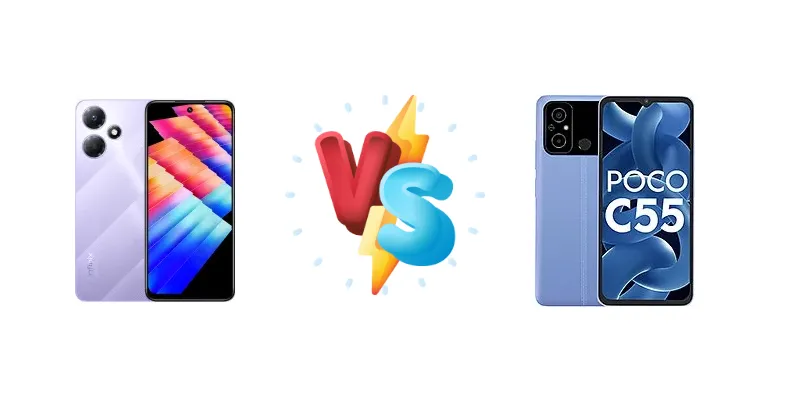
The sub-$150 smartphone market is fiercely competitive, and the Xiaomi Poco C55 and Infinix Hot 30 Play NFC are two contenders vying for dominance. Both aim to deliver essential features like NFC and decent performance at an accessible price point, but they take different approaches to achieving this. This comparison dissects their core components to determine which phone offers the best value for your money.
🏆 Quick Verdict
For users prioritizing gaming and overall responsiveness, the Xiaomi Poco C55 emerges as the better choice. Its Helio G85 chipset, featuring more powerful Cortex-A75 cores, provides a noticeable performance edge over the Infinix Hot 30 Play NFC’s Helio G37. While the Infinix boasts faster 18W charging, the Poco’s superior processing power makes it the winner for most users.
| Network |
|---|
| 2G bands | GSM 850 / 900 / 1800 / 1900 | GSM 850 / 900 / 1800 / 1900 |
| 3G bands | HSDPA 850 / 900 / 1700(AWS) / 1900 / 2100 | HSDPA 850 / 900 / 2100 |
| 4G bands | 1, 2, 3, 4, 5, 7, 8, 20, 28, 38, 40, 41 | 1, 3, 5, 8, 40, 41 |
| Speed | HSPA, LTE | HSPA, LTE |
| Technology | GSM / HSPA / LTE | GSM / HSPA / LTE |
| Launch |
|---|
| Announced | 2023, May 22 | 2023, February 21 |
| Status | Available. Released 2023, May 22 | Available. Released 2023, February 28 |
| Body |
|---|
| Build | Glass front, plastic frame, plastic back | Glass front (Panda Glass), eco leather back |
| Dimensions | 170.6 x 77.5 x 8.6 mm (6.72 x 3.05 x 0.34 in) | 168.8 x 76.4 x 8.8 mm (6.65 x 3.01 x 0.35 in) |
| SIM | Nano-SIM + Nano-SIM | Nano-SIM + Nano-SIM |
| Weight | 205 g (7.23 oz) | 192 g (6.77 oz) |
| | - | Dust and splash resistant |
| Display |
|---|
| Protection | - | Panda Glass |
| Resolution | 720 x 1640 pixels (~263 ppi density) | 720 x 1650 pixels (~268 ppi density) |
| Size | 6.82 inches, 110.5 cm2 (~83.5% screen-to-body ratio) | 6.71 inches, 106.5 cm2 (~82.6% screen-to-body ratio) |
| Type | IPS LCD, 90Hz, 500 nits (peak) | IPS LCD |
| Platform |
|---|
| CPU | Octa-core (4x2.3 GHz Cortex-A53 & 4x1.7 GHz Cortex-A53) | Octa-core (2x2.0 GHz Cortex-A75 & 6x1.8 GHz Cortex-A55) |
| Chipset | Mediatek MT6765 Helio G37 (12 nm) | Mediatek MT6769Z Helio G85 (12 nm) |
| GPU | PowerVR GE8320 | Mali-G52 MC2 |
| OS | Android 13, XOS 12.6 | Android 12, MIUI 13 for POCO |
| Memory |
|---|
| Card slot | microSDXC (dedicated slot) | microSDXC (dedicated slot) |
| Internal | 128GB 4GB RAM, 128GB 8GB RAM | 64GB 4GB RAM, 128GB 6GB RAM |
| | - | eMMC 5.1 |
| Main Camera |
|---|
| Dual | 16 MP, f/1.8, (wide), PDAF
Auxiliary lens | 50 MP, f/1.8, (wide), PDAF
0.08 MP (depth) |
| Features | Dual-LED flash, HDR, panorama | LED flash, HDR |
| Single | - | 50 MP, f/1.8, (wide), PDAF
Auxiliary lens |
| Video | 1080p@30fps | 1080p@30fps |
| Selfie camera |
|---|
| Features | Dual-LED flash, HDR | HDR |
| Single | 8 MP, f/2.0, (wide) | 5 MP |
| Video | 1080p@30fps | 1080p@30fps |
| Sound |
|---|
| 3.5mm jack | - | Yes |
| 35mm jack | Yes | Yes |
| Loudspeaker | Yes | Yes |
| Comms |
|---|
| Bluetooth | Yes | 5.0, A2DP, LE |
| NFC | Yes | No |
| Positioning | GPS | GPS, GLONASS, GALILEO, BDS, QZSS |
| Radio | FM radio | FM radio, recording |
| USB | USB Type-C 2.0, OTG | microUSB 2.0, OTG |
| WLAN | Wi-Fi 802.11 a/b/g/n/ac, dual-band, Wi-Fi Direct | Wi-Fi 802.11 a/b/g/n/ac, dual-band |
| Features |
|---|
| Sensors | Fingerprint (side-mounted), accelerometer, proximity, compass | Fingerprint (rear-mounted), accelerometer |
| | - | Virtual proximity sensing |
| Battery |
|---|
| Charging | 18W wired | 10W wired |
| Type | 6000 mAh | Li-Po 5000 mAh |
| Misc |
|---|
| Colors | Mirage Black, Blade White, Bora Purple | Cool Blue, Power Black, Forest Green |
| Models | X6835B, X6835 | 22127PC95I |
| Price | - | About 110 EUR |
| SAR | - | 0.87 W/kg (head) 0.77 W/kg (body) |
Infinix Hot 30 Play NFC
- Faster 18W charging for quicker top-ups
- Potentially longer battery life due to less powerful chipset
- NFC support for contactless payments
- Less powerful Helio G37 chipset for gaming and multitasking
- Older CPU architecture (Cortex-A53)
- Likely less refined software experience
Xiaomi Poco C55
- More powerful Helio G85 chipset for better performance
- More efficient CPU architecture (Cortex-A75)
- Xiaomi’s typically optimized software experience
- Slower 10W charging
- Potentially shorter battery life under heavy load
- May have more pre-installed bloatware
Display Comparison
Neither device is expected to excel in display quality, given their price bracket. Specifics like panel type (IPS vs. LCD) and resolution are not provided, but both likely feature 720p+ displays. The key difference lies elsewhere. The focus here is on the processing power needed to drive the display smoothly, rather than the display itself.
Camera Comparison
Without detailed sensor information, a direct camera comparison is difficult. However, it’s safe to assume both phones feature budget-oriented camera setups. The presence of a 2MP macro lens on both devices suggests limited utility; these sensors typically produce low-quality images. The primary sensor’s size and aperture will be the determining factors, but without that data, the Poco C55’s image processing algorithms, often refined by Xiaomi, may offer a slight advantage in image quality.
Performance
The Poco C55’s Mediatek Helio G85 chipset is the clear winner in this category. While both chips are built on a 12nm process, the G85’s CPU configuration – 2x2.0 GHz Cortex-A75 and 6x1.8 GHz Cortex-A55 – is significantly more capable than the Hot 30 Play NFC’s 4x2.3 GHz Cortex-A53 & 4x1.7 GHz Cortex-A53. The Cortex-A75 cores in the G85 offer substantially higher single-core performance, translating to snappier app launches and smoother multitasking. The G37 relies solely on less efficient Cortex-A53 cores. This architectural difference will be most noticeable during gaming and resource-intensive tasks.
Battery Life
The Infinix Hot 30 Play NFC’s 18W wired charging is a significant advantage over the Poco C55’s 10W charging. While battery capacity isn’t specified, the faster charging speed will result in quicker top-ups. However, the Poco C55’s more efficient chipset may offset some of this advantage by consuming less power during typical usage. The difference in charging speed will be most apparent for users who frequently need to recharge their phones throughout the day.
Buying Guide
Buy the Infinix Hot 30 Play NFC if you prioritize faster charging speeds and are a very casual smartphone user who primarily focuses on basic tasks like calls, messaging, and light social media. Buy the Xiaomi Poco C55 if you want a more responsive experience for gaming, multitasking, and demanding applications, even if it means sacrificing slightly slower charging.
Frequently Asked Questions
❓ Will the Poco C55 be able to run demanding games like PUBG Mobile smoothly?
The Helio G85 in the Poco C55 is capable of running PUBG Mobile at medium settings with reasonable frame rates. While it won't deliver a flagship-level gaming experience, it's significantly better equipped for gaming than the Infinix Hot 30 Play NFC’s Helio G37, which may struggle with consistent performance.
❓ How long will it take to fully charge the Infinix Hot 30 Play NFC with the 18W charger?
While a precise 0-100% charging time isn't available, the 18W charging should take approximately 2.5 to 3.5 hours, depending on usage during charging. This is considerably faster than the Poco C55’s 10W charging, which could take upwards of 4 hours.
❓ Does the Poco C55 have a dedicated microSD card slot for storage expansion?
Yes, the Poco C55 includes a dedicated microSD card slot, allowing you to expand the storage capacity beyond the internal storage options. This is a crucial feature for users who plan to store a large number of photos, videos, or apps.
❓ Is the difference in performance between the Helio G85 and Helio G37 noticeable in everyday tasks?
Yes, the difference is noticeable. While both phones can handle basic tasks, the Poco C55 with the Helio G85 will feel snappier when opening apps, switching between them, and browsing the web. The G37’s older architecture will result in occasional lag and slowdowns during multitasking.