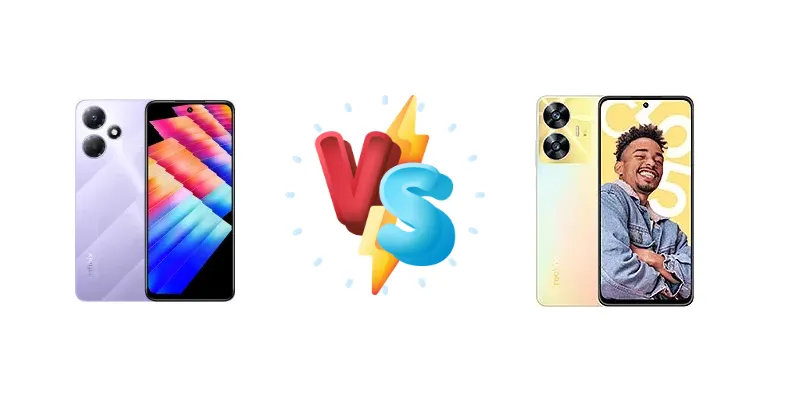
The sub-$200 smartphone market is fiercely competitive, and the Infinix Hot 30 Play NFC and Realme C55 are two strong contenders. Both aim to deliver essential features at an accessible price, but they take different approaches to achieving this. The Infinix prioritizes NFC connectivity and a focus on basic usability, while the Realme C55 emphasizes faster charging and a slightly more refined display experience. This comparison will dissect their key differences to determine which device offers the best value.
🏆 Quick Verdict
For the average user prioritizing fast charging and a slightly brighter display, the Realme C55 is the better choice. Its 33W charging significantly reduces downtime. However, users specifically needing NFC and a slightly more modern CPU architecture might lean towards the Infinix Hot 30 Play NFC.
| Network |
|---|
| 2G bands | GSM 850 / 900 / 1800 / 1900 | GSM 850 / 900 / 1800 / 1900 |
| 3G bands | HSDPA 850 / 900 / 1700(AWS) / 1900 / 2100 | HSDPA 850 / 900 / 2100 |
| 4G bands | 1, 2, 3, 4, 5, 7, 8, 20, 28, 38, 40, 41 | 1, 3, 5, 8, 38, 40, 41 |
| Speed | HSPA, LTE | HSPA, LTE |
| Technology | GSM / HSPA / LTE | GSM / HSPA / LTE |
| Launch |
|---|
| Announced | 2023, May 22 | 2023, March 07 |
| Status | Available. Released 2023, May 22 | Available. Released 2023, March 08 |
| Body |
|---|
| Build | Glass front, plastic frame, plastic back | Glass front, plastic frame, plastic back |
| Dimensions | 170.6 x 77.5 x 8.6 mm (6.72 x 3.05 x 0.34 in) | 165.6 x 75.9 x 7.9 mm (6.52 x 2.99 x 0.31 in) |
| SIM | Nano-SIM + Nano-SIM | Nano-SIM + Nano-SIM |
| Weight | 205 g (7.23 oz) | 189.5 g (6.70 oz) |
| Display |
|---|
| Resolution | 720 x 1640 pixels (~263 ppi density) | 1080 x 2400 pixels, 20:9 ratio (~392 ppi density) |
| Size | 6.82 inches, 110.5 cm2 (~83.5% screen-to-body ratio) | 6.72 inches, 109.0 cm2 (~86.7% screen-to-body ratio) |
| Type | IPS LCD, 90Hz, 500 nits (peak) | IPS LCD, 90Hz, 680 nits (peak) |
| Platform |
|---|
| CPU | Octa-core (4x2.3 GHz Cortex-A53 & 4x1.7 GHz Cortex-A53) | Octa-core (2x2.0 GHz Cortex-A75 & 6x1.8 GHz Cortex-A55) |
| Chipset | Mediatek MT6765 Helio G37 (12 nm) | Mediatek MT6769H Helio G88 (12 nm) |
| GPU | PowerVR GE8320 | Mali-G52 MC2 |
| OS | Android 13, XOS 12.6 | Android 13, Realme UI 4.0 |
| Memory |
|---|
| Card slot | microSDXC (dedicated slot) | microSDXC (dedicated slot) |
| Internal | 128GB 4GB RAM, 128GB 8GB RAM | 64GB 4GB RAM, 64GB 6GB RAM, 128GB 4GB RAM, 128GB 6GB RAM, 128GB 8GB RAM, 256GB 8GB RAM |
| Main Camera |
|---|
| Dual | 16 MP, f/1.8, (wide), PDAF
Auxiliary lens | 64 MP, (wide), 1/2.0", PDAF
Auxiliary lens |
| Features | Dual-LED flash, HDR, panorama | LED flash, HDR, panorama |
| Single | - | 8 MP, (wide) |
| Video | 1080p@30fps | 1080p@30/60fps |
| Selfie camera |
|---|
| Features | Dual-LED flash, HDR | HDR, panorama |
| Single | 8 MP, f/2.0, (wide) | 8 MP, (wide) |
| Video | 1080p@30fps | 1080p@30fps |
| Sound |
|---|
| 3.5mm jack | - | Yes |
| 35mm jack | Yes | Yes |
| Loudspeaker | Yes | Yes |
| Comms |
|---|
| Bluetooth | Yes | 5.2, A2DP, LE |
| NFC | Yes | Yes, 360˚ (market/region dependent) |
| Positioning | GPS | GPS, GLONASS, GALILEO, BDS |
| Radio | FM radio | No |
| USB | USB Type-C 2.0, OTG | USB Type-C 2.0 |
| WLAN | Wi-Fi 802.11 a/b/g/n/ac, dual-band, Wi-Fi Direct | Wi-Fi 802.11 a/b/g/n/ac, dual-band |
| Features |
|---|
| Sensors | Fingerprint (side-mounted), accelerometer, proximity, compass | Fingerprint (side-mounted), accelerometer, proximity, compass |
| Battery |
|---|
| Charging | 18W wired | 33W wired, 50% in 29 min |
| Type | 6000 mAh | 5000 mAh |
| Misc |
|---|
| Colors | Mirage Black, Blade White, Bora Purple | Sun Shower, Rainy Night, Rainforest |
| Models | X6835B, X6835 | RMX3710 |
| Price | - | ₹ 8,399 |
| Tests |
|---|
| Battery life | - |
Endurance rating 123h
|
| Camera | - |
Photo / Video |
| Display | - |
Contrast ratio: 1264:1 (nominal) |
| Loudspeaker | - |
-31.8 LUFS (Below average)
|
| Performance | - |
AnTuTu: 257263 (v9)
GeekBench: 1452 (v5.1), 1413 (v6)
GFXBench: 9fps (ES 3.1 onscreen) |
Infinix Hot 30 Play NFC
- Includes NFC for contactless payments and features.
- Slightly newer CPU architecture (Helio G37)
- Competitive price point
- Slower 18W charging
- Likely lower display brightness compared to Realme C55
- Less powerful chipset than the Realme C55
Realme C55
- Faster 33W charging with quick top-up times
- Brighter display (659 nits measured)
- More powerful Helio G88 chipset
- Lacks NFC connectivity
- Similar battery endurance to Infinix despite faster charging
- Camera performance likely similar to Infinix
Display Comparison
The Realme C55 boasts a measured peak brightness of 659 nits, offering superior visibility in bright sunlight compared to the Infinix Hot 30 Play NFC, which lacks published brightness data. Both displays share a 1264:1 contrast ratio, suggesting similar color depth and black levels. However, the Realme C55’s higher brightness is a tangible advantage for outdoor use. While both are likely LCD panels, the Realme’s brightness suggests a potentially higher quality panel overall. Bezels are comparable, and neither phone features a high refresh rate, focusing on power efficiency over visual fluidity.
Camera Comparison
Both devices list 'Photo / Video' capabilities, but lack specific details regarding sensor size or image processing. Given the price point, expectations should be tempered. The Realme C55 likely benefits from MediaTek’s ISP improvements in the Helio G88, potentially leading to slightly better image quality. The inclusion of a 2MP macro camera on both devices is largely a marketing tactic, offering limited practical benefit due to the small sensor size and lack of optical image stabilization (OIS). Real-world camera performance will likely be similar, with both phones performing adequately in good lighting conditions but struggling in low light.
Performance
The Realme C55’s Mediatek Helio G88 chipset represents a clear performance advantage over the Infinix Hot 30 Play NFC’s Helio G37. The G88 utilizes two Cortex-A75 cores clocked at 2.0 GHz alongside six Cortex-A55 cores at 1.8 GHz, a configuration that provides a noticeable boost in single-core and multi-core performance compared to the G37’s four Cortex-A53 cores at 2.3 GHz and four at 1.7 GHz. The A75 cores are architecturally superior, offering better instructions-per-clock (IPC). While the G37’s higher clock speed on the A53 cores might offer a slight edge in specific, highly-threaded tasks, the G88’s overall architecture is more efficient and responsive for everyday use and gaming. Both phones utilize a 12nm process, so thermal management will likely be similar, but the G88 will complete tasks faster, reducing sustained load.
Battery Life
Both the Infinix Hot 30 Play NFC and Realme C55 achieve an endurance rating of 123 hours, suggesting comparable battery life under similar usage patterns. However, the Realme C55’s 33W wired charging is a significant advantage, achieving 50% charge in just 29 minutes. The Infinix Hot 30 Play NFC is limited to 18W charging, resulting in a considerably longer charging time. This difference in charging speed translates to a more convenient user experience, especially for those who frequently need to top up their battery.
Buying Guide
Buy the Infinix Hot 30 Play NFC if you absolutely require NFC for mobile payments or digital key access and value a CPU architecture that, while not significantly faster, is a generation newer. Buy the Realme C55 if you prioritize minimizing charging times and appreciate a display with a measured peak brightness of 659 nits, making it more usable outdoors. Both phones are excellent choices for basic smartphone tasks, but their strengths cater to different user needs.
Frequently Asked Questions
❓ Does the Realme C55's Helio G88 chipset struggle with demanding games like PUBG Mobile?
While the Helio G88 isn't a flagship gaming chip, it's capable of running PUBG Mobile at medium settings with a stable frame rate. Expect some frame drops during intense firefights, but it's generally playable. Optimizing in-game settings is crucial for a smooth experience.
❓ Is the 18W charging on the Infinix Hot 30 Play NFC noticeably slow compared to the Realme C55's 33W?
Yes, the difference is significant. The Realme C55 can reach 50% charge in approximately 29 minutes, while the Infinix Hot 30 Play NFC will take considerably longer – likely over an hour – to achieve the same level. This makes the Realme C55 much more convenient for users who need a quick power boost.
❓ How important is NFC on the Infinix Hot 30 Play NFC, and what can it be used for?
NFC (Near Field Communication) allows for contactless payments via services like Google Pay, and can also be used for features like quickly pairing with Bluetooth devices and digital car keys (if supported by your vehicle). If you frequently use mobile payments or anticipate needing these features, the Infinix Hot 30 Play NFC is a strong choice.
❓ Are the 2MP macro cameras on either phone worth using?
Generally, no. 2MP macro cameras typically produce images with limited detail and sharpness. They are often included as a marketing feature but offer little practical benefit compared to using the main camera in standard photo mode.