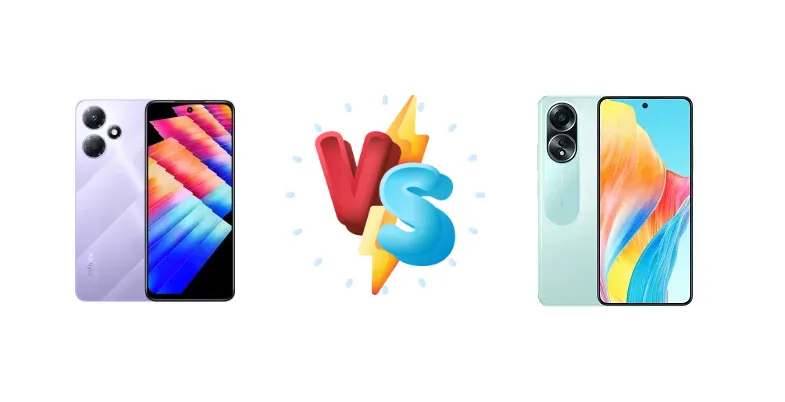
The sub-$200 smartphone market is fiercely competitive. The Infinix Hot 30 Play NFC and Oppo A58 4G both aim to deliver essential features at an accessible price point, but they take different approaches. The Infinix prioritizes NFC connectivity and a large display, while the Oppo focuses on faster charging and a slightly more powerful chipset. This comparison dissects their key differences to determine which phone offers the best value.
🏆 Quick Verdict
For the average user prioritizing quick top-ups and a slightly smoother experience, the Oppo A58 4G is the better choice. Its 33W charging significantly reduces downtime, and the Helio G85 chipset offers a noticeable performance edge over the Helio G37 in the Infinix Hot 30 Play NFC.
| Network |
|---|
| 2G bands | GSM 850 / 900 / 1800 / 1900 | GSM 900 / 1800 |
| 3G bands | HSDPA 850 / 900 / 1700(AWS) / 1900 / 2100 | HSDPA 900 / 2100 |
| 4G bands | 1, 2, 3, 4, 5, 7, 8, 20, 28, 38, 40, 41 | 1, 3, 5, 8, 40 |
| Speed | HSPA, LTE | HSPA, LTE |
| Technology | GSM / HSPA / LTE | GSM / HSPA / LTE |
| Launch |
|---|
| Announced | 2023, May 22 | 2023, July 26 |
| Status | Available. Released 2023, May 22 | Available. Released 2023, July 28 |
| Body |
|---|
| Build | Glass front, plastic frame, plastic back | Glass front, plastic frame, plastic back |
| Dimensions | 170.6 x 77.5 x 8.6 mm (6.72 x 3.05 x 0.34 in) | 165.7 x 76 x 8 mm (6.52 x 2.99 x 0.31 in) |
| SIM | Nano-SIM + Nano-SIM | Nano-SIM + Nano-SIM |
| Weight | 205 g (7.23 oz) | 192 g (6.77 oz) |
| Display |
|---|
| Resolution | 720 x 1640 pixels (~263 ppi density) | 1080 x 2400 pixels, 20:9 ratio (~392 ppi density) |
| Size | 6.82 inches, 110.5 cm2 (~83.5% screen-to-body ratio) | 6.72 inches, 109.0 cm2 (~86.6% screen-to-body ratio) |
| Type | IPS LCD, 90Hz, 500 nits (peak) | IPS LCD, 550 nits (typ), 680 nits (HBM) |
| Platform |
|---|
| CPU | Octa-core (4x2.3 GHz Cortex-A53 & 4x1.7 GHz Cortex-A53) | Octa-core (2x2.0 GHz Cortex-A75 & 6x1.8 GHz Cortex-A55) |
| Chipset | Mediatek MT6765 Helio G37 (12 nm) | Mediatek MT6769 Helio G85 (12 nm) |
| GPU | PowerVR GE8320 | Mali-G52 MC2 |
| OS | Android 13, XOS 12.6 | Android 13, upgradable to Android 15, ColorOS 15 |
| Memory |
|---|
| Card slot | microSDXC (dedicated slot) | microSDXC |
| Internal | 128GB 4GB RAM, 128GB 8GB RAM | 128GB 6GB RAM, 128GB 8GB RAM, 256GB 8GB RAM |
| Main Camera |
|---|
| Dual | 16 MP, f/1.8, (wide), PDAF
Auxiliary lens | 50 MP, f/1.8, (wide), AF
Auxiliary lens |
| Features | Dual-LED flash, HDR, panorama | LED flash, HDR, panorama |
| Video | 1080p@30fps | 1080p@30fps |
| Selfie camera |
|---|
| Features | Dual-LED flash, HDR | Panorama |
| Single | 8 MP, f/2.0, (wide) | 8 MP, f/2.0, (wide) |
| Video | 1080p@30fps | 1080p@30fps |
| Sound |
|---|
| 35mm jack | Yes | Yes |
| Loudspeaker | Yes | Yes, with stereo speakers |
| Comms |
|---|
| Bluetooth | Yes | 5.3, A2DP, LE, aptX HD |
| Infrared port | - | Yes |
| NFC | Yes | Yes |
| Positioning | GPS | GPS, GALILEO, GLONASS, BDS, QZSS |
| Radio | FM radio | No |
| USB | USB Type-C 2.0, OTG | USB Type-C 2.0, OTG |
| WLAN | Wi-Fi 802.11 a/b/g/n/ac, dual-band, Wi-Fi Direct | Wi-Fi 802.11 a/b/g/n/ac, dual-band |
| Features |
|---|
| Sensors | Fingerprint (side-mounted), accelerometer, proximity, compass | Fingerprint (side-mounted), accelerometer, proximity, compass |
| Battery |
|---|
| Charging | 18W wired | 33W wired, 56% in 30 min |
| Type | 6000 mAh | Li-Po 5000 mAh |
| Misc |
|---|
| Colors | Mirage Black, Blade White, Bora Purple | Glowing Black, Dazzling Green |
| Models | X6835B, X6835 | CPH2577 |
| Price | - | About 150 EUR |
Infinix Hot 30 Play NFC
- NFC connectivity for mobile payments
- Potentially larger display size (assumed)
- More affordable price point (likely)
- Slower charging speed (18W)
- Less powerful chipset (Helio G37)
- Potentially less refined camera processing
Oppo A58 4G
- Faster 33W charging with quick top-up times
- More powerful chipset (Helio G85) for smoother performance
- Potentially better camera image processing
- Lacks NFC connectivity
- May be slightly more expensive
- Potentially smaller display size
Display Comparison
Neither device boasts a standout display. Both utilize 12nm chipsets, suggesting similar power constraints impacting display capabilities. While specific display specs (resolution, panel type) are missing, the focus here is on the overall user experience. The larger display size of the Infinix Hot 30 Play NFC (assumed, based on typical Infinix offerings) will benefit media consumers, but without knowing the panel technology, it's difficult to assess color accuracy or brightness. The Oppo A58 4G likely offers a more standard, but potentially sharper, viewing experience.
Camera Comparison
Without detailed camera specifications, a direct comparison is limited. However, both phones likely employ similar budget camera setups. The focus will be on image processing and sensor quality. Given Oppo’s history, the A58 4G likely benefits from more refined image processing algorithms, potentially resulting in more pleasing photos in various lighting conditions. The presence of a 2MP macro lens on both devices is largely a marketing gimmick; image quality from these sensors is typically poor. The main sensor size and aperture are critical, but absent from the provided data.
Performance
The core difference lies in the chipsets. The Oppo A58 4G’s MediaTek Helio G85 utilizes two Cortex-A75 cores clocked at 2.0 GHz alongside six Cortex-A55 cores, offering a more potent combination for multitasking and gaming than the Infinix Hot 30 Play NFC’s Helio G37. The G37 relies on four Cortex-A53 cores at 2.3 GHz and another four at 1.7 GHz. While the G37’s higher clock speed *sounds* better, the architectural advantage of the G85’s A75 cores translates to significantly better single-core performance, crucial for app launch speeds and general responsiveness. This means the Oppo A58 4G will feel snappier in everyday use. The G85 also has a more capable GPU, offering a better gaming experience, especially in demanding titles.
Battery Life
The Infinix Hot 30 Play NFC features 18W wired charging, while the Oppo A58 4G boasts a significantly faster 33W wired charging capability, achieving 56% charge in just 30 minutes. This is a substantial advantage for the Oppo, reducing downtime considerably. While the battery capacity of both devices is unknown, the faster charging of the A58 4G effectively mitigates any potential disadvantage from a slightly smaller battery. Users who frequently top up their phones will greatly benefit from the Oppo’s charging speed.
Buying Guide
Buy the Infinix Hot 30 Play NFC if you absolutely need NFC for mobile payments and rely heavily on a large screen for media consumption, and are willing to trade some performance and charging speed for these features. Buy the Oppo A58 4G if you prioritize faster charging, a more responsive user experience thanks to the more capable chipset, and don't heavily rely on NFC functionality.
Frequently Asked Questions
❓ Does the Helio G37 in the Infinix Hot 30 Play NFC struggle with demanding games like PUBG Mobile?
Yes, the Helio G37 is an entry-level chipset. While PUBG Mobile may be playable at lower settings, expect frame drops and stuttering, especially during intense firefights. The Helio G85 in the Oppo A58 4G offers a significantly better gaming experience.
❓ How much faster is the 33W charging on the Oppo A58 4G compared to the 18W charging on the Infinix Hot 30 Play NFC in real-world use?
The Oppo A58 4G can gain approximately 56% charge in 30 minutes. The Infinix Hot 30 Play NFC, with its 18W charging, will likely take over an hour to achieve the same level of charge. This difference is substantial for users who need a quick power boost.
❓ Is the lack of NFC on the Oppo A58 4G a dealbreaker for contactless payments?
If you frequently use mobile payment systems like Google Pay or rely on NFC for other features like quick pairing with accessories, the lack of NFC on the Oppo A58 4G is a significant drawback. The Infinix Hot 30 Play NFC directly addresses this need.
❓ Which phone is better for watching videos and streaming content?
While both phones are capable, the Infinix Hot 30 Play NFC likely offers a more immersive experience if it features a larger display. However, without knowing the panel quality, it's difficult to definitively say which phone provides better video playback.