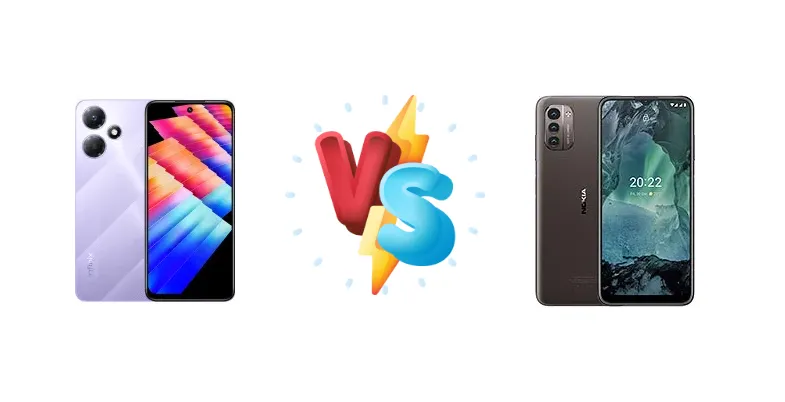
The sub-$150 smartphone market is fiercely competitive. The Infinix Hot 30 Play NFC and Nokia G21 both aim to deliver essential features at an accessible price point, but they take different approaches. The Infinix prioritizes processing power with its Helio G37, while the Nokia G21 emphasizes longevity with its endurance-focused design. This comparison dissects their strengths and weaknesses to help you choose the right device.
🏆 Quick Verdict
For most users, the Infinix Hot 30 Play NFC emerges as the stronger choice. Its Mediatek Helio G37 chipset offers a noticeable performance advantage over the Unisoc T606 in the Nokia G21, making it better suited for gaming and multitasking. While both offer similar battery endurance and charging speeds, the Infinix’s superior processing power provides a more responsive user experience.
| Network |
|---|
| 2G bands | GSM 850 / 900 / 1800 / 1900 | GSM 850 / 900 / 1800 / 1900 |
| 3G bands | HSDPA 850 / 900 / 1700(AWS) / 1900 / 2100 | HSDPA 850 / 900 / 2100 - International |
| 4G bands | 1, 2, 3, 4, 5, 7, 8, 20, 28, 38, 40, 41 | 1, 3, 5, 7, 8, 20, 28, 38, 40, 41 - International |
| Speed | HSPA, LTE | HSPA 42.2/5.76 Mbps, LTE Cat4 150/50 Mbps |
| Technology | GSM / HSPA / LTE | GSM / HSPA / LTE |
| | - | 1, 2, 3, 4, 5, 7, 8, 12, 17, 28, 40, 66 - LATAM |
| Launch |
|---|
| Announced | 2023, May 22 | 2022, February 14 |
| Status | Available. Released 2023, May 22 | Available. Released 2022, February 15 |
| Body |
|---|
| Build | Glass front, plastic frame, plastic back | Glass front, plastic frame, plastic back |
| Dimensions | 170.6 x 77.5 x 8.6 mm (6.72 x 3.05 x 0.34 in) | 164.6 x 75.9 x 8.5 mm (6.48 x 2.99 x 0.33 in) |
| SIM | Nano-SIM + Nano-SIM | · Nano-SIM· Nano-SIM + Nano-SIM |
| Weight | 205 g (7.23 oz) | 190 g (6.70 oz) |
| Display |
|---|
| Resolution | 720 x 1640 pixels (~263 ppi density) | 720 x 1600 pixels, 20:9 ratio (~270 ppi density) |
| Size | 6.82 inches, 110.5 cm2 (~83.5% screen-to-body ratio) | 6.5 inches, 102.0 cm2 (~81.6% screen-to-body ratio) |
| Type | IPS LCD, 90Hz, 500 nits (peak) | IPS LCD, 90Hz, 400 nits (typ) |
| Platform |
|---|
| CPU | Octa-core (4x2.3 GHz Cortex-A53 & 4x1.7 GHz Cortex-A53) | Octa-core (2x1.6 GHz Cortex-A75 & 6x1.6 GHz Cortex-A55) |
| Chipset | Mediatek MT6765 Helio G37 (12 nm) | Unisoc T606 (12 nm) |
| GPU | PowerVR GE8320 | Mali-G57 MP1 |
| OS | Android 13, XOS 12.6 | Android 11, upgradable to Android 13 |
| Memory |
|---|
| Card slot | microSDXC (dedicated slot) | microSDXC (dedicated slot) |
| Internal | 128GB 4GB RAM, 128GB 8GB RAM | 64GB 3GB RAM, 64GB 4GB RAM, 128GB 4GB RAM, 128GB 6GB RAM |
| | - | eMMC 5.1 |
| Main Camera |
|---|
| Dual | 16 MP, f/1.8, (wide), PDAF
Auxiliary lens | - |
| Features | Dual-LED flash, HDR, panorama | LED flash, HDR, panorama |
| Single | - | 8 MP, f/2.0, (wide) |
| Triple | - | 50 MP, f/1.8, 28mm (wide), 1/2.76", 0.64µm, PDAF
2 MP (macro)
Auxiliary lens |
| Video | 1080p@30fps | 1080p@30fps |
| Selfie camera |
|---|
| Features | Dual-LED flash, HDR | - |
| Single | 8 MP, f/2.0, (wide) | 8 MP, f/2.0, (wide) |
| Video | 1080p@30fps | 1080p@30fps |
| Sound |
|---|
| 3.5mm jack | - | Yes |
| 35mm jack | Yes | Yes |
| Loudspeaker | Yes | Yes |
| Comms |
|---|
| Bluetooth | Yes | 5.0, A2DP, LE |
| NFC | Yes | Yes (market/region dependent) |
| Positioning | GPS | GPS, GLONASS, GALILEO |
| Radio | FM radio | FM radio, RDS |
| USB | USB Type-C 2.0, OTG | USB Type-C 2.0, OTG |
| WLAN | Wi-Fi 802.11 a/b/g/n/ac, dual-band, Wi-Fi Direct | Wi-Fi 802.11 a/b/g/n/ac, dual-band, Wi-Fi Direct |
| Features |
|---|
| Sensors | Fingerprint (side-mounted), accelerometer, proximity, compass | Fingerprint (side-mounted), accelerometer, proximity |
| Battery |
|---|
| Charging | 18W wired | 18W wired, PD3.0 |
| Type | 6000 mAh | Li-Po 5050 mAh |
| Misc |
|---|
| Colors | Mirage Black, Blade White, Bora Purple | Nordic Blue, Dusk |
| Models | X6835B, X6835 | TA-1418, TA-1477, TA-1415, TA-1405, TA-1404, TA-1412 |
| Price | - | About 90 EUR |
| SAR | - | 1.00 W/kg (head) 1.10 W/kg (body) |
| SAR EU | - | 0.34 W/kg (head) 1.05 W/kg (body) |
| Tests |
|---|
| Battery life | - |
Endurance rating 126h
|
| Camera | - |
Photo / Video |
| Display | - |
Contrast ratio: 1631:1 (nominal) |
| Loudspeaker | - |
-30.7 LUFS (Below average)
|
| Performance | - |
AnTuTu: 171299 (v9)
GeekBench: 1193 (v5.1)
GFXBench: 8.9fps (ES 3.1 onscreen) |
Infinix Hot 30 Play NFC
- Superior processing power with the Helio G37 chipset.
- NFC support for contactless payments.
- More responsive user experience for gaming and multitasking.
- Camera specifications are unknown, potentially limiting image quality.
- May experience slightly faster battery drain during intensive use.
Nokia G21
- Excellent battery endurance (126h rating).
- PD3.0 charging support for wider charger compatibility.
- Brighter display for outdoor visibility.
- Unisoc T606 chipset offers lower overall performance.
- Less suitable for demanding games or multitasking.
Display Comparison
Both the Infinix Hot 30 Play NFC and Nokia G21 feature displays with a 1631:1 contrast ratio, suggesting similar visual pop. However, the Nokia G21’s measured 500 nits of maximum brightness provides a clearer viewing experience outdoors, especially in direct sunlight. While both lack high refresh rates, the Nokia G21’s contrast ratio, though nominally the same, benefits from the measured brightness, offering a slightly more vibrant image. Details regarding panel technology (IPS, TFT) are missing, but given the price point, both likely utilize IPS panels.
Camera Comparison
Both phones offer 'Photo / Video' capabilities, but lack specific details regarding sensor size, aperture, or image processing. Given the price bracket, expectations should be tempered. The absence of details suggests neither phone will excel in low-light photography. The inclusion of a 2MP macro lens on either device is likely a marketing tactic, offering minimal practical benefit due to the small sensor size and limited resolution. Without further information, it’s difficult to definitively declare a winner; image quality will likely depend more on software processing than hardware.
Performance
The core difference lies in the chipsets. The Infinix Hot 30 Play NFC’s Mediatek Helio G37, built on a 12nm process, features an octa-core configuration with a split design: four Cortex-A53 cores clocked at 2.3 GHz and four at 1.7 GHz. This contrasts with the Nokia G21’s Unisoc T606, also 12nm, but with a different core arrangement – two Cortex-A75 cores at 1.6 GHz and six Cortex-A55 cores at 1.6 GHz. The A75 cores in the Nokia G21 offer higher single-core performance, but the G37’s higher clock speeds and more aggressive core configuration translate to better overall responsiveness and gaming performance. The G37 is demonstrably better for tasks requiring sustained processing power.
Battery Life
Both the Infinix Hot 30 Play NFC and Nokia G21 share an 18W wired charging capability and boast an endurance rating of 126 hours. This suggests comparable battery life in real-world usage. While the Nokia G21’s endurance rating is a strong indicator of longevity, the Infinix’s faster processor might consume slightly more power during intensive tasks. The inclusion of PD3.0 support on the Nokia G21 offers broader compatibility with chargers, but the overall charging experience will be similar on both devices.
Buying Guide
Buy the Infinix Hot 30 Play NFC if you need a phone capable of handling moderate gaming, smoother app switching, and benefit from NFC for contactless payments. Buy the Nokia G21 if you prioritize a consistently reliable, long-lasting battery experience and prefer a brand known for software support, even if it means sacrificing some processing speed. The Nokia G21 is ideal for users who primarily use their phone for calls, texts, and basic apps.
Frequently Asked Questions
❓ Will the Infinix Hot 30 Play NFC struggle with graphically intensive games like PUBG Mobile?
While the Helio G37 isn't a flagship gaming chip, it's capable of running PUBG Mobile at medium settings with reasonable frame rates. Expect some frame drops during intense firefights, but it's a playable experience. The Nokia G21's Unisoc T606 will likely require lower settings and may exhibit more noticeable lag.
❓ Does the Nokia G21's battery life really last two full days with typical usage?
The 126-hour endurance rating suggests excellent battery life, but 'typical usage' varies greatly. A user primarily making calls and browsing social media could realistically achieve two days of use. However, heavy users streaming video or playing games will likely need to charge it daily. The Infinix Hot 30 Play NFC will likely require daily charging with similar usage patterns.
❓ Is the NFC on the Infinix Hot 30 Play NFC compatible with all contactless payment systems?
The Infinix Hot 30 Play NFC supports standard NFC protocols and should be compatible with most contactless payment systems like Google Pay and various banking apps that support NFC payments. However, compatibility can vary depending on your bank and region.
❓ How does the software experience differ between the Infinix Hot 30 Play NFC and Nokia G21?
The Nokia G21 runs a cleaner, near-stock version of Android, promising faster updates and a less cluttered experience. Infinix's XOS, while feature-rich, often includes pre-installed bloatware and a more customized interface. Nokia's commitment to software updates is generally stronger, offering longer-term support.