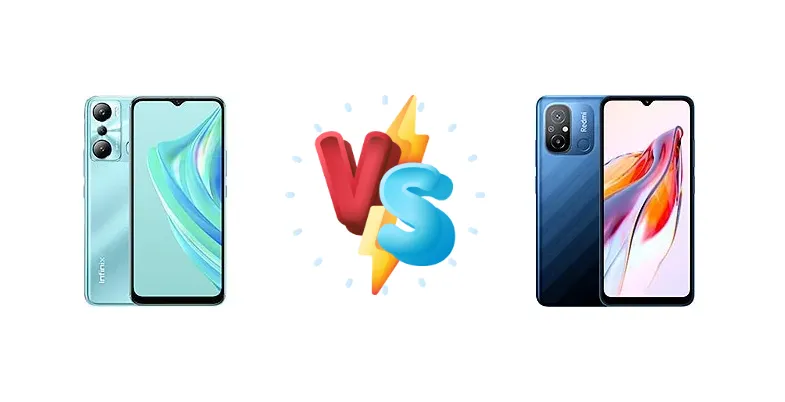
The budget smartphone market is fiercely competitive, offering incredible value for money. Two contenders vying for your attention are the Infinix Hot 20i and the Xiaomi Redmi 12C. Both promise a lot, but which one delivers the best overall experience?
🏆 Quick Verdict
The Xiaomi Redmi 12C takes the crown thanks to its significantly more powerful Helio G85 chipset, resulting in smoother performance and a better user experience. While the Infinix Hot 20i offers reverse charging, the Redmi 12C's superior processing power makes it the better choice for most users.
| Network |
|---|
| 2G bands | GSM 850 / 900 / 1800 / 1900 | GSM 850 / 900 / 1800 / 1900 |
| 3G bands | HSDPA 900 / 2100 | HSDPA 850 / 900 / 2100 |
| 4G bands | 1, 3, 7, 8, 20 | 1, 3, 5, 7, 8, 20, 28, 38, 40, 41 - International |
| Speed | HSPA, LTE | HSPA, LTE |
| Technology | GSM / HSPA / LTE | GSM / CDMA / HSPA / EVDO / LTE |
| | - | CDMA2000 1xEV-DO |
| Launch |
|---|
| Announced | 2022, September 28 | 2022, December 31 |
| Status | Available. Released 2022, September 28 | Available. Released 2023, January 01 |
| Body |
|---|
| Build | Glass front, plastic back, plastic frame | - |
| Dimensions | 164.8 x 76.4 x 8.8 mm (6.49 x 3.01 x 0.35 in) | 168.8 x 76.4 x 8.8 mm (6.65 x 3.01 x 0.35 in) |
| SIM | Nano-SIM + Nano-SIM | Nano-SIM + Nano-SIM |
| Weight | 195 g (6.88 oz) | 192 g (6.77 oz) |
| Display |
|---|
| Resolution | 720 x 1612 pixels, 20:9 ratio (~267 ppi density) | 720 x 1650 pixels (~268 ppi density) |
| Size | 6.6 inches, 104.6 cm2 (~83.1% screen-to-body ratio) | 6.71 inches, 106.5 cm2 (~82.6% screen-to-body ratio) |
| Type | IPS LCD, 500 nits (peak) | IPS LCD, 500 nits (typ) |
| Platform |
|---|
| CPU | Octa-core (4x2.0 GHz Cortex-A53 & 4x1.5 GHz Cortex-A53) / Quad-core 2.0 GHz Cortex-A53 | Octa-core (2x2.0 GHz Cortex-A75 & 6x1.8 GHz Cortex-A55) |
| Chipset | Mediatek MT6762G Helio G25 (12 nm) / Mediatek MT6761 Helio A22 (12 nm) | Mediatek MT6769Z Helio G85 (12 nm) |
| GPU | PowerVR GE8320 | Mali-G52 MC2 |
| OS | Android 12 or Android 12 (Go edition), XOS 10.6 | Android 12, MIUI 13 |
| Memory |
|---|
| Card slot | microSDXC (dedicated slot) | microSDXC (dedicated slot) |
| Internal | 64GB 2GB RAM, 64GB 3GB RAM, 64GB 4GB RAM, 128GB 4GB RAM, 128GB 6GB RAM | 32GB 2GB RAM, 32GB 3GB RAM, 32GB 4GB RAM, 64GB 3GB RAM, 64GB 4GB RAM, 128GB 3GB RAM, 128GB 4GB RAM, 128GB 6GB RAM |
| | - | eMMC 5.1 |
| Main Camera |
|---|
| Dual | - | 50 MP, (wide), PDAF
0.08 MP (depth) |
| Features | Dual-LED flash | LED flash, HDR |
| Single | 8 MP | 50 MP, f/1.8, (wide), 1/2.76", PDAF
Auxiliary lens |
| Triple | 13 MP, f/1.8, (wide), AF
Auxiliary lenses | - |
| Video | 1080p@30fps | 1080p@30fps |
| Selfie camera |
|---|
| Features | LED flash | - |
| Single | 8 MP | 5 MP, f/2.2, (wide) |
| Video | 1080p@30fps | 1080p@30fps |
| Sound |
|---|
| 3.5mm jack | Yes | Yes |
| 35mm jack | Yes | Yes |
| Loudspeaker | Yes | Yes |
| Comms |
|---|
| Bluetooth | Yes | 5.1, A2DP, LE |
| NFC | No | Yes (market/region dependent) |
| Positioning | GPS | GPS, GLONASS, BDS, GALILEO |
| Radio | FM radio | FM radio |
| USB | microUSB 2.0, OTG | microUSB 2.0 |
| WLAN | Wi-Fi 802.11 a/b/g/n/ac, dual-band | Wi-Fi 802.11 a/b/g/n/ac, dual-band, Wi-Fi Direct |
| Features |
|---|
| Sensors | Fingerprint (rear-mounted), accelerometer, proximity | Fingerprint (rear-mounted), accelerometer |
| | - | Virtual proximity sensing |
| Battery |
|---|
| Charging | 10W wired
5W reverse wired | 10W wired |
| Type | Li-Ion 5000 mAh | Li-Po 5000 mAh |
| Misc |
|---|
| Colors | Wilderness Black, Luna Blue, Energy Green, Sunset Gold | Graphite Gray, Ocean Blue, Mint Green, Lavender Purple |
| Models | X665C, X665E | 22120RN86G, 22120RN86I, 22126RN91Y, 2212ARNC4L |
| Price | About 120 EUR | £ 132.99 / € 107.41 |
| SAR | - | 1.08 W/kg (head) 0.64 W/kg (body) |
| SAR EU | - | 0.98 W/kg (head) 0.99 W/kg (body) |
Infinix Hot 20i
- Reverse wired charging
- Large display
- Decent battery life
- Weaker processor
- Potentially slower performance
- Less refined software experience
Xiaomi Redmi 12C
- More powerful processor (Helio G85)
- Smoother performance
- Better gaming experience
- Generally better software support
- No reverse charging
- Basic camera features
Display Comparison
Both phones feature large 6.6-inch displays, likely with HD+ resolution. Expect decent viewing angles and color reproduction for the price point, but don't anticipate flagship-level quality. The Redmi 12C might have slightly better brightness due to its newer panel, but this is not definitively confirmed.
Camera Comparison
Camera specs are similar on paper, with both offering multiple rear lenses including a primary sensor. However, the Redmi 12C's more powerful processor likely contributes to better image processing, resulting in slightly better photos, especially in low light. Expect decent image quality for social media sharing on both devices.
Performance
This is where the Redmi 12C shines. The Helio G85 chipset is a substantial upgrade over the Hot 20i's Helio G25/A22. Expect noticeably faster app loading times, smoother scrolling, and better gaming performance on the Redmi 12C. The Hot 20i will handle basic tasks adequately, but will struggle with more demanding applications.
Battery Life
Both phones feature large batteries (likely around 5000mAh). While the Hot 20i *might* offer marginally longer battery life due to the less demanding chipset, the difference will be minimal in real-world usage. The Redmi 12C's efficient processor also contributes to good battery performance.
Buying Guide
The Infinix Hot 20i is a good option for users prioritizing reverse charging and potentially slightly longer battery life (though this is marginal). The Xiaomi Redmi 12C is ideal for those seeking a smoother, more responsive experience for everyday tasks, gaming, and multitasking.
Frequently Asked Questions
❓ Which phone is better for gaming?
The Xiaomi Redmi 12C is significantly better for gaming due to its more powerful Helio G85 chipset. The Infinix Hot 20i will struggle with more demanding games.
❓ Does the Infinix Hot 20i have reverse charging?
Yes, the Infinix Hot 20i supports 5W reverse wired charging, allowing you to charge other devices using the phone's battery.
❓ Which phone has better software support?
Xiaomi generally provides better and more frequent software updates than Infinix, so the Redmi 12C is likely to receive updates for a longer period.