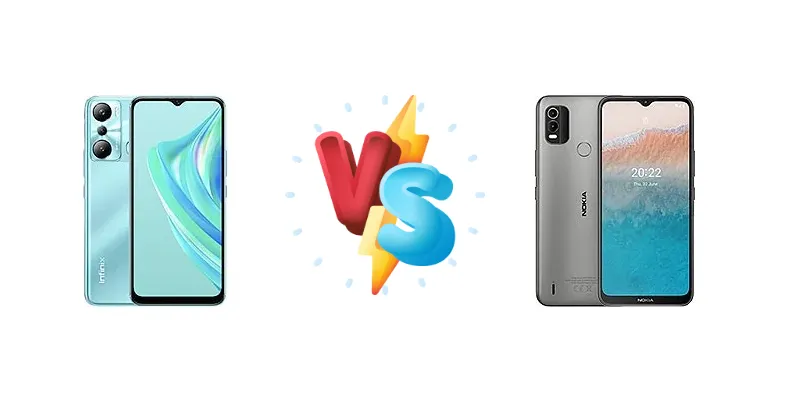
The Infinix Hot 20i and Nokia C21 Plus represent the extreme end of the smartphone price spectrum. Both aim to deliver essential smartphone functionality at a minimal cost, but they take different approaches to achieving this. The Hot 20i offers a potentially faster processor with Mediatek's Helio G25, while the C21 Plus relies on Unisoc's SC9863A, prioritizing efficiency. This comparison dives deep into the specifics to determine which device offers the best value.
🏆 Quick Verdict
For most users, the Infinix Hot 20i emerges as the stronger choice. While both phones are firmly in the entry-level category, the Hot 20i’s Helio G25 chipset (in its higher-end configuration) provides a noticeable performance advantage for everyday tasks and light gaming, justifying its position as the better all-rounder.
| Network |
|---|
| 2G bands | GSM 850 / 900 / 1800 / 1900 | GSM 850 / 900 / 1800 / 1900 |
| 3G bands | HSDPA 900 / 2100 | HSDPA 850 / 900 / 2100 |
| 4G bands | 1, 3, 7, 8, 20 | LTE |
| Speed | HSPA, LTE | HSPA 42.2/5.76 Mbps, LTE Cat4 150/50 Mbps |
| Technology | GSM / HSPA / LTE | GSM / HSPA / LTE |
| | - | HSDPA 850 / 900 / 1700(AWS) / 1900 / 2100 |
| Launch |
|---|
| Announced | 2022, September 28 | 2022, February 28 |
| Status | Available. Released 2022, September 28 | Available. Released 2022, April 29 |
| Body |
|---|
| Build | Glass front, plastic back, plastic frame | Glass front, aluminum frame, plastic back |
| Dimensions | 164.8 x 76.4 x 8.8 mm (6.49 x 3.01 x 0.35 in) | 164.8 x 75.9 x 8.6 mm (6.49 x 2.99 x 0.34 in) |
| SIM | Nano-SIM + Nano-SIM | · Nano-SIM· Nano-SIM + Nano-SIM |
| Weight | 195 g (6.88 oz) | 178 g or 191 g (6.28 oz) |
| | - | Splash protection |
| Display |
|---|
| Protection | - | Scratch-resistant glass |
| Resolution | 720 x 1612 pixels, 20:9 ratio (~267 ppi density) | 720 x 1600 pixels, 20:9 ratio (~269 ppi density) |
| Size | 6.6 inches, 104.6 cm2 (~83.1% screen-to-body ratio) | 6.52 inches, 102.6 cm2 (~82.1% screen-to-body ratio) |
| Type | IPS LCD, 500 nits (peak) | IPS LCD |
| Platform |
|---|
| CPU | Octa-core (4x2.0 GHz Cortex-A53 & 4x1.5 GHz Cortex-A53) / Quad-core 2.0 GHz Cortex-A53 | Octa-core (4x1.6 GHz Cortex-A55 & 4x1.2 GHz Cortex-A55) |
| Chipset | Mediatek MT6762G Helio G25 (12 nm) / Mediatek MT6761 Helio A22 (12 nm) | Unisoc SC9863A (28 nm) |
| GPU | PowerVR GE8320 | IMG8322 |
| OS | Android 12 or Android 12 (Go edition), XOS 10.6 | Android 11 (Go edition) |
| Memory |
|---|
| Card slot | microSDXC (dedicated slot) | microSDXC (dedicated slot) |
| Internal | 64GB 2GB RAM, 64GB 3GB RAM, 64GB 4GB RAM, 128GB 4GB RAM, 128GB 6GB RAM | 32GB 2GB RAM, 32GB 3GB RAM, 64GB 2GB RAM, 64GB 3GB RAM, 64GB 4GB RAM |
| | - | eMMC 5.1 |
| Main Camera |
|---|
| Dual | - | 13 MP, (wide), AF
Auxiliary lens |
| Features | Dual-LED flash | LED flash, HDR, panorama |
| Single | 8 MP | 5 MP |
| Triple | 13 MP, f/1.8, (wide), AF
Auxiliary lenses | - |
| Video | 1080p@30fps | 1080p@30fps |
| Selfie camera |
|---|
| Features | LED flash | LED flash |
| Single | 8 MP | 5 MP |
| Video | 1080p@30fps | 720p |
| Sound |
|---|
| 3.5mm jack | Yes | Yes |
| 35mm jack | Yes | Yes |
| Loudspeaker | Yes | Yes |
| Comms |
|---|
| Bluetooth | Yes | 4.2, A2DP |
| NFC | No | No |
| Positioning | GPS | GPS |
| Radio | FM radio | FM radio |
| USB | microUSB 2.0, OTG | microUSB 2.0 |
| WLAN | Wi-Fi 802.11 a/b/g/n/ac, dual-band | Wi-Fi 802.11 b/g/n |
| Features |
|---|
| Sensors | Fingerprint (rear-mounted), accelerometer, proximity | Fingerprint (rear-mounted), accelerometer, proximity |
| Battery |
|---|
| Charging | 10W wired
5W reverse wired | 10W wired |
| Type | Li-Ion 5000 mAh | Li-Ion 4000/5050 mAh |
| Misc |
|---|
| Colors | Wilderness Black, Luna Blue, Energy Green, Sunset Gold | Dark Cyan, Warm Gray |
| Models | X665C, X665E | TA-1433, TA-1431, TA-1426, TA-1424 |
| Price | About 120 EUR | About 120 EUR |
| SAR | - | 0.57 W/kg (head) 0.65 W/kg (body) |
| SAR EU | - | 0.40 W/kg (head) 0.99 W/kg (body) |
Infinix Hot 20i
- Potentially faster processor (Helio G25)
- Reverse wired charging capability
- More core count for multitasking
- Inconsistent chipset options (G25 or A22)
- 10W charging is slow
Nokia C21 Plus
- Potentially more stable software experience (Nokia)
- Efficient Cortex-A55 cores
- Lower price point (potentially)
- Less powerful processor (Unisoc SC9863A)
- Less efficient 28nm process
- No reverse charging
Display Comparison
Neither device boasts a standout display. Both are likely to feature LCD panels, typical for this price point. However, detailed display specs (resolution, brightness) are missing. The focus here is on processing power, not visual fidelity. Bezels are expected to be substantial on both, maximizing screen real estate within a budget.
Camera Comparison
Camera performance is unlikely to be a key differentiator. Both phones likely feature basic camera setups. Detailed sensor information is absent, but given the price point, expect modest image quality. The focus should not be on photographic capabilities, as both will struggle in low-light conditions. Any 2MP macro or depth sensors are likely to be of limited practical use.
Performance
The core difference lies in the chipsets. The Infinix Hot 20i offers two configurations: the Mediatek Helio G25 (12nm) with an octa-core CPU (2.0 GHz Cortex-A53 & 1.5 GHz Cortex-A53) and the older Helio A22 (12nm) with a quad-core CPU (2.0 GHz Cortex-A53). The Nokia C21 Plus utilizes the Unisoc SC9863A (28nm) with an octa-core CPU (1.6 GHz Cortex-A55 & 1.2 GHz Cortex-A55). The Helio G25, even with its older architecture, benefits from more cores and a higher clock speed, offering a performance edge. Crucially, the Cortex-A53 cores in the Helio G25 are older than the A55 cores in the Unisoc chip, but the higher clock speed and core count compensate. The Unisoc’s 28nm process is less efficient than the Helio’s 12nm, potentially leading to higher power consumption for similar tasks. This impacts sustained performance and battery life.
Battery Life
Both devices offer 10W wired charging, a standard for this segment. The Infinix Hot 20i adds 5W reverse wired charging, a niche feature allowing it to act as a power bank for other devices. While battery capacity isn’t specified, the more efficient 12nm process of the Helio G25 in the Hot 20i *could* translate to slightly better battery life, even with a similar capacity battery, due to reduced power draw during operation. Expect a full charge to take well over two hours on both devices.
Buying Guide
Buy the Infinix Hot 20i if you prioritize responsiveness and the ability to handle slightly more demanding apps or games. It’s ideal for users who frequently switch between applications or enjoy casual mobile gaming. Buy the Nokia C21 Plus if you value a potentially more stable software experience (given Nokia’s Android One heritage) and are primarily focused on basic communication – calls, texts, and light social media – with minimal performance demands.
Frequently Asked Questions
❓ Which phone is better for playing PUBG Mobile, even on low settings?
The Infinix Hot 20i, specifically the version with the Helio G25, is the better choice for PUBG Mobile. While neither phone will deliver a high-framerate experience, the G25’s more powerful CPU and GPU will provide a smoother, more playable experience than the Unisoc SC9863A, even at the lowest graphics settings.
❓ Does the Infinix Hot 20i's reverse charging feature work with wireless earbuds?
No, the Infinix Hot 20i’s 5W reverse *wired* charging only works with devices that can be charged via a USB cable. It won't work with wireless earbuds or other devices that require wireless charging.
❓ Is the software on the Nokia C21 Plus likely to receive frequent updates?
Nokia traditionally offers a cleaner Android experience and a commitment to security updates, even on their entry-level devices. However, the C21 Plus is a very basic phone, so don't expect major Android version upgrades. Expect security patches for a reasonable period, but long-term software support is limited.