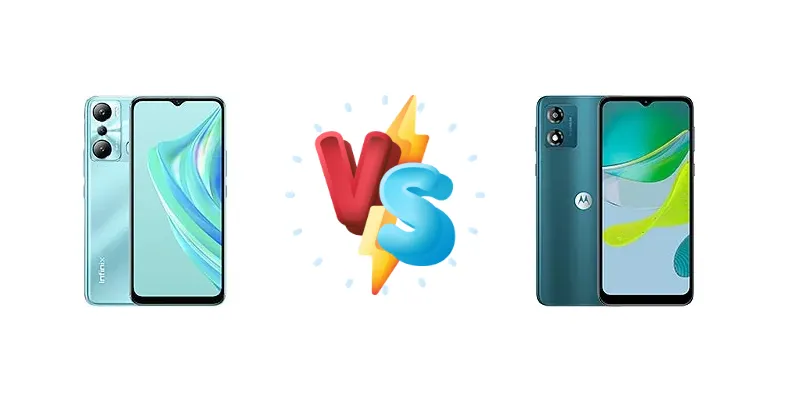
The sub-$150 smartphone market is fiercely competitive. Both the Infinix Hot 20i and Motorola Moto E13 aim to deliver essential smartphone functionality at an accessible price. However, they take different approaches to achieving this, primarily through varying chipset choices. This comparison dissects those differences and helps you determine which device best suits your needs.
🏆 Quick Verdict
For most users, the Motorola Moto E13 offers a slightly more refined experience thanks to the Unisoc T606’s more modern CPU architecture. While the Infinix Hot 20i offers a choice of chipsets, the Helio G25 variant is less efficient and powerful. The Moto E13’s CPU provides a smoother experience for everyday tasks and light multitasking.
| Network |
|---|
| 2G bands | GSM 850 / 900 / 1800 / 1900 | GSM 850 / 900 / 1800 / 1900 |
| 3G bands | HSDPA 900 / 2100 | HSDPA 850 / 900 / 2100 |
| 4G bands | 1, 3, 7, 8, 20 | 1, 3, 5, 7, 8, 28, 38, 40, 41 |
| Speed | HSPA, LTE | HSPA, LTE |
| Technology | GSM / HSPA / LTE | GSM / HSPA / LTE |
| | - | 1, 3, 5, 7, 8, 20, 28, 38, 40, 41 |
| Launch |
|---|
| Announced | 2022, September 28 | 2023, January 24 |
| Status | Available. Released 2022, September 28 | Available. Released 2023, February 13 |
| Body |
|---|
| Build | Glass front, plastic back, plastic frame | Glass front, plastic frame, plastic back |
| Dimensions | 164.8 x 76.4 x 8.8 mm (6.49 x 3.01 x 0.35 in) | 164.2 x 75 x 8.5 mm (6.46 x 2.95 x 0.33 in) |
| SIM | Nano-SIM + Nano-SIM | Nano-SIM + Nano-SIM |
| Weight | 195 g (6.88 oz) | 179.5 g (6.35 oz) |
| | - | Water-resistant design |
| Display |
|---|
| Resolution | 720 x 1612 pixels, 20:9 ratio (~267 ppi density) | 720 x 1600 pixels, 20:9 ratio (~270 ppi density) |
| Size | 6.6 inches, 104.6 cm2 (~83.1% screen-to-body ratio) | 6.5 inches, 102.0 cm2 (~82.8% screen-to-body ratio) |
| Type | IPS LCD, 500 nits (peak) | IPS LCD |
| Platform |
|---|
| CPU | Octa-core (4x2.0 GHz Cortex-A53 & 4x1.5 GHz Cortex-A53) / Quad-core 2.0 GHz Cortex-A53 | Octa-core (2x1.6 GHz Cortex-A75 & 6x1.6 GHz Cortex-A55) |
| Chipset | Mediatek MT6762G Helio G25 (12 nm) / Mediatek MT6761 Helio A22 (12 nm) | Unisoc T606 (12 nm) |
| GPU | PowerVR GE8320 | Mali-G57 MP1 |
| OS | Android 12 or Android 12 (Go edition), XOS 10.6 | Android 13 (Go edition) |
| Memory |
|---|
| Card slot | microSDXC (dedicated slot) | microSDXC (dedicated slot) |
| Internal | 64GB 2GB RAM, 64GB 3GB RAM, 64GB 4GB RAM, 128GB 4GB RAM, 128GB 6GB RAM | 32GB 2GB RAM, 64GB 2GB RAM, 64GB 4GB RAM, 128GB 8GB RAM |
| | - | eMMC 5.1 |
| Main Camera |
|---|
| Features | Dual-LED flash | LED flash, HDR, panorama |
| Single | 8 MP | 13 MP, f/2.2, (wide), 1.12µm, PDAF |
| Triple | 13 MP, f/1.8, (wide), AF
Auxiliary lenses | - |
| Video | 1080p@30fps | 1080p@30fps |
| Selfie camera |
|---|
| Features | LED flash | - |
| Single | 8 MP | 5 MP, f/2.4, (wide), 1/5.0", 1.12µm |
| Video | 1080p@30fps | 1080p@30fps |
| Sound |
|---|
| 3.5mm jack | Yes | Yes |
| 35mm jack | Yes | Yes |
| Loudspeaker | Yes | Yes |
| Comms |
|---|
| Bluetooth | Yes | 5.0, A2DP, LE |
| NFC | No | No |
| Positioning | GPS | GPS, GLONASS, GALILEO |
| Radio | FM radio | FM radio, recording |
| USB | microUSB 2.0, OTG | USB Type-C 2.0, OTG |
| WLAN | Wi-Fi 802.11 a/b/g/n/ac, dual-band | Wi-Fi 802.11 a/b/g/n/ac, dual-band |
| Features |
|---|
| Sensors | Fingerprint (rear-mounted), accelerometer, proximity | Accelerometer, proximity |
| Battery |
|---|
| Charging | 10W wired
5W reverse wired | 10W wired |
| Type | Li-Ion 5000 mAh | Li-Po 5000 mAh |
| Misc |
|---|
| Colors | Wilderness Black, Luna Blue, Energy Green, Sunset Gold | Cosmic Black, Creamy White, Aurora Green |
| Models | X665C, X665E | - |
| Price | About 120 EUR | $ 119.99 / € 104.99 |
Infinix Hot 20i
- Option of a slightly more powerful (but less efficient) Helio G25 chipset.
- 5W reverse wired charging for emergency power sharing.
- Potentially lower price point depending on region.
- Helio A22 variant offers significantly weaker performance.
- Less efficient chipset potentially leading to shorter battery life.
- Older CPU architecture compared to the Moto E13.
Motorola Moto E13
- More modern and efficient Unisoc T606 chipset.
- Improved CPU architecture for smoother performance.
- Better responsiveness for everyday tasks and multitasking.
- No reverse wired charging.
- 10W charging is slow.
- Basic camera system.
Display Comparison
Neither device boasts a standout display. Both likely utilize LCD panels, a common cost-saving measure in this segment. Specifics like resolution and peak brightness are not provided, but we can assume they are similar – likely 720p+ and adequate for indoor use. The focus here isn’t on visual fidelity, but on basic functionality. Bezels are likely to be substantial on both devices, maximizing screen real estate within a compact form factor.
Camera Comparison
Camera performance is expected to be basic on both devices. Details are scarce, but it’s safe to assume both feature a primary camera and potentially a depth or macro sensor. Given the price point, image quality will be heavily reliant on software processing. The absence of OIS (Optical Image Stabilization) on either device means low-light performance will be limited. Focusing on the primary sensor’s megapixel count is less important than the sensor size and image processing algorithms employed. Without specific sensor details, it’s difficult to declare a clear winner, but the Unisoc T606’s ISP (Image Signal Processor) may offer slightly better image processing capabilities.
Performance
This is where the key difference lies. The Motorola Moto E13’s Unisoc T606 features a combination of Cortex-A75 and Cortex-A55 cores, offering a more efficient and powerful architecture than the Infinix Hot 20i’s options. The Helio G25 utilizes older Cortex-A53 cores in an octa-core configuration, while the Helio A22 is a quad-core A53. The A75 cores in the T606 provide a noticeable performance boost in single-core tasks and improved responsiveness. While both chipsets are 12nm, the architectural advantage of the Unisoc T606 translates to better overall performance, especially in multitasking and app loading times. The Infinix Hot 20i’s Helio A22 variant will struggle with even moderate workloads.
Battery Life
Both phones feature 10W wired charging, a standard offering in this price bracket. Neither is going to charge rapidly. Battery capacity isn’t specified for either device, but typical capacities for this segment range from 4000mAh to 5000mAh. The Infinix Hot 20i adds 5W reverse wired charging, allowing it to act as a power bank for other devices, a niche feature that may appeal to some users. However, the efficiency of the Helio G25 chipset may result in slightly lower battery life compared to the Moto E13’s more efficient Unisoc T606.
Buying Guide
Buy the Infinix Hot 20i if you prioritize having a choice of chipsets (though the Helio A22 is significantly weaker) and potentially need 5W reverse wired charging. Buy the Motorola Moto E13 if you value a more responsive user experience, a more modern CPU architecture, and a generally smoother performance for daily tasks like browsing, social media, and messaging.
Frequently Asked Questions
❓ Will the Infinix Hot 20i with the Helio A22 chipset struggle with popular apps like WhatsApp and Facebook?
Yes, the Helio A22 is a very basic chipset. While it can handle these apps, you may experience noticeable lag and slowdowns, especially when multitasking or using more demanding features within those apps. The Helio G25 variant will perform better, but still lags behind the Moto E13.
❓ Is the Unisoc T606 in the Moto E13 capable of playing mobile games like PUBG Mobile or Call of Duty Mobile?
The Unisoc T606 can run PUBG Mobile and Call of Duty Mobile, but you’ll need to lower the graphics settings to medium or low and accept lower frame rates. It’s not a gaming powerhouse, but it provides a playable experience for casual gaming.
❓ How significant is the difference in performance between the Helio G25 and Helio A22 versions of the Infinix Hot 20i?
The difference is substantial. The Helio G25 has a dedicated gaming focus and a more powerful GPU, resulting in significantly better performance in games and demanding applications compared to the Helio A22. The A22 is best suited for very basic tasks.
❓ Does either phone support fast charging or Power Delivery (PD)?
No, both phones are limited to 10W wired charging. Neither supports fast charging standards like Power Delivery or Quick Charge. Expect a full charge to take over two hours.