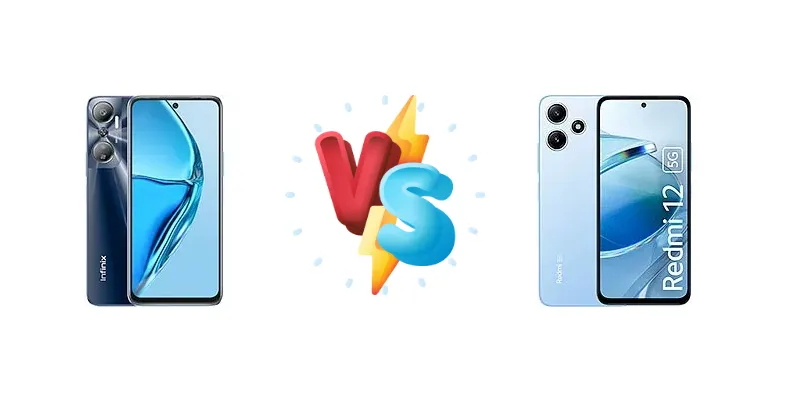
The sub-$200 5G smartphone market is fiercely competitive. The Infinix Hot 20 and Xiaomi Redmi 12 5G both aim to deliver connectivity and functionality without breaking the bank. However, they take different approaches to achieving this, with the Infinix prioritizing raw processing power and the Redmi focusing on efficiency and 5G integration. This comparison dissects their key differences to help you choose the right device.
🏆 Quick Verdict
For the average user prioritizing future-proofing and consistent performance, the Xiaomi Redmi 12 5G is the better choice. Its Snapdragon 4 Gen 2, built on a 4nm process, offers superior efficiency and 5G capabilities, despite the Infinix Hot 20’s slightly faster CPU clock speeds.
| Network |
|---|
| 2G bands | GSM 850 / 900 / 1800 / 1900 | GSM 850 / 900 / 1800 / 1900 |
| 3G bands | HSDPA 850 / 900 / 1700(AWS) / 1900 / 2100 | HSDPA 850 / 900 / 2100 |
| 4G bands | 1, 2, 3, 4, 5, 7, 8, 20, 28A, 28, 38, 40, 41 | 1, 3, 5, 8, 40, 41 |
| 5G bands | - | 1, 3, 5, 8, 28, 40, 78 SA/NSA |
| Speed | HSPA, LTE | HSPA, LTE, 5G |
| Technology | GSM / HSPA / LTE | GSM / HSPA / LTE / 5G |
| | 1, 3, 5, 8, 38, 40, 41 | - |
| Launch |
|---|
| Announced | 2022, October 13 | 2023, August 01 |
| Status | Available. Released 2022, October 13 | Available. Released 2023, August 04 |
| Body |
|---|
| Build | Glass front, plastic frame, plastic back | Glass front (Gorilla Glass), plastic frame, glass back (Gorilla Glass) |
| Dimensions | 170.7 x 77.4 x 8.3 mm (6.72 x 3.05 x 0.33 in) | 168.6 x 76.3 x 8.2 mm (6.64 x 3.00 x 0.32 in) |
| SIM | Nano-SIM + Nano-SIM | Nano-SIM + Nano-SIM |
| Weight | 198 g (6.98 oz) | 199 g (7.02 oz) |
| Display |
|---|
| Protection | - | Corning Gorilla Glass |
| Resolution | 720 x 1640 pixels (~263 ppi density) | 1080 x 2460 pixels (~396 ppi density) |
| Size | 6.82 inches, 110.5 cm2 (~83.6% screen-to-body ratio) | 6.79 inches, 109.5 cm2 (~85.1% screen-to-body ratio) |
| Type | IPS LCD, 90Hz | IPS LCD, 90Hz, 550 nits |
| Platform |
|---|
| CPU | Octa-core (2x2.0 GHz Cortex-A75 & 6x1.8 GHz Cortex-A55) | Octa-core (2x2.2 GHz Cortex-A78 & 6x1.95 GHz Cortex-A55) |
| Chipset | Mediatek MT6769Z Helio G85 (12 nm) | Qualcomm SM4450 Snapdragon 4 Gen 2 (4 nm) |
| GPU | Mali-G52 MC2 | Adreno 613 |
| OS | Android 12, XOS 12 | Android 13, upgradable to Android 15, HyperOS 2 |
| Memory |
|---|
| Card slot | microSDXC (dedicated slot) | microSDXC (uses shared SIM slot) |
| Internal | 128GB 4GB RAM, 128GB 6GB RAM, 128GB 8GB RAM | 128GB 4GB RAM, 128GB 6GB RAM, 128GB 8GB RAM, 256GB 8GB RAM |
| Main Camera |
|---|
| Dual | 50 MP, f/1.6, (wide), PDAF
Auxiliary lens | 50 MP, f/1.8, (wide), PDAF
Auxiliary lens |
| Features | Quad-LED flash, HDR, panorama | LED flash, HDR |
| Single | 8 MP, f/2.0, (wide) | - |
| Video | 1080p@30fps | 1080p@30fps |
| Selfie camera |
|---|
| Features | Dual-LED flash | HDR |
| Single | 8 MP, f/2.0, (wide) | 8 MP, f/2.0, (wide), 1.12µm |
| Video | 1080p@30fps | 1080p@30fps |
| Sound |
|---|
| 3.5mm jack | Yes | - |
| 35mm jack | Yes | Yes |
| Loudspeaker | Yes, with stereo speakers | Yes |
| Comms |
|---|
| Bluetooth | 5.0, A2DP, LE | 5.3, A2DP, LE |
| Infrared port | - | Yes |
| NFC | Yes (except 128/4 option) | Unspecified |
| Positioning | GPS | GPS, GLONASS, GALILEO, BDS |
| Radio | FM radio | No |
| USB | USB Type-C 2.0, OTG | USB Type-C |
| WLAN | Wi-Fi 802.11 a/b/g/n/ac, dual-band | Wi-Fi 802.11 a/b/g/n/ac, dual-band |
| Features |
|---|
| Sensors | Fingerprint (side-mounted), accelerometer, proximity, compass | Fingerprint (side-mounted), accelerometer, compass |
| Battery |
|---|
| Charging | 18W wired
5W reverse wired | 18W wired, PD |
| Type | 5000 mAh | Li-Po 5000 mAh |
| Misc |
|---|
| Colors | Sonic Black, Legend White, Tempo Blue, Fantasy Purple | Jade Black, Pastel Blue, Moonstone Silver |
| Models | X6826, X6826B, X6826C | 23076RN4BI, 23076RN8DY, 2AFZZRN8DY |
| Price | About 190 EUR | € 104.09 / ₹ 15,999 |
| SAR | - | 1.09 W/kg (head) 0.88 W/kg (body) |
| SAR EU | - | 0.98 W/kg (head) 1.00 W/kg (body) |
Infinix Hot 20
- Potentially higher peak CPU performance in short bursts.
- Reverse wired charging for topping up accessories.
- Aggressive pricing may make it the more affordable option.
- Less efficient 12nm chipset leads to shorter battery life.
- Helio G85 prone to thermal throttling under sustained load.
- 5G performance likely inferior to the Redmi 12 5G.
Xiaomi Redmi 12 5G
- More efficient 4nm Snapdragon 4 Gen 2 chipset.
- Integrated 5G modem for faster and more reliable connectivity.
- Power Delivery (PD) charging support for wider charger compatibility.
- Slightly lower CPU clock speeds compared to the Infinix Hot 20.
- May be slightly more expensive than the Infinix Hot 20.
- Camera performance likely similar to the Infinix Hot 20.
Display Comparison
Neither device boasts a standout display. Both likely feature LCD panels, common in this price bracket. The key difference lies under the hood. While specific display specs are missing, the Redmi 12 5G benefits from Qualcomm’s display optimization, potentially leading to better color accuracy and viewing angles. The Infinix Hot 20, relying on a Mediatek chipset, may have less sophisticated display calibration. Bezels are likely comparable, and neither phone is expected to offer high refresh rates.
Camera Comparison
Camera performance is likely to be similar, with both phones targeting the budget segment. Without detailed sensor information, it’s safe to assume both will feature a primary sensor paired with depth and macro lenses (the usefulness of the latter is questionable). The Redmi 12 5G may benefit from Qualcomm’s image signal processor (ISP), potentially offering better dynamic range and noise reduction. Image processing algorithms will play a crucial role, and Xiaomi generally offers more refined software optimization. Expect acceptable results in good lighting conditions, but struggles in low-light scenarios for both devices.
Performance
The performance gap is the most significant differentiator. The Xiaomi Redmi 12 5G’s Qualcomm Snapdragon 4 Gen 2 (4nm) is a clear advantage over the Infinix Hot 20’s MediaTek Helio G85 (12nm). The 4nm fabrication process translates to significantly better power efficiency and thermal management. While the Helio G85 has slightly higher clocked Cortex-A75 cores (2.0 GHz vs 2.2 GHz on the Redmi), the Snapdragon 4 Gen 2’s newer architecture and process node provide a more consistent and sustained performance. This means less throttling during extended gaming sessions and smoother multitasking. The Redmi 12 5G also benefits from integrated 5G modem, offering faster and more reliable connectivity.
Battery Life
Both phones feature 18W wired charging, but the Redmi 12 5G’s more efficient Snapdragon 4 Gen 2 chipset will translate to longer battery life. While battery capacity isn’t specified, the Redmi’s superior power efficiency will likely offset any potential capacity difference. The Redmi 12 5G also supports Power Delivery (PD) charging, offering wider compatibility with chargers. The Infinix Hot 20’s 18W charging, while adequate, won’t be as efficient due to the less optimized chipset.
Buying Guide
Buy the Infinix Hot 20 if you need a phone primarily for casual gaming and multitasking, and are willing to trade some battery life and 5G performance for a potentially smoother experience in demanding apps. Buy the Xiaomi Redmi 12 5G if you prioritize 5G connectivity, all-day battery life, and a more refined, efficient user experience, even if it means slightly less peak CPU performance.
Frequently Asked Questions
❓ Will the Infinix Hot 20 overheat during prolonged gaming sessions like PUBG or Call of Duty?
The MediaTek Helio G85 is known to throttle under sustained load. While the Infinix Hot 20 can handle short gaming bursts, expect frame rate drops and increased heat during extended gaming sessions. The Redmi 12 5G’s Snapdragon 4 Gen 2 is much better equipped to handle prolonged gaming due to its superior thermal efficiency.
❓ Does the Xiaomi Redmi 12 5G support carrier aggregation for faster 5G speeds?
While specific carrier aggregation support varies by region and carrier, Qualcomm chipsets generally offer robust carrier aggregation capabilities. This means the Redmi 12 5G is more likely to achieve faster 5G speeds in areas with carrier aggregation enabled compared to the Infinix Hot 20, which uses a MediaTek chipset with potentially limited carrier aggregation support.
❓ Is the 18W charging on either phone considered fast charging in 2024?
18W charging is relatively slow by 2024 standards. While it will charge the phones overnight, it won't provide a quick top-up. The Redmi 12 5G’s support for Power Delivery (PD) offers some flexibility, but neither phone offers truly fast charging capabilities.