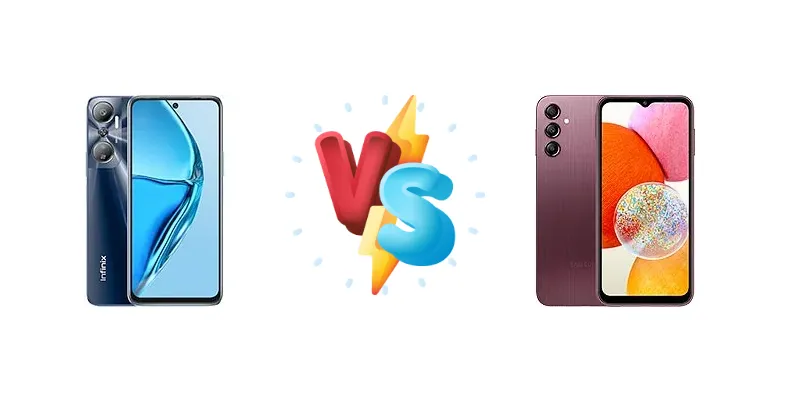
The sub-$200 smartphone market is fiercely competitive. The Infinix Hot 20 and Samsung Galaxy A14 both aim to deliver essential features at an accessible price point, but they take different approaches. The Hot 20 prioritizes gaming performance with its Helio G85, while the Galaxy A14 offers a choice between a Helio G80 and an Exynos 850, potentially balancing efficiency and power. This comparison dissects the key differences to determine which device best suits your needs.
🏆 Quick Verdict
For users prioritizing gaming and raw performance on a tight budget, the Infinix Hot 20 is the better choice due to its Helio G85 chipset. However, the Samsung Galaxy A14 (specifically the Exynos 850 variant) offers a more refined software experience and potentially better long-term software support, making it ideal for everyday users.
| Network |
|---|
| 2G bands | GSM 850 / 900 / 1800 / 1900 | GSM 850 / 900 / 1800 / 1900 |
| 3G bands | HSDPA 850 / 900 / 1700(AWS) / 1900 / 2100 | HSDPA 850 / 900 / 2100 |
| 4G bands | 1, 2, 3, 4, 5, 7, 8, 20, 28A, 28, 38, 40, 41 | 1, 3, 5, 7, 8, 20, 28, 38, 40, 41 |
| Speed | HSPA, LTE | HSPA, LTE |
| Technology | GSM / HSPA / LTE | GSM / HSPA / LTE |
| | 1, 3, 5, 8, 38, 40, 41 | - |
| Launch |
|---|
| Announced | 2022, October 13 | 2023, February 28 |
| Status | Available. Released 2022, October 13 | Available. Released 2023, March 27 |
| Body |
|---|
| Build | Glass front, plastic frame, plastic back | Glass front, plastic back, plastic frame |
| Dimensions | 170.7 x 77.4 x 8.3 mm (6.72 x 3.05 x 0.33 in) | 167.7 x 78 x 9.1 mm (6.60 x 3.07 x 0.36 in) |
| SIM | Nano-SIM + Nano-SIM | · Nano-SIM· Nano-SIM + Nano-SIM |
| Weight | 198 g (6.98 oz) | 201 g (7.09 oz) |
| Display |
|---|
| Resolution | 720 x 1640 pixels (~263 ppi density) | 1080 x 2408 pixels, 20:9 ratio (~400 ppi density) |
| Size | 6.82 inches, 110.5 cm2 (~83.6% screen-to-body ratio) | 6.6 inches, 104.9 cm2 (~80.2% screen-to-body ratio) |
| Type | IPS LCD, 90Hz | PLS LCD |
| Platform |
|---|
| CPU | Octa-core (2x2.0 GHz Cortex-A75 & 6x1.8 GHz Cortex-A55) | Octa-core (2x2.0 GHz Cortex-A75 & 6x1.8 GHz Cortex-A55) - Version AOcta-core (4x2.0 GHz Cortex-A55 & 4x2.0 GHz Cortex-A55) - Version B |
| Chipset | Mediatek MT6769Z Helio G85 (12 nm) | Mediatek MT6769 Helio G80 (12 nm) - Version AExynos 850 (8 nm) - Version B |
| GPU | Mali-G52 MC2 | Mali-G52 MC2 |
| OS | Android 12, XOS 12 | Android 13, upgradable to Android 15, One UI 7 |
| Memory |
|---|
| Card slot | microSDXC (dedicated slot) | microSDXC (dedicated slot) |
| Internal | 128GB 4GB RAM, 128GB 6GB RAM, 128GB 8GB RAM | 64GB 4GB RAM, 128GB 4GB RAM, 128GB 6GB RAM |
| Main Camera |
|---|
| Dual | 50 MP, f/1.6, (wide), PDAF
Auxiliary lens | - |
| Features | Quad-LED flash, HDR, panorama | LED flash, panorama, HDR |
| Single | 8 MP, f/2.0, (wide) | 13 MP, f/2.0, (wide) |
| Triple | - | 50 MP, f/1.8, 26mm (wide), 1/2.75", 0.64µm, PDAF
5 MP, f/2.2, 17mm (ultrawide), 1/5.0", 1.12µm
2 MP (macro) |
| Video | 1080p@30fps | 1080p@30fps |
| Selfie camera |
|---|
| Features | Dual-LED flash | - |
| Single | 8 MP, f/2.0, (wide) | 13 MP, f/2.0, 26mm (wide), 1/3.1", 1.12µm |
| Video | 1080p@30fps | 1080p@30fps |
| Sound |
|---|
| 3.5mm jack | Yes | Yes |
| 35mm jack | Yes | Yes |
| Loudspeaker | Yes, with stereo speakers | Yes |
| Comms |
|---|
| Bluetooth | 5.0, A2DP, LE | 5.1 or 5.3, A2DP, LE |
| NFC | Yes (except 128/4 option) | Yes (market/region dependent) |
| Positioning | GPS | GPS, GALILEO, GLONASS, BDS, QZSS |
| Radio | FM radio | Unspecified |
| USB | USB Type-C 2.0, OTG | USB Type-C 2.0 |
| WLAN | Wi-Fi 802.11 a/b/g/n/ac, dual-band | Wi-Fi 802.11 a/b/g/n/ac, dual-band, Wi-Fi Direct |
| Features |
|---|
| Sensors | Fingerprint (side-mounted), accelerometer, proximity, compass | Fingerprint (side-mounted), accelerometer, proximity, compass |
| Battery |
|---|
| Charging | 18W wired
5W reverse wired | 15W wired |
| Type | 5000 mAh | Li-Po 5000 mAh |
| Misc |
|---|
| Colors | Sonic Black, Legend White, Tempo Blue, Fantasy Purple | Black, Dark Red, Silver, Green |
| Models | X6826, X6826B, X6826C | SM-A145F, SM-A145F/DSN, SM-A145M, SM-A145M/DS, SM-A145P, SM-A145R |
| Price | About 190 EUR | € 85.76 / $ 147.60 / £ 79.95 |
| SAR EU | - | 0.46 W/kg (head) 1.37 W/kg (body) |
Infinix Hot 20
- Faster charging (18W vs 15W)
- More powerful chipset for gaming (Helio G85)
- Potentially better value for performance
- Likely less refined software experience
- Potentially shorter software support lifespan
Samsung Galaxy A14
- Established brand reputation (Samsung)
- Potentially longer software support
- Exynos 850 variant offers better efficiency
- Slower charging (15W)
- Helio G80 variant offers lower performance
- Potentially higher price
Display Comparison
Both phones utilize 12nm chipsets, suggesting similar power draw and thermal characteristics. Display specifications are not provided in the context data, so a direct comparison is difficult. However, given the price bracket, both likely feature LCD panels with 60Hz refresh rates. Samsung typically offers better color calibration and viewing angles, even on its budget devices, potentially giving the A14 an edge in display quality. Bezels are likely comparable, focusing on maximizing screen real estate within the budget constraints.
Camera Comparison
Camera details are limited. Both phones likely feature a multi-camera setup, but the context data doesn't specify sensor sizes or apertures. The presence of a 2MP macro camera on either device is largely a marketing tactic, offering limited practical benefit due to the small sensor size. Image processing will differ significantly; Samsung’s software typically prioritizes vibrant, saturated colors, while Infinix often aims for a more natural look. Without detailed sensor information, it’s difficult to declare a clear winner, but Samsung’s established camera algorithms likely provide a more consistent experience.
Performance
The core difference lies in the chipsets. The Infinix Hot 20’s MediaTek Helio G85 (12nm) features a dual-core Cortex-A75 setup paired with six Cortex-A55 cores, optimized for gaming. The Samsung Galaxy A14 presents a split: the Helio G80 (12nm) version uses the same core configuration but with slightly lower clock speeds, resulting in reduced performance. Crucially, the A14 also has an Exynos 850 (8nm) variant. This 8nm process node offers improved power efficiency and potentially higher sustained performance compared to the 12nm Helio G85 and G80. The Exynos 850’s CPU configuration differs significantly, using four Cortex-A55 cores at 2.0 GHz, suggesting a focus on efficiency rather than peak performance. Gamers will benefit from the Hot 20’s G85, while the Exynos 850 A14 will handle multitasking and everyday tasks more smoothly.
Battery Life
Battery capacity isn’t specified, but both phones likely house batteries in the 5000mAh range, typical for this price segment. The Infinix Hot 20’s 18W charging is faster than the Samsung Galaxy A14’s 15W charging. This translates to quicker top-ups, reducing downtime. While a larger battery capacity is desirable, the faster charging speed of the Hot 20 mitigates the impact of a potentially slightly smaller battery, offering a more convenient user experience.
Buying Guide
Buy the Infinix Hot 20 if you need a phone primarily for mobile gaming, streaming, and demanding apps, and are willing to trade off some software polish. Buy the Samsung Galaxy A14 if you prefer a more established brand with a cleaner software experience, longer software support, and a focus on reliable daily use, even if it means slightly less raw processing power. Consider the Exynos 850 version of the A14 for a performance boost over the Helio G80.
Frequently Asked Questions
❓ Does the Exynos 850 in the Galaxy A14 overheat during prolonged gaming sessions?
The Exynos 850's 8nm process node is more efficient than the 12nm Helio G85, meaning it's less prone to overheating. While it won't match the raw performance of the G85, it should maintain stable performance for longer gaming sessions without significant throttling.
❓ Is the 2MP macro camera on either phone worth using?
Generally, 2MP macro cameras on budget phones offer limited image quality. The small sensor size results in soft, noisy images. While they can be fun to experiment with, don't expect professional-level macro photography from either device.
❓ Can the Infinix Hot 20 handle demanding games like PUBG Mobile at high settings?
The Helio G85 in the Infinix Hot 20 is capable of running PUBG Mobile, but you may need to compromise on graphics settings to achieve a smooth frame rate. Expect playable performance at medium settings, potentially with some occasional frame drops during intense action.
❓ How does the software experience differ between the Infinix Hot 20 and Samsung Galaxy A14?
Samsung's One UI is a more polished and feature-rich software experience compared to Infinix's custom UI. Samsung also typically provides longer software support, including security updates and Android version upgrades.