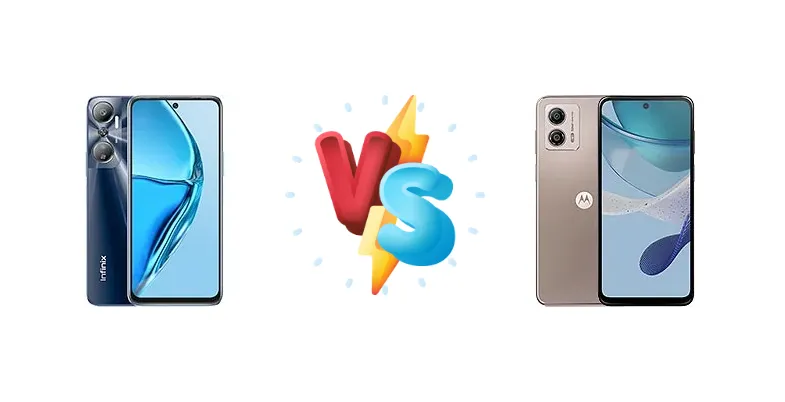
The sub-$200 smartphone market is fiercely competitive, and the Infinix Hot 20 and Motorola Moto G53 represent compelling options for users seeking 5G connectivity without breaking the bank. While both aim for affordability, they take different approaches to chipset selection and feature prioritization, making a direct comparison crucial for informed buyers.
🏆 Quick Verdict
For the average user prioritizing consistent performance and a brighter display, the Motorola Moto G53 emerges as the better choice. Its Snapdragon 480+ chipset, built on a more efficient 8nm process, offers a noticeable advantage over the Infinix Hot 20’s Helio G85, despite similar CPU core counts. However, the Hot 20’s reverse wired charging is a unique benefit.
| Network |
|---|
| 2G bands | GSM 850 / 900 / 1800 / 1900 | GSM 850 / 900 / 1800 / 1900 |
| 3G bands | HSDPA 850 / 900 / 1700(AWS) / 1900 / 2100 | HSDPA 850 / 900 / 1900 / 2100 - EMEA & AP, China |
| 4G bands | 1, 2, 3, 4, 5, 7, 8, 20, 28A, 28, 38, 40, 41 | 1, 2, 3, 5, 7, 8, 18, 19, 20, 26, 28, 32, 38, 40, 41, 42 - EMEA & AP |
| 5G bands | - | 1, 3, 5, 7, 8, 20, 28, 38, 40, 41, 77, 78 SA/NSA - EMEA & AP |
| Speed | HSPA, LTE | HSPA, LTE, 5G |
| Technology | GSM / HSPA / LTE | GSM / CDMA / HSPA / LTE / 5G |
| | 1, 3, 5, 8, 38, 40, 41 | 1, 5, 8, 28, 41, 78 SA/NSA - China |
| Launch |
|---|
| Announced | 2022, October 13 | 2022, December 15 |
| Status | Available. Released 2022, October 13 | Available. Released 2022, December 15 |
| Body |
|---|
| Build | Glass front, plastic frame, plastic back | Glass front, plastic back, plastic frame |
| Dimensions | 170.7 x 77.4 x 8.3 mm (6.72 x 3.05 x 0.33 in) | 162.7 x 74.7 x 8.2 mm (6.41 x 2.94 x 0.32 in) |
| SIM | Nano-SIM + Nano-SIM | · Nano-SIM + eSIM· Nano-SIM + Nano-SIM |
| Weight | 198 g (6.98 oz) | 183 g (6.46 oz) |
| | - | Water-resistant design |
| Display |
|---|
| Resolution | 720 x 1640 pixels (~263 ppi density) | 720 x 1600 pixels, 20:9 ratio (~270 ppi density) |
| Size | 6.82 inches, 110.5 cm2 (~83.6% screen-to-body ratio) | 6.5 inches, 102.0 cm2 (~83.9% screen-to-body ratio) |
| Type | IPS LCD, 90Hz | IPS LCD, 120Hz |
| Platform |
|---|
| CPU | Octa-core (2x2.0 GHz Cortex-A75 & 6x1.8 GHz Cortex-A55) | Octa-core (2x2.2 GHz Kryo 460 & 6x1.8 GHz Kryo 460) |
| Chipset | Mediatek MT6769Z Helio G85 (12 nm) | Qualcomm SM4350-AC Snapdragon 480+ 5G (8 nm) |
| GPU | Mali-G52 MC2 | Adreno 619 |
| OS | Android 12, XOS 12 | Android 13, planned upgrade to Android 14 |
| Memory |
|---|
| Card slot | microSDXC (dedicated slot) | microSDXC (uses shared SIM slot) |
| Internal | 128GB 4GB RAM, 128GB 6GB RAM, 128GB 8GB RAM | 64GB 4GB RAM, 128GB 4GB RAM, 128GB 6GB RAM, 128GB 8GB RAM |
| Main Camera |
|---|
| Dual | 50 MP, f/1.6, (wide), PDAF
Auxiliary lens | 50 MP, f/1.8 (wide), 1/2.76", 0.64µm, PDAF
2 MP (macro) |
| Features | Quad-LED flash, HDR, panorama | LED flash, HDR, panorama |
| Single | 8 MP, f/2.0, (wide) | - |
| Video | 1080p@30fps | 1080p@30fps |
| Selfie camera |
|---|
| Features | Dual-LED flash | - |
| Single | 8 MP, f/2.0, (wide) | 8 MP, f/2.0, (wide), 1/4.0", 1.12µm
or
16 MP, f/2.2, (wide), 1.0µm |
| Video | 1080p@30fps | 1080p@30fps |
| Sound |
|---|
| 3.5mm jack | Yes | Yes |
| 35mm jack | Yes | Yes |
| Loudspeaker | Yes, with stereo speakers | Yes, with stereo speakers |
| Comms |
|---|
| Bluetooth | 5.0, A2DP, LE | 5.1, A2DP, LE |
| NFC | Yes (except 128/4 option) | Yes (market/region dependent) |
| Positioning | GPS | GPS, GLONASS, GALILEO, BDS |
| Radio | FM radio | FM radio (market/region dependent) |
| USB | USB Type-C 2.0, OTG | USB Type-C 2.0, OTG |
| WLAN | Wi-Fi 802.11 a/b/g/n/ac, dual-band | Wi-Fi 802.11 a/b/g/n/ac, dual-band |
| Features |
|---|
| Sensors | Fingerprint (side-mounted), accelerometer, proximity, compass | Fingerprint (side-mounted), accelerometer, gyro, proximity, compass |
| Battery |
|---|
| Charging | 18W wired
5W reverse wired | 18W wired (China, LATAM)
10W wired (International)
Reverse wired |
| Type | 5000 mAh | Li-Po 5000 mAh |
| Misc |
|---|
| Colors | Sonic Black, Legend White, Tempo Blue, Fantasy Purple | Ink Blue, Arctic Silver, Pale Pink |
| Models | X6826, X6826B, X6826C | XT2335-2 |
| Price | About 190 EUR | $ 295.00 / £ 143.15 |
| Tests |
|---|
| Battery life | - |
Endurance rating 123h
|
| Camera | - |
Photo / Video |
| Display | - |
Contrast ratio: 1746:1 (nominal) |
| Loudspeaker | - |
-26.0 LUFS (Very good)
|
| Performance | - |
AnTuTu: 314195 (v9)
GeekBench: 1594 (v5.1), 1797 (v6.0)
GFXBench: 29fps (ES 3.1 onscreen) |
Infinix Hot 20
- Faster 18W charging (consistent across regions)
- 5W Reverse Wired Charging – useful for accessories
- Potentially lower price point (depending on region)
- Less efficient Helio G85 chipset
- Likely lower sustained performance due to thermal throttling
- Display lacks the brightness of the Moto G53
Motorola Moto G53
- More efficient Snapdragon 480+ chipset (8nm)
- Brighter display (599 nits) for better outdoor visibility
- Smoother multitasking and app responsiveness
- Potentially slower 10W charging in some regions
- Lacks reverse wired charging functionality
- May be slightly more expensive than the Hot 20
Display Comparison
Both the Infinix Hot 20 and Motorola Moto G53 feature displays with a 1746:1 contrast ratio, suggesting similar visual pop. However, the Moto G53 boasts a significantly brighter panel, reaching a measured 599 nits. This higher peak brightness translates to improved outdoor visibility, a crucial advantage for users frequently exposed to sunlight. While both lack high refresh rates, the G53’s superior brightness makes it the more practical choice for everyday use. Details regarding panel technology (IPS vs. VA) are missing, but the contrast ratio suggests IPS panels are likely used in both.
Camera Comparison
Both phones are described as having 'Photo / Video' capabilities, lacking specific details. Without sensor size or aperture information, a direct comparison is difficult. It’s safe to assume both will rely on software processing to enhance image quality. The absence of details suggests neither phone is positioned as a photography powerhouse, and users should temper expectations. The inclusion of a 2MP macro camera on either device is likely a marketing tactic, offering limited practical benefit due to the small sensor size and low resolution.
Performance
The core difference lies in the chipsets. The Motorola Moto G53’s Qualcomm Snapdragon 480+ (8nm) offers a clear architectural advantage over the Infinix Hot 20’s MediaTek Helio G85 (12nm). The 8nm process node inherently provides better power efficiency, leading to less thermal throttling during sustained workloads. While both CPUs feature a similar core configuration – 2x high-performance cores and 6x efficiency cores – the Snapdragon’s Kryo 460 cores are generally more efficient than the Cortex-A75/A55 combination in the Helio G85. This translates to smoother app switching and a more responsive user experience on the Moto G53, particularly noticeable in graphically demanding tasks.
Battery Life
Both devices share an endurance rating of 123 hours, indicating comparable battery life under similar usage conditions. However, the charging speeds differ. The Moto G53 offers 18W charging in China and LATAM, but is limited to 10W in international markets, while the Infinix Hot 20 consistently delivers 18W. This means the Hot 20 will likely achieve a faster 0-100% charge time. The Hot 20 also includes 5W reverse wired charging, allowing it to function as a portable power bank for accessories, a feature absent on the Moto G53.
Buying Guide
Buy the Infinix Hot 20 if you frequently use your phone as a power bank for other devices, valuing its 5W reverse wired charging capability. It’s also a reasonable pick if your usage is primarily light – social media, calls, and basic apps – and you’re on a very tight budget. Buy the Motorola Moto G53 if you prioritize smoother multitasking, occasional gaming, and a more visible screen in bright sunlight. The Snapdragon 480+ provides a more future-proof 5G experience and better overall responsiveness.
Frequently Asked Questions
❓ Does the Snapdragon 480+ in the Moto G53 struggle with demanding games like PUBG Mobile?
While the Snapdragon 480+ isn't a gaming powerhouse, it's capable of running PUBG Mobile at medium settings with reasonable frame rates. The 8nm process helps mitigate thermal throttling, allowing for sustained performance during gaming sessions, unlike the Helio G85 which is more prone to overheating.
❓ Is the 10W charging on the international Moto G53 a significant drawback?
Yes, the 10W charging is noticeably slower than the 18W charging found on the Infinix Hot 20 and the China/LATAM versions of the Moto G53. Expect significantly longer charge times, potentially taking over 3 hours for a full charge. This is a key consideration if fast charging is a priority.
❓ How useful is the 5W reverse wired charging on the Infinix Hot 20 in real-world scenarios?
The 5W reverse charging is best suited for topping up small accessories like wireless earbuds or a smartwatch. It won't rapidly charge a smartphone, but it's a convenient feature for emergency situations or when you're away from a power outlet.
❓ Which phone is better for streaming videos and browsing the web?
The Motorola Moto G53 is better suited for these tasks. The brighter display makes videos more enjoyable, and the Snapdragon 480+ provides a smoother browsing experience with faster page loading times and less lag.