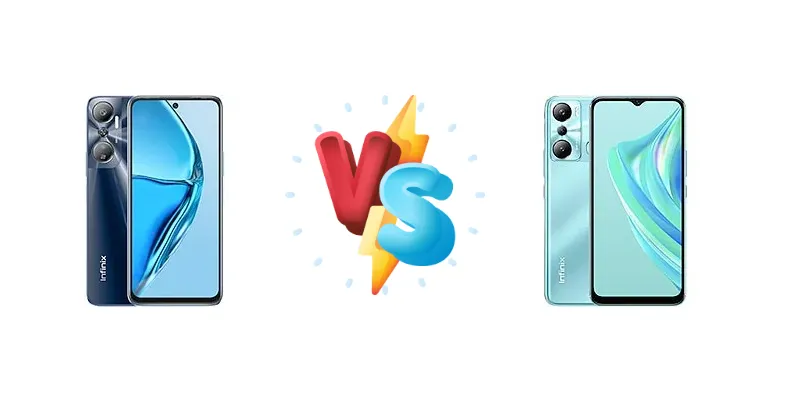
The Infinix Hot series is known for delivering impressive features at affordable prices. The Hot 20 and Hot 20i are two contenders in this space, but which one offers the best value? This comprehensive comparison will help you decide which phone is right for you.
🏆 Quick Verdict
The Infinix Hot 20 clearly outperforms the Hot 20i thanks to its significantly more powerful Helio G85 chipset. While both offer decent battery life, the Hot 20's faster charging and superior performance make it the better overall choice for most users.
| Network |
|---|
| 2G bands | GSM 850 / 900 / 1800 / 1900 | GSM 850 / 900 / 1800 / 1900 |
| 3G bands | HSDPA 850 / 900 / 1700(AWS) / 1900 / 2100 | HSDPA 900 / 2100 |
| 4G bands | 1, 2, 3, 4, 5, 7, 8, 20, 28A, 28, 38, 40, 41 | 1, 3, 7, 8, 20 |
| Speed | HSPA, LTE | HSPA, LTE |
| Technology | GSM / HSPA / LTE | GSM / HSPA / LTE |
| | 1, 3, 5, 8, 38, 40, 41 | - |
| Launch |
|---|
| Announced | 2022, October 13 | 2022, September 28 |
| Status | Available. Released 2022, October 13 | Available. Released 2022, September 28 |
| Body |
|---|
| Build | Glass front, plastic frame, plastic back | Glass front, plastic back, plastic frame |
| Dimensions | 170.7 x 77.4 x 8.3 mm (6.72 x 3.05 x 0.33 in) | 164.8 x 76.4 x 8.8 mm (6.49 x 3.01 x 0.35 in) |
| SIM | Nano-SIM + Nano-SIM | Nano-SIM + Nano-SIM |
| Weight | 198 g (6.98 oz) | 195 g (6.88 oz) |
| Display |
|---|
| Resolution | 720 x 1640 pixels (~263 ppi density) | 720 x 1612 pixels, 20:9 ratio (~267 ppi density) |
| Size | 6.82 inches, 110.5 cm2 (~83.6% screen-to-body ratio) | 6.6 inches, 104.6 cm2 (~83.1% screen-to-body ratio) |
| Type | IPS LCD, 90Hz | IPS LCD, 500 nits (peak) |
| Platform |
|---|
| CPU | Octa-core (2x2.0 GHz Cortex-A75 & 6x1.8 GHz Cortex-A55) | Octa-core (4x2.0 GHz Cortex-A53 & 4x1.5 GHz Cortex-A53) / Quad-core 2.0 GHz Cortex-A53 |
| Chipset | Mediatek MT6769Z Helio G85 (12 nm) | Mediatek MT6762G Helio G25 (12 nm) / Mediatek MT6761 Helio A22 (12 nm) |
| GPU | Mali-G52 MC2 | PowerVR GE8320 |
| OS | Android 12, XOS 12 | Android 12 or Android 12 (Go edition), XOS 10.6 |
| Memory |
|---|
| Card slot | microSDXC (dedicated slot) | microSDXC (dedicated slot) |
| Internal | 128GB 4GB RAM, 128GB 6GB RAM, 128GB 8GB RAM | 64GB 2GB RAM, 64GB 3GB RAM, 64GB 4GB RAM, 128GB 4GB RAM, 128GB 6GB RAM |
| Main Camera |
|---|
| Dual | 50 MP, f/1.6, (wide), PDAF
Auxiliary lens | - |
| Features | Quad-LED flash, HDR, panorama | Dual-LED flash |
| Single | 8 MP, f/2.0, (wide) | 8 MP |
| Triple | - | 13 MP, f/1.8, (wide), AF
Auxiliary lenses |
| Video | 1080p@30fps | 1080p@30fps |
| Selfie camera |
|---|
| Features | Dual-LED flash | LED flash |
| Single | 8 MP, f/2.0, (wide) | 8 MP |
| Video | 1080p@30fps | 1080p@30fps |
| Sound |
|---|
| 3.5mm jack | Yes | Yes |
| 35mm jack | Yes | Yes |
| Loudspeaker | Yes, with stereo speakers | Yes |
| Comms |
|---|
| Bluetooth | 5.0, A2DP, LE | Yes |
| NFC | Yes (except 128/4 option) | No |
| Positioning | GPS | GPS |
| Radio | FM radio | FM radio |
| USB | USB Type-C 2.0, OTG | microUSB 2.0, OTG |
| WLAN | Wi-Fi 802.11 a/b/g/n/ac, dual-band | Wi-Fi 802.11 a/b/g/n/ac, dual-band |
| Features |
|---|
| Sensors | Fingerprint (side-mounted), accelerometer, proximity, compass | Fingerprint (rear-mounted), accelerometer, proximity |
| Battery |
|---|
| Charging | 18W wired
5W reverse wired | 10W wired
5W reverse wired |
| Type | 5000 mAh | Li-Ion 5000 mAh |
| Misc |
|---|
| Colors | Sonic Black, Legend White, Tempo Blue, Fantasy Purple | Wilderness Black, Luna Blue, Energy Green, Sunset Gold |
| Models | X6826, X6826B, X6826C | X665C, X665E |
| Price | About 190 EUR | About 120 EUR |
Infinix Hot 20
- Significantly faster performance
- Better gaming experience
- Faster 18W charging
- Likely better camera image processing
- Potentially slightly higher price
Infinix Hot 20i
- More affordable
- Decent battery life
- 5000mAh battery
- Slow 10W charging
- Underpowered processor
- Struggles with demanding tasks
- Less impressive camera performance
Display Comparison
Both phones likely feature a similar 6.6-inch HD+ display, offering adequate viewing for everyday use. However, the Hot 20's more powerful processor *could* potentially allow for slightly better display processing and color accuracy, though this is often minimal in this price range. Expect similar brightness and viewing angles.
Camera Comparison
Both phones likely feature a triple-camera setup, potentially including a 50MP main sensor. However, the Hot 20's more powerful processor will likely contribute to better image processing, resulting in sharper and more detailed photos, especially in low-light conditions. Video recording capabilities should be similar, likely topping out at 1080p.
Performance
This is where the Hot 20 shines. The Helio G85 chipset is a substantial upgrade over the Helio G25/A22 found in the Hot 20i. Expect significantly faster app loading times, smoother multitasking, and a much better gaming experience on the Hot 20. The Hot 20i will struggle with more demanding apps and games.
Battery Life
Both phones are expected to have a large 5000mAh battery, providing all-day battery life for moderate usage. The Hot 20 has an advantage with 18W wired charging, while the Hot 20i is limited to 10W. This means the Hot 20 will charge significantly faster.
Buying Guide
The Infinix Hot 20 is ideal for users who prioritize performance, smoother multitasking, and a better gaming experience. The Hot 20i is a good option for those on a tighter budget who primarily need a phone for basic tasks like calling, texting, and light social media use.
Frequently Asked Questions
❓ Is the Infinix Hot 20i good for gaming?
The Hot 20i is not ideal for gaming. Its processor struggles with demanding games, resulting in lag and low frame rates. The Hot 20 offers a much better gaming experience.
❓ How long does the battery last on each phone?
Both phones offer all-day battery life with moderate usage thanks to their 5000mAh batteries. However, the Hot 20 charges significantly faster.
❓ Which phone has the better camera?
The Infinix Hot 20 generally has the better camera due to its more powerful processor, which allows for improved image processing and better low-light performance.