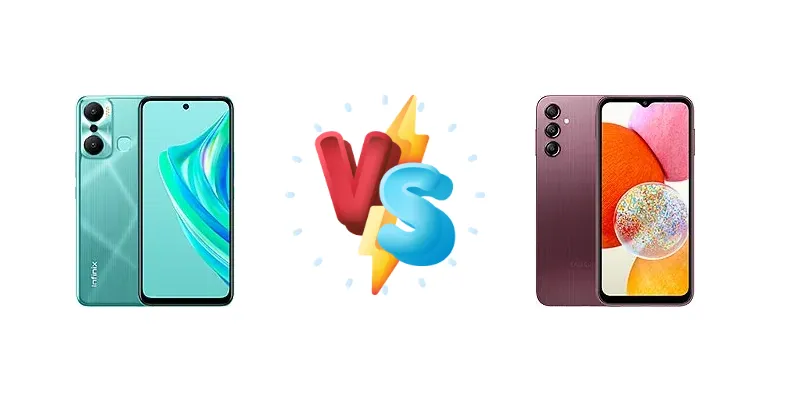
The sub-$150 smartphone market is fiercely competitive. The Infinix Hot 20 Play and Samsung Galaxy A14 both aim to deliver essential features at an accessible price point, but they take different approaches. The Hot 20 Play prioritizes raw processing power for the price, while the Galaxy A14 offers Samsung’s brand recognition and a potentially more refined software experience, with variations in chipset options.
🏆 Quick Verdict
For users prioritizing gaming and demanding tasks on a tight budget, the Infinix Hot 20 Play offers a performance edge thanks to its Helio G37 chipset. However, the Samsung Galaxy A14, particularly the Exynos 850 variant, provides a more balanced experience with potentially better software support and a more efficient processor for everyday tasks.
| Network |
|---|
| 2G bands | GSM 850 / 900 / 1800 / 1900 | GSM 850 / 900 / 1800 / 1900 |
| 3G bands | HSDPA 850 / 900 / 1700(AWS) / 1900 / 2100 | HSDPA 850 / 900 / 2100 |
| 4G bands | 1, 2, 3, 4, 5, 7, 8, 20, 28A, 28, 38, 40, 41 | 1, 3, 5, 7, 8, 20, 28, 38, 40, 41 |
| Speed | HSPA, LTE | HSPA, LTE |
| Technology | GSM / HSPA / LTE | GSM / HSPA / LTE |
| | 1, 3, 5, 8, 38, 40, 41 | - |
| Launch |
|---|
| Announced | 2022, October 13 | 2023, February 28 |
| Status | Available. Released 2022, October 13 | Available. Released 2023, March 27 |
| Body |
|---|
| Build | Glass front, plastic frame, plastic back | Glass front, plastic back, plastic frame |
| Dimensions | 171 x 78 x 8.9 mm (6.73 x 3.07 x 0.35 in) | 167.7 x 78 x 9.1 mm (6.60 x 3.07 x 0.36 in) |
| SIM | Nano-SIM + Nano-SIM | · Nano-SIM· Nano-SIM + Nano-SIM |
| Weight | 209.6 g (7.41 oz) | 201 g (7.09 oz) |
| Display |
|---|
| Resolution | 720 x 1640 pixels (~263 ppi density) | 1080 x 2408 pixels, 20:9 ratio (~400 ppi density) |
| Size | 6.82 inches, 110.5 cm2 (~82.8% screen-to-body ratio) | 6.6 inches, 104.9 cm2 (~80.2% screen-to-body ratio) |
| Type | IPS LCD, 90Hz, 500 nits (peak) | PLS LCD |
| Platform |
|---|
| CPU | Octa-core (4x2.3 GHz Cortex-A53 & 4x1.8 GHz Cortex-A53) | Octa-core (2x2.0 GHz Cortex-A75 & 6x1.8 GHz Cortex-A55) - Version AOcta-core (4x2.0 GHz Cortex-A55 & 4x2.0 GHz Cortex-A55) - Version B |
| Chipset | Mediatek MT6765 Helio G37 (12 nm) | Mediatek MT6769 Helio G80 (12 nm) - Version AExynos 850 (8 nm) - Version B |
| GPU | PowerVR GE8320 | Mali-G52 MC2 |
| OS | Android 12, XOS 10.6 | Android 13, upgradable to Android 15, One UI 7 |
| Memory |
|---|
| Card slot | microSDXC (dedicated slot) | microSDXC (dedicated slot) |
| Internal | 64GB 4GB RAM, 128GB 4GB RAM | 64GB 4GB RAM, 128GB 4GB RAM, 128GB 6GB RAM |
| Main Camera |
|---|
| Dual | 13 MP, f/1.8, (wide), 1/3.1", 1.12µm, AF
Auxiliary lens | - |
| Features | Quad-LED flash | LED flash, panorama, HDR |
| Single | 8 MP | 13 MP, f/2.0, (wide) |
| Triple | - | 50 MP, f/1.8, 26mm (wide), 1/2.75", 0.64µm, PDAF
5 MP, f/2.2, 17mm (ultrawide), 1/5.0", 1.12µm
2 MP (macro) |
| Video | 1080p@30fps | 1080p@30fps |
| Selfie camera |
|---|
| Features | Dual-LED flash | - |
| Single | 8 MP | 13 MP, f/2.0, 26mm (wide), 1/3.1", 1.12µm |
| Video | 1080p@30fps | 1080p@30fps |
| Sound |
|---|
| 3.5mm jack | Yes | Yes |
| 35mm jack | Yes | Yes |
| Loudspeaker | Yes | Yes |
| Comms |
|---|
| Bluetooth | Yes | 5.1 or 5.3, A2DP, LE |
| NFC | No | Yes (market/region dependent) |
| Positioning | GPS | GPS, GALILEO, GLONASS, BDS, QZSS |
| Radio | FM radio | Unspecified |
| USB | USB Type-C 2.0, OTG | USB Type-C 2.0 |
| WLAN | Wi-Fi 802.11 a/b/g/n/ac, dual-band | Wi-Fi 802.11 a/b/g/n/ac, dual-band, Wi-Fi Direct |
| Features |
|---|
| Sensors | Fingerprint (rear-mounted), accelerometer, gyro, proximity, compass | Fingerprint (side-mounted), accelerometer, proximity, compass |
| Battery |
|---|
| Charging | 18W wired
5W reverse wired | 15W wired |
| Type | 6000 mAh | Li-Po 5000 mAh |
| Misc |
|---|
| Colors | Racing Black, Luna Blue, Aurora Green, Fantasy Purple | Black, Dark Red, Silver, Green |
| Models | X6825 | SM-A145F, SM-A145F/DSN, SM-A145M, SM-A145M/DS, SM-A145P, SM-A145R |
| Price | About 130 EUR | € 85.76 / $ 147.60 / £ 79.95 |
| SAR EU | - | 0.46 W/kg (head) 1.37 W/kg (body) |
Infinix Hot 20 Play
- Faster charging (18W)
- Potentially higher raw processing power (Helio G37)
- Reverse wired charging
- Older CPU architecture (Cortex-A53)
- Likely less refined software experience
- Potentially shorter software support
Samsung Galaxy A14
- More efficient processor (Exynos 850 variant)
- Samsung brand recognition and software
- Potentially longer software support
- Slower charging (15W)
- Helio G80 variant offers less performance uplift
- May be slightly more expensive
Display Comparison
Neither device boasts a standout display. Both likely utilize LCD panels, common in this price bracket. While specific details like resolution and peak brightness are missing, the focus here is on processing power, not visual fidelity. Bezels are expected to be noticeable on both. Color accuracy will likely be standard for the segment, prioritizing power efficiency over color calibration.
Camera Comparison
Camera performance will be largely dependent on software processing. Both phones likely feature a primary camera around the 13-50MP range (spec not provided), but image quality will be more about computational photography than sensor size. The inclusion of a 2MP macro camera on both devices is largely a marketing tactic, offering limited practical benefit. The A14 may benefit from Samsung’s more mature image processing algorithms, potentially resulting in more pleasing photos in various lighting conditions. OIS is unlikely on either device.
Performance
This is where the key differences emerge. The Infinix Hot 20 Play’s Mediatek Helio G37, while a 12nm chip, features a higher clock speed on its primary cores (2.3 GHz Cortex-A53) compared to the Galaxy A14’s Helio G80 (2.0 GHz Cortex-A75 & 1.8 GHz Cortex-A55). However, the G80’s architecture is more modern, utilizing Cortex-A75 cores which offer significantly better single-core performance than the A53 cores in the G37. The Galaxy A14 also has a variant with the 8nm Exynos 850, which offers superior power efficiency and sustained performance compared to both the G37 and G80. The A14’s LPDDR4X RAM is standard for the price, while the Hot 20 Play’s RAM configuration is unknown, but likely similar. The Exynos 850 version of the A14 will likely exhibit less thermal throttling under sustained load.
Battery Life
The Infinix Hot 20 Play’s 18W charging is faster than the Galaxy A14’s 15W charging. While battery capacity is unknown for both, the more efficient Exynos 850 in the A14 variant could translate to comparable or even better real-world battery life despite potentially having a smaller battery. The Hot 20 Play’s 5W reverse wired charging is a useful feature for topping up accessories, absent on the A14.
Buying Guide
Buy the Infinix Hot 20 Play if you need a phone primarily for gaming or running demanding apps and are willing to trade off some software polish. It’s ideal for users who maximize performance per dollar. Buy the Samsung Galaxy A14 if you prefer a more established brand, a potentially longer software support lifecycle, and a smoother experience for everyday tasks like browsing, social media, and light photography. The A14 is better suited for users who value reliability and ease of use.
Frequently Asked Questions
❓ Does the Exynos 850 chip in the Galaxy A14 overheat during prolonged gaming sessions?
The Exynos 850 is an 8nm chip, making it significantly more power-efficient than the Helio G37. While it won't deliver flagship-level gaming performance, it's less prone to overheating and thermal throttling during extended gaming sessions compared to the Hot 20 Play's G37.
❓ Is the 2MP macro camera on either phone actually useful for taking detailed close-up photos?
Generally, 2MP macro cameras on budget phones offer limited detail and image quality. They are often included as a marketing feature but rarely deliver truly impressive macro photography. Expect soft images and limited dynamic range.
❓ Which phone is better for playing PUBG Mobile at higher frame rates?
The Infinix Hot 20 Play, with its higher clocked Helio G37, *may* achieve slightly higher frame rates in PUBG Mobile, but this will come at the cost of potentially increased thermal throttling. The Exynos 850 variant of the A14 will likely offer a more stable, albeit potentially lower, frame rate experience.
❓ How long can I expect software updates and security patches to be available for the Samsung Galaxy A14?
Samsung generally provides longer software support for its devices than Infinix. The Galaxy A14 is likely to receive at least 3 years of security updates and potentially 2 major Android version upgrades, offering greater long-term value.