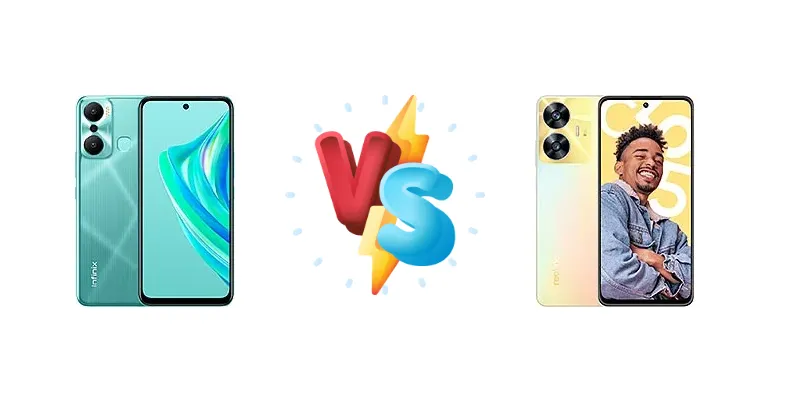
The sub-$150 smartphone market is fiercely competitive, and the Infinix Hot 20 Play and Realme C55 are two contenders vying for your attention. While both aim to deliver essential smartphone functionality at an accessible price, they take different approaches. The Infinix prioritizes a larger display and reverse charging, while the Realme C55 focuses on faster charging and a slightly more powerful chipset. This comparison dives deep into the specifics to determine which device offers the best value.
🏆 Quick Verdict
For most users, the Realme C55 emerges as the better choice. Its Helio G88 chipset provides a noticeable performance edge over the Hot 20 Play’s Helio G37, and the 33W charging significantly reduces downtime. While the battery endurance is similar, the faster charging makes the C55 more convenient for power users.
| Network |
|---|
| 2G bands | GSM 850 / 900 / 1800 / 1900 | GSM 850 / 900 / 1800 / 1900 |
| 3G bands | HSDPA 850 / 900 / 1700(AWS) / 1900 / 2100 | HSDPA 850 / 900 / 2100 |
| 4G bands | 1, 2, 3, 4, 5, 7, 8, 20, 28A, 28, 38, 40, 41 | 1, 3, 5, 8, 38, 40, 41 |
| Speed | HSPA, LTE | HSPA, LTE |
| Technology | GSM / HSPA / LTE | GSM / HSPA / LTE |
| | 1, 3, 5, 8, 38, 40, 41 | - |
| Launch |
|---|
| Announced | 2022, October 13 | 2023, March 07 |
| Status | Available. Released 2022, October 13 | Available. Released 2023, March 08 |
| Body |
|---|
| Build | Glass front, plastic frame, plastic back | Glass front, plastic frame, plastic back |
| Dimensions | 171 x 78 x 8.9 mm (6.73 x 3.07 x 0.35 in) | 165.6 x 75.9 x 7.9 mm (6.52 x 2.99 x 0.31 in) |
| SIM | Nano-SIM + Nano-SIM | Nano-SIM + Nano-SIM |
| Weight | 209.6 g (7.41 oz) | 189.5 g (6.70 oz) |
| Display |
|---|
| Resolution | 720 x 1640 pixels (~263 ppi density) | 1080 x 2400 pixels, 20:9 ratio (~392 ppi density) |
| Size | 6.82 inches, 110.5 cm2 (~82.8% screen-to-body ratio) | 6.72 inches, 109.0 cm2 (~86.7% screen-to-body ratio) |
| Type | IPS LCD, 90Hz, 500 nits (peak) | IPS LCD, 90Hz, 680 nits (peak) |
| Platform |
|---|
| CPU | Octa-core (4x2.3 GHz Cortex-A53 & 4x1.8 GHz Cortex-A53) | Octa-core (2x2.0 GHz Cortex-A75 & 6x1.8 GHz Cortex-A55) |
| Chipset | Mediatek MT6765 Helio G37 (12 nm) | Mediatek MT6769H Helio G88 (12 nm) |
| GPU | PowerVR GE8320 | Mali-G52 MC2 |
| OS | Android 12, XOS 10.6 | Android 13, Realme UI 4.0 |
| Memory |
|---|
| Card slot | microSDXC (dedicated slot) | microSDXC (dedicated slot) |
| Internal | 64GB 4GB RAM, 128GB 4GB RAM | 64GB 4GB RAM, 64GB 6GB RAM, 128GB 4GB RAM, 128GB 6GB RAM, 128GB 8GB RAM, 256GB 8GB RAM |
| Main Camera |
|---|
| Dual | 13 MP, f/1.8, (wide), 1/3.1", 1.12µm, AF
Auxiliary lens | 64 MP, (wide), 1/2.0", PDAF
Auxiliary lens |
| Features | Quad-LED flash | LED flash, HDR, panorama |
| Single | 8 MP | 8 MP, (wide) |
| Video | 1080p@30fps | 1080p@30/60fps |
| Selfie camera |
|---|
| Features | Dual-LED flash | HDR, panorama |
| Single | 8 MP | 8 MP, (wide) |
| Video | 1080p@30fps | 1080p@30fps |
| Sound |
|---|
| 3.5mm jack | Yes | Yes |
| 35mm jack | Yes | Yes |
| Loudspeaker | Yes | Yes |
| Comms |
|---|
| Bluetooth | Yes | 5.2, A2DP, LE |
| NFC | No | Yes, 360˚ (market/region dependent) |
| Positioning | GPS | GPS, GLONASS, GALILEO, BDS |
| Radio | FM radio | No |
| USB | USB Type-C 2.0, OTG | USB Type-C 2.0 |
| WLAN | Wi-Fi 802.11 a/b/g/n/ac, dual-band | Wi-Fi 802.11 a/b/g/n/ac, dual-band |
| Features |
|---|
| Sensors | Fingerprint (rear-mounted), accelerometer, gyro, proximity, compass | Fingerprint (side-mounted), accelerometer, proximity, compass |
| Battery |
|---|
| Charging | 18W wired
5W reverse wired | 33W wired, 50% in 29 min |
| Type | 6000 mAh | 5000 mAh |
| Misc |
|---|
| Colors | Racing Black, Luna Blue, Aurora Green, Fantasy Purple | Sun Shower, Rainy Night, Rainforest |
| Models | X6825 | RMX3710 |
| Price | About 130 EUR | ₹ 8,399 |
| Tests |
|---|
| Battery life | - |
Endurance rating 123h
|
| Camera | - |
Photo / Video |
| Display | - |
Contrast ratio: 1264:1 (nominal) |
| Loudspeaker | - |
-31.8 LUFS (Below average)
|
| Performance | - |
AnTuTu: 257263 (v9)
GeekBench: 1452 (v5.1), 1413 (v6)
GFXBench: 9fps (ES 3.1 onscreen) |
Infinix Hot 20 Play
- Reverse wired charging for accessory top-ups
- Potentially larger display size (unconfirmed, but typical for Infinix)
- Competitive price point
- Slower Helio G37 chipset
- Significantly slower 18W charging
- Likely less responsive user experience
Realme C55
- Faster and more efficient Helio G88 chipset
- 33W fast charging for quick power-ups
- Higher peak display brightness
- No reverse charging capability
- Similar battery endurance to the Infinix
- May be slightly more expensive
Display Comparison
Both the Infinix Hot 20 Play and Realme C55 feature displays with a 1264:1 contrast ratio, suggesting similar visual pop. However, the Realme C55 boasts a measured peak brightness of 659 nits, which will translate to better visibility outdoors compared to the Infinix, whose brightness is not specified. While both likely utilize IPS LCD panels, the Realme’s higher brightness is a tangible advantage for everyday use. Bezels are comparable, and neither device is expected to offer particularly high color accuracy for professional work.
Camera Comparison
Both devices list 'Photo / Video' capabilities, but lack specific details. Given the price point, image quality will likely be similar, relying heavily on software processing. The absence of detailed sensor information suggests neither phone will excel in low-light conditions. It's safe to assume both will feature a primary camera and potentially depth/macro sensors, but focusing on the main sensor specs is crucial. Without that data, it's difficult to declare a clear winner; however, Realme's image processing algorithms generally offer a more refined look.
Performance
The Realme C55’s Mediatek Helio G88 chipset represents a clear upgrade over the Infinix Hot 20 Play’s Helio G37. The G88 utilizes a more modern CPU architecture with 2x 2.0 GHz Cortex-A75 cores and 6x 1.8 GHz Cortex-A55 cores, compared to the G37’s 4x 2.3 GHz Cortex-A53 and 4x 1.8 GHz Cortex-A53 configuration. The Cortex-A75 cores in the G88 provide a significant boost in single-core performance, resulting in snappier app launches and smoother multitasking. While both chipsets are 12nm, the architectural improvements in the G88 translate to a more responsive user experience. Neither phone is a gaming powerhouse, but the G88 will handle less demanding titles with greater ease.
Battery Life
Both the Infinix Hot 20 Play and Realme C55 achieve an endurance rating of 123 hours, indicating comparable battery life under similar usage conditions. However, the Realme C55’s 33W wired charging is a game-changer. It can reach 50% charge in just 29 minutes, while the Infinix Hot 20 Play’s 18W charging is considerably slower. The inclusion of 5W reverse wired charging on the Infinix is a niche feature, allowing it to act as a power bank for accessories, but the Realme’s faster charging is a more universally beneficial feature.
Buying Guide
Buy the Infinix Hot 20 Play if you prioritize a larger screen for media consumption and the convenience of reverse wired charging to top up accessories. Buy the Realme C55 if you value quicker app loading times, smoother multitasking, and significantly faster charging speeds, making it ideal for users who are constantly on the go.
Frequently Asked Questions
❓ Does the Helio G88 in the Realme C55 struggle with demanding games like PUBG Mobile?
While the Helio G88 isn't a flagship gaming chip, it can handle PUBG Mobile at medium settings with reasonable frame rates. Expect some occasional stuttering during intense firefights, but it's a playable experience. The Infinix Hot 20 Play's Helio G37 will likely require even lower settings and may exhibit more noticeable lag.
❓ How useful is the 5W reverse charging on the Infinix Hot 20 Play in real-world scenarios?
The 5W reverse charging is best suited for topping up small accessories like Bluetooth earbuds or a smartwatch. It's too slow to significantly charge a smartphone, but it can be a lifesaver in a pinch if you need a small boost for your wireless headphones.
❓ Is the Realme C55's 33W charging compatible with Power Delivery (PD) chargers?
The Realme C55 utilizes its own proprietary fast charging protocol. While it *may* work with some PD chargers, it won't achieve the full 33W charging speed unless you use the included charger. Using a standard 5W charger will result in significantly slower charging times.
❓ What type of storage does each phone use, and is it expandable?
Neither device explicitly states the storage type (eMMC vs UFS). However, given the price point, it's likely both utilize eMMC storage. Both phones support microSD card expansion, allowing you to increase storage capacity, but the maximum supported capacity varies and should be confirmed with the retailer.