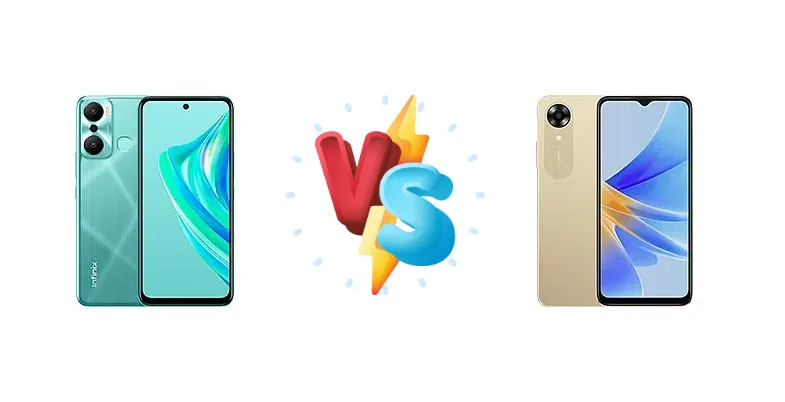
The Infinix Hot 20 Play and Oppo A17k represent the fiercely competitive sub-$150 smartphone market. Both devices target first-time smartphone buyers and users prioritizing affordability, but subtle differences in their Mediatek Helio chipsets and features can significantly impact the user experience. This comparison dissects these nuances to determine which phone delivers the best value.
🏆 Quick Verdict
For the average user, the Infinix Hot 20 Play emerges as the slightly better choice. While both phones share a similar CPU configuration, the Hot 20 Play’s Helio G37 chipset offers a marginal performance advantage, coupled with the convenience of 18W fast charging and 5W reverse charging, making it a more versatile option.
| Network |
|---|
| 2G bands | GSM 850 / 900 / 1800 / 1900 | GSM 850 / 900 / 1800 / 1900 |
| 3G bands | HSDPA 850 / 900 / 1700(AWS) / 1900 / 2100 | HSDPA 850 / 900 / 2100 |
| 4G bands | 1, 2, 3, 4, 5, 7, 8, 20, 28A, 28, 38, 40, 41 | 1, 3, 5, 8, 38, 40, 41 |
| Speed | HSPA, LTE | HSPA, LTE |
| Technology | GSM / HSPA / LTE | GSM / HSPA / LTE |
| | 1, 3, 5, 8, 38, 40, 41 | - |
| Launch |
|---|
| Announced | 2022, October 13 | 2022, October 13 |
| Status | Available. Released 2022, October 13 | Available. Released 2022, October 18 |
| Body |
|---|
| Build | Glass front, plastic frame, plastic back | - |
| Dimensions | 171 x 78 x 8.9 mm (6.73 x 3.07 x 0.35 in) | 164.2 x 75.6 x 8.3 mm (6.46 x 2.98 x 0.33 in) |
| SIM | Nano-SIM + Nano-SIM | Nano-SIM + Nano-SIM |
| Weight | 209.6 g (7.41 oz) | 189 g (6.67 oz) |
| | - | IPX4 water resistance |
| Display |
|---|
| Protection | - | Panda Glass |
| Resolution | 720 x 1640 pixels (~263 ppi density) | 720 x 1612 pixels, 20:9 ratio (~269 ppi density) |
| Size | 6.82 inches, 110.5 cm2 (~82.8% screen-to-body ratio) | 6.56 inches, 103.4 cm2 (~83.3% screen-to-body ratio) |
| Type | IPS LCD, 90Hz, 500 nits (peak) | IPS LCD, 480 nits (typ), 600 nits (HBM) |
| Platform |
|---|
| CPU | Octa-core (4x2.3 GHz Cortex-A53 & 4x1.8 GHz Cortex-A53) | Octa-core (4x2.3 GHz Cortex-A53 & 4x1.8 GHz Cortex-A53) |
| Chipset | Mediatek MT6765 Helio G37 (12 nm) | Mediatek MT6765 Helio G35 (12 nm) |
| GPU | PowerVR GE8320 | PowerVR GE8320 |
| OS | Android 12, XOS 10.6 | Android 12, ColorOS 12.1 |
| Memory |
|---|
| Card slot | microSDXC (dedicated slot) | microSDXC |
| Internal | 64GB 4GB RAM, 128GB 4GB RAM | 64GB 3GB RAM |
| | - | eMMC 5.1 |
| Main Camera |
|---|
| Dual | 13 MP, f/1.8, (wide), 1/3.1", 1.12µm, AF
Auxiliary lens | - |
| Features | Quad-LED flash | LED flash, panorama |
| Single | 8 MP | 8 MP, f/2.0, (wide), AF |
| Video | 1080p@30fps | 1080p@30fps |
| Selfie camera |
|---|
| Features | Dual-LED flash | - |
| Single | 8 MP | 5 MP, f/2.2, (wide) |
| Video | 1080p@30fps | 1080p@30fps |
| Sound |
|---|
| 3.5mm jack | Yes | Yes |
| 35mm jack | Yes | Yes |
| Loudspeaker | Yes | Yes |
| Comms |
|---|
| Bluetooth | Yes | 5.3, A2DP, LE, aptX HD |
| NFC | No | No |
| Positioning | GPS | GPS, GLONASS, BDS, GALILEO |
| Radio | FM radio | Unspecified |
| USB | USB Type-C 2.0, OTG | microUSB 2.0, OTG |
| WLAN | Wi-Fi 802.11 a/b/g/n/ac, dual-band | Wi-Fi 802.11 a/b/g/n/ac, dual-band |
| Features |
|---|
| Sensors | Fingerprint (rear-mounted), accelerometer, gyro, proximity, compass | Fingerprint (side-mounted), accelerometer, proximity, compass |
| Battery |
|---|
| Charging | 18W wired
5W reverse wired | - |
| Type | 6000 mAh | Li-Po 5000 mAh |
| Misc |
|---|
| Colors | Racing Black, Luna Blue, Aurora Green, Fantasy Purple | Navy Blue, Gold |
| Models | X6825 | CPH2471 |
| Price | About 130 EUR | About 130 EUR |
Infinix Hot 20 Play
- Faster 18W charging
- 5W Reverse Charging capability
- Slightly more powerful Helio G37 chipset
- Software experience may be less refined
- Design may be less premium
Oppo A17k
- Potentially cleaner software experience
- Sleek design aesthetic (based on Oppo's brand image)
- Reliable brand reputation
- Slower charging speeds
- Less powerful Helio G35 chipset
- No reverse charging
Display Comparison
Neither Infinix nor Oppo provide detailed display specifications beyond the basic panel type. Given the price point, both likely utilize LCD panels. The absence of information regarding peak brightness, color gamut coverage, or refresh rates suggests a focus on cost reduction. Bezels are expected to be noticeable on both devices. Color accuracy will likely be standard for this segment, prioritizing power efficiency over color fidelity.
Camera Comparison
Camera specifications are where details become sparse. Both phones likely feature a primary camera and potentially a depth sensor. The absence of information regarding sensor size and aperture makes a direct comparison difficult. It’s safe to assume both phones will struggle in low-light conditions. The marketing often highlights megapixel counts, but in this price range, sensor size and image processing are far more critical. The 2MP macro cameras often found in this segment are generally of limited practical use, offering minimal detail and requiring ideal lighting conditions.
Performance
Both the Infinix Hot 20 Play and Oppo A17k are powered by Mediatek’s Helio G35 and G37 chipsets respectively, both fabricated on a 12nm process. The CPUs are identical: an octa-core configuration with 4x2.3 GHz Cortex-A53 cores and 4x1.8 GHz Cortex-A53 cores. However, the Helio G37 in the Hot 20 Play boasts a slightly higher GPU clock speed, offering a marginal improvement in graphics performance. This translates to potentially smoother gameplay in less demanding titles and a more responsive UI. While neither chipset is designed for intensive gaming, the G37 provides a small edge. RAM configurations are not specified, but both are likely to offer options around 3-4GB, which is adequate for basic tasks but can lead to app reloading under heavy multitasking.
Battery Life
Battery capacity is not specified for either device, but both likely house batteries in the 5000mAh range, typical for this price bracket. The key difference lies in charging speed. The Infinix Hot 20 Play supports 18W wired charging, significantly faster than the Oppo A17k’s charging capabilities (likely 10W). This translates to a considerably quicker 0-100% charge time for the Infinix. Furthermore, the Hot 20 Play includes 5W reverse wired charging, allowing it to act as a power bank for other devices – a feature absent on the Oppo A17k.
Buying Guide
Buy the Infinix Hot 20 Play if you need a phone capable of handling moderate gaming and multitasking with a bit more headroom, and if the inclusion of 18W fast charging and reverse charging is important to you. Buy the Oppo A17k if you prioritize a clean, streamlined software experience and a potentially more polished design aesthetic, accepting a slightly less powerful chipset and slower charging speeds.
Frequently Asked Questions
❓ Will the Infinix Hot 20 Play handle popular games like PUBG Mobile or Call of Duty?
While neither phone is a gaming powerhouse, the Infinix Hot 20 Play’s Helio G37 chipset will offer a slightly better experience. Expect to play at lower graphics settings and frame rates to maintain smooth gameplay. Frame drops and occasional lag are likely, especially in intense scenes.
❓ How long does it take to fully charge the Oppo A17k?
Given the likely 10W charging support, fully charging the Oppo A17k from 0% to 100% will likely take around 3-4 hours. This is considerably slower than the Infinix Hot 20 Play’s 18W charging, which can achieve a full charge in approximately 2 hours.
❓ Is the software on the Oppo A17k more user-friendly than on the Infinix Hot 20 Play?
Oppo’s ColorOS is generally known for its cleaner interface and user-friendly features compared to some other Android skins. Infinix’s XOS, while improving, can sometimes include more pre-installed apps (bloatware). If a streamlined software experience is a priority, the Oppo A17k may be preferable.
❓ Does the Infinix Hot 20 Play’s reverse charging feature work with all devices?
The Infinix Hot 20 Play’s 5W reverse charging is compatible with most devices that charge via USB-C or Micro-USB. However, charging speeds will be slow, and it’s best suited for topping up smaller devices like wireless earbuds or smartwatches.