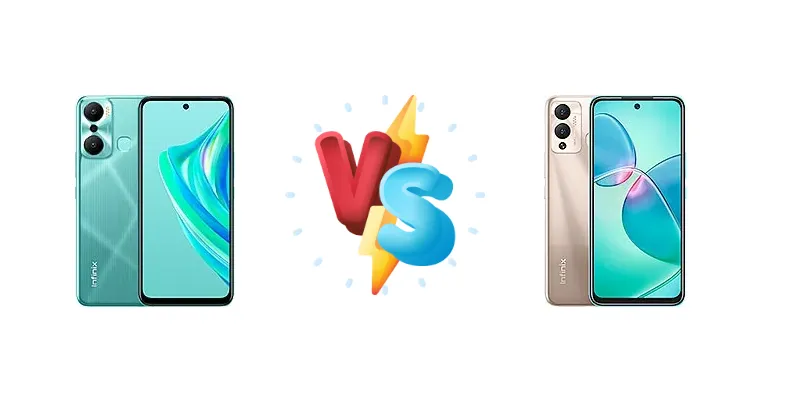
Looking for a budget-friendly smartphone that doesn't compromise on essential features? The Infinix Hot series consistently delivers, and today we're pitting the Hot 20 Play against the Hot 12 Play. Both offer impressive value, but which one comes out on top?
🏆 Quick Verdict
The Infinix Hot 20 Play edges out the Hot 12 Play thanks to its faster charging and slightly more modern chipset. While the Hot 12 Play offers a couple of CPU variations, the Hot 20 Play's overall package provides a better user experience for the price.
| Network |
|---|
| 2G bands | GSM 850 / 900 / 1800 / 1900 | GSM 850 / 900 / 1800 / 1900 |
| 3G bands | HSDPA 850 / 900 / 1700(AWS) / 1900 / 2100 | HSDPA 850 / 900 / 2100 |
| 4G bands | 1, 2, 3, 4, 5, 7, 8, 20, 28A, 28, 38, 40, 41 | 1, 3, 5, 8, 38, 40, 41 |
| Speed | HSPA, LTE | HSPA, LTE |
| Technology | GSM / HSPA / LTE | GSM / HSPA / LTE |
| | 1, 3, 5, 8, 38, 40, 41 | 1, 2, 3, 4, 5, 7, 8, 20, 28, 38, 40, 41 |
| Launch |
|---|
| Announced | 2022, October 13 | 2022, May 23 |
| Status | Available. Released 2022, October 13 | Available. Released 2022, May 30 |
| Body |
|---|
| Build | Glass front, plastic frame, plastic back | Glass front, plastic back, plastic frame |
| Dimensions | 171 x 78 x 8.9 mm (6.73 x 3.07 x 0.35 in) | 171 x 78 x 8.9 mm (6.73 x 3.07 x 0.35 in) |
| SIM | Nano-SIM + Nano-SIM | Nano-SIM + Nano-SIM |
| Weight | 209.6 g (7.41 oz) | 209 g (7.37 oz) |
| Display |
|---|
| Resolution | 720 x 1640 pixels (~263 ppi density) | 720 x 1612 pixels, 20:9 ratio (~259 ppi density) |
| Size | 6.82 inches, 110.5 cm2 (~82.8% screen-to-body ratio) | 6.82 inches, 111.7 cm2 (~83.8% screen-to-body ratio) |
| Type | IPS LCD, 90Hz, 500 nits (peak) | IPS LCD, 90Hz |
| Platform |
|---|
| CPU | Octa-core (4x2.3 GHz Cortex-A53 & 4x1.8 GHz Cortex-A53) | Octa-core (4x2.3 GHz Cortex-A53 & 4x1.8 GHz Cortex-A53) - X6816Octa-core (2x1.8 GHz Cortex-A75 & 6x1.8 GHz Cortex-A55) - X6816C |
| Chipset | Mediatek MT6765 Helio G37 (12 nm) | Mediatek MT6765V/CB Helio G37 (12 nm) - X6816Unisoc T610 (12 nm) - X6816C |
| GPU | PowerVR GE8320 | PowerVR GE8320 - X6816Mali-G52 MP2 - X6816C |
| OS | Android 12, XOS 10.6 | Android 11, XOS 10 |
| Memory |
|---|
| Card slot | microSDXC (dedicated slot) | microSDXC (dedicated slot) |
| Internal | 64GB 4GB RAM, 128GB 4GB RAM | 64GB 4GB RAM, 128GB 4GB RAM, 128GB 6GB RAM |
| | - | eMMC 5.1 |
| Main Camera |
|---|
| Dual | 13 MP, f/1.8, (wide), 1/3.1", 1.12µm, AF
Auxiliary lens | 13 MP, f/1.8, (wide), 1/3.1", 1.12µm, AF
Auxiliary lens |
| Features | Quad-LED flash | Dual-LED flash, panorama, HDR |
| Single | 8 MP | 8 MP |
| Video | 1080p@30fps | 1080p@30fps |
| Selfie camera |
|---|
| Features | Dual-LED flash | Dual-LED flash |
| Single | 8 MP | 8 MP |
| Video | 1080p@30fps | 1080p@30fps |
| Sound |
|---|
| 3.5mm jack | Yes | Yes |
| 35mm jack | Yes | Yes |
| Loudspeaker | Yes | Yes |
| Comms |
|---|
| Bluetooth | Yes | Yes |
| NFC | No | No |
| Positioning | GPS | GPS |
| Radio | FM radio | FM radio |
| USB | USB Type-C 2.0, OTG | USB Type-C 2.0, OTG |
| WLAN | Wi-Fi 802.11 a/b/g/n/ac, dual-band | Wi-Fi 802.11 a/b/g/n/ac, dual-band, Wi-Fi Direct |
| Features |
|---|
| Sensors | Fingerprint (rear-mounted), accelerometer, gyro, proximity, compass | Fingerprint (rear-mounted), accelerometer, proximity, compass |
| Battery |
|---|
| Charging | 18W wired
5W reverse wired | 10W wired |
| Type | 6000 mAh | 6000 mAh |
| Misc |
|---|
| Colors | Racing Black, Luna Blue, Aurora Green, Fantasy Purple | Racing Black, Horizon Blue, Daylight Green, Champagne Gold |
| Models | X6825 | X6816C, X6816 |
| Price | About 130 EUR | About 60 EUR |
Infinix Hot 20 Play
- Faster 18W Charging
- Potentially slightly better performance
- Reverse Wired Charging
- Larger Software Updates (Likely)
- May be slightly more expensive
- Design might be less appealing to some
Infinix Hot 12 Play
- More Affordable
- Large Battery
- Potential Unisoc T610 variant for slightly better CPU performance
- Slower 10W Charging
- Potentially fewer software updates
- Performance can vary based on chipset
Display Comparison
Both phones typically feature a large 6.6-inch display, likely with an HD+ resolution. While specific panel technology (IPS, AMOLED) isn't always clearly stated, expect decent viewing angles and color reproduction for the price range. The Hot 20 Play might have a slightly brighter display, but this is often dependent on the specific variant.
Camera Comparison
Both phones likely feature a multi-camera setup on the rear, typically including a primary sensor (13MP or higher), depth sensor, and macro lens. Image quality will be adequate for social media and casual photography in good lighting conditions. Low-light performance is expected to be average. The Hot 20 Play might have slightly improved image processing algorithms.
Performance
The Hot 20 Play utilizes the Mediatek Helio G37, a 12nm chipset. The Hot 12 Play presents a more complex scenario with potential variations: MT6765V/CB Helio G37 or Unisoc T610. The Unisoc T610, with its Cortex-A75 core, *could* offer a slight performance advantage in certain scenarios, but the G37 is generally more efficient. Real-world performance will depend heavily on RAM and software optimization.
Battery Life
Both phones boast large 6000mAh batteries, promising excellent battery life. However, the Hot 20 Play's 18W wired charging is a significant advantage over the Hot 12 Play's 10W charging. This means significantly faster charging times for the Hot 20 Play.
Buying Guide
The Infinix Hot 20 Play is ideal for users prioritizing fast charging and a slightly more responsive experience. The Hot 12 Play is a good choice for those seeking a very affordable option and are less concerned about charging speed or peak performance. Both are great for media consumption and basic tasks.
Frequently Asked Questions
❓ Which phone has better battery life?
Both have a 6000mAh battery, so battery life should be comparable. However, the Hot 20 Play's faster charging means you'll spend less time plugged in.
❓ Is the Unisoc T610 in the Hot 12 Play significantly faster than the Helio G37?
The Unisoc T610 *can* offer a slight performance boost due to its Cortex-A75 core, but the difference is unlikely to be dramatic in everyday use. Software optimization plays a bigger role.