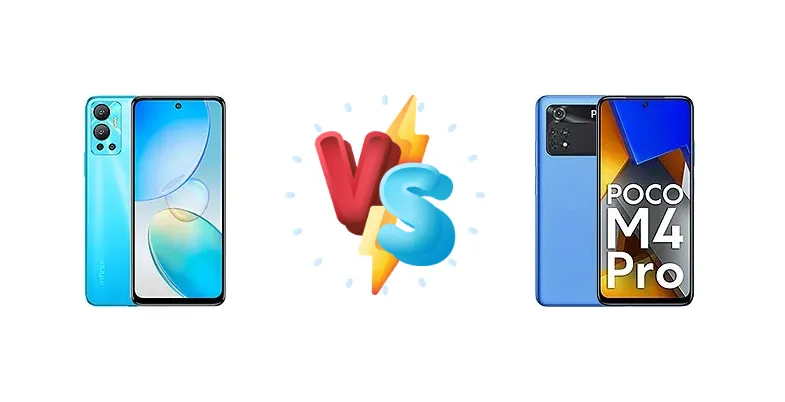
The sub-$200 smartphone market is fiercely competitive, and the Infinix Hot 12 and Xiaomi Poco M4 Pro are two strong contenders. Both aim to deliver a compelling experience without breaking the bank, but they take different approaches. The Hot 12 focuses on providing a functional experience, while the Poco M4 Pro prioritizes faster charging and a slightly more powerful chipset.
🏆 Quick Verdict
For most users, the Xiaomi Poco M4 Pro is the better choice. Its Helio G96 chipset offers a noticeable performance edge over the Hot 12’s Helio G85, and the 33W fast charging significantly reduces downtime. While both phones offer similar battery endurance, the Poco M4 Pro’s faster charging is a key advantage.
| Network |
|---|
| 2G bands | GSM 850 / 900 / 1800 / 1900 | GSM 850 / 900 / 1800 / 1900 |
| 3G bands | HSDPA 850 / 900 / 2100 | HSDPA 850 / 900 / 1700(AWS) / 1900 / 2100 - International |
| 4G bands | 1, 3, 5, 8, 38, 40, 41 | 1, 2, 3, 4, 5, 7, 8, 20, 28, 38, 40, 41 - International |
| Speed | HSPA, LTE | HSPA, LTE |
| Technology | GSM / HSPA / LTE | GSM / HSPA / LTE |
| | 1, 3, 7, 8, 20 | 1, 3, 5, 8, 40, 41 - India |
| Launch |
|---|
| Announced | 2022, April 26 | 2022, February 28 |
| Status | Available. Released 2022, April 26 | Available. Released 2022, March 16 |
| Body |
|---|
| Build | Glass front, plastic back, plastic frame | Glass front (Gorilla Glass 3), plastic frame, plastic back |
| Dimensions | 170.5 x 77.6 x 8.3 mm (6.71 x 3.06 x 0.33 in) | 159.9 x 73.9 x 8.1 mm (6.30 x 2.91 x 0.32 in) |
| SIM | Nano-SIM + Nano-SIM | Nano-SIM + Nano-SIM |
| Weight | 195 g (6.88 oz) | 179.5 g (6.31 oz) |
| | - | IP53, dust and splash resistant |
| Display |
|---|
| Protection | - | Corning Gorilla Glass 3 |
| Resolution | 720 x 1612 pixels, 20:9 ratio (~259 ppi density) | 1080 x 2400 pixels, 20:9 ratio (~409 ppi density) |
| Size | 6.82 inches, 111.7 cm2 (~84.5% screen-to-body ratio) | 6.43 inches, 99.8 cm2 (~84.5% screen-to-body ratio) |
| Type | IPS LCD, 90Hz | AMOLED, 90Hz, 700 nits, 1000 nits (peak) |
| Platform |
|---|
| CPU | Octa-core (2x2.0 GHz Cortex-A75 & 6x1.8 GHz Cortex-A55) | Octa-core (2x2.05 GHz Cortex-A76 & 6x2.0 GHz Cortex-A55) |
| Chipset | Mediatek MT6769Z Helio G85 (12 nm) | Mediatek MT6781 Helio G96 (12 nm) |
| GPU | Mali-G52 MC2 | Mali-G57 MC2 |
| OS | Android 12, XOS 10.6 | Android 11, MIUI 13 for POCO |
| Memory |
|---|
| Card slot | microSDXC (dedicated slot) | microSDXC (dedicated slot) |
| Internal | 128GB 4GB RAM, 128GB 6GB RAM | 64GB 6GB RAM, 128GB 6GB RAM, 128GB 8GB RAM, 256GB 8GB RAM |
| | - | UFS 2.2 |
| Main Camera |
|---|
| Features | Dual-LED flash | LED flash, HDR, panorama |
| Single | 8 MP | 16 MP, f/2.5, (wide), 1/3.06" 1.0µm |
| Triple | 13 MP, f/1.8, (wide), AF
2 MP
Auxiliary lens | 64 MP, f/1.8, 26mm (wide), 0.7µm, PDAF
8 MP, f/2.2, 118˚ (ultrawide), 1/4.0", 1.12µm
2 MP (macro) |
| Video | 1080p@30fps | 1080p@30fps |
| Selfie camera |
|---|
| Features | Dual-LED flash | HDR |
| Single | 8 MP | 16 MP, f/2.5, (wide), 1/3.06" 1.0µm |
| Video | 1080p@30fps | 1080p@30fps |
| Sound |
|---|
| 3.5mm jack | Yes | Yes |
| 35mm jack | Yes | Yes |
| Loudspeaker | Yes, with dual speakers | Yes, with stereo speakers |
| | - | 24-bit/192kHz audio |
| Comms |
|---|
| Bluetooth | Yes | 5.0, A2DP, LE |
| Infrared port | - | Yes |
| NFC | No | Yes |
| Positioning | GPS | GPS, GLONASS, BDS, GALILEO |
| Radio | FM radio | FM radio, recording |
| USB | Yes | USB Type-C 2.0, OTG |
| WLAN | Wi-Fi 802.11 a/b/g/n/ac, dual-band | Wi-Fi 802.11 a/b/g/n/ac, dual-band, Wi-Fi Direct |
| Features |
|---|
| Sensors | Fingerprint (side-mounted), accelerometer, proximity, compass | Fingerprint (side-mounted), accelerometer, gyro, compass |
| | - | Virtual proximity sensing |
| Battery |
|---|
| Charging | 18W wired | 33W wired, PD3.0, QC3, 100% in 58 min |
| Type | Li-Ion 5000 mAh | Li-Po 5000 mAh |
| Misc |
|---|
| Colors | Racing Black, Legend White, Origin Blue, Lucky Green | Power Black, Cool Blue, Poco Yellow |
| Models | X6817, X6817B | MZB0B5VIN, 2201117PI, 2201117PG |
| Price | About 150 EUR | € 100.18 |
| SAR | - | 0.85 W/kg (head) 0.85 W/kg (body) |
| SAR EU | - | 0.59 W/kg (head) 0.84 W/kg (body) |
| Tests |
|---|
| Battery life | - |
Endurance rating 126h
|
| Camera | - |
Photo / Video |
| Display | - |
Contrast ratio: Infinite (nominal) |
| Loudspeaker | - |
-25.2 LUFS (Very good)
|
| Performance | - |
AnTuTu: 318444 (v9)
GeekBench: 1836 (v5.1)
GFXBench: 12fps (ES 3.1 onscreen) |
Infinix Hot 12
- More affordable price point
- Decent battery life for basic use
- Functional and reliable performance for everyday tasks
- Slower processor compared to Poco M4 Pro
- Significantly slower charging speed
- Less detailed display specifications
Xiaomi Poco M4 Pro
- Faster and more efficient Helio G96 chipset
- 33W fast charging with PD3.0 and QC3 support
- Brighter display for better outdoor visibility
- Slightly higher price compared to Infinix Hot 12
- Camera details are limited
- Similar battery endurance to the Hot 12 despite faster charging
Display Comparison
The Poco M4 Pro boasts a brighter display, reaching a measured 737 nits, compared to an unspecified brightness for the Infinix Hot 12. This higher peak brightness translates to better visibility outdoors under direct sunlight. While both displays have an 'infinite' contrast ratio (typical for IPS LCDs), the Poco M4 Pro’s superior brightness is a clear advantage. The Hot 12’s display specifications are less detailed, suggesting a more basic panel.
Camera Comparison
Both phones feature 'Photo / Video' capabilities, but detailed camera specifications are lacking. Without sensor size or aperture information, a direct comparison is difficult. However, given the Poco M4 Pro’s positioning as a slightly more premium device, it likely benefits from more sophisticated image processing algorithms and potentially a larger main sensor. The inclusion of a 2MP macro camera on both devices is largely a marketing tactic, offering limited practical benefit due to the small sensor size and lack of optical image stabilization (OIS).
Performance
The Poco M4 Pro’s Mediatek Helio G96 chipset represents a step up from the Infinix Hot 12’s Helio G85. The G96 utilizes Cortex-A76 cores clocked at 2.05 GHz, offering a slight architectural advantage over the Hot 12’s Cortex-A75 cores at 2.0 GHz. While both are octa-core CPUs, the G96’s core design and slightly higher clock speeds will result in smoother performance in demanding applications and games. The G96 also benefits from a more efficient GPU, further enhancing the gaming experience. The Hot 12 is adequate for everyday tasks, but the Poco M4 Pro provides a more responsive and fluid experience.
Battery Life
Both the Infinix Hot 12 and the Xiaomi Poco M4 Pro achieve an endurance rating of 126 hours, indicating similar overall battery life. However, the Poco M4 Pro’s 33W wired charging, supporting PD3.0 and QC3, is a significant advantage over the Hot 12’s 18W charging. The Poco M4 Pro can reach 100% charge in just 58 minutes, while the Hot 12 will take considerably longer. This faster charging capability minimizes downtime and provides greater convenience for users who frequently use their phones throughout the day.
Buying Guide
Buy the Infinix Hot 12 if you prioritize absolute affordability and a simple, no-frills experience. It’s a solid option for basic tasks like calling, texting, and light social media use. Buy the Xiaomi Poco M4 Pro if you value faster performance for gaming and multitasking, and appreciate the convenience of significantly faster 33W charging. It’s the better all-rounder for users who demand more from their smartphone.
Frequently Asked Questions
❓ Is the Helio G96 in the Poco M4 Pro powerful enough for demanding games like PUBG or Call of Duty?
The Helio G96 is capable of running PUBG and Call of Duty at medium settings with reasonable frame rates. While it won't deliver a flagship-level gaming experience, it provides a noticeable improvement over the Helio G85 in the Infinix Hot 12, offering smoother gameplay and fewer stutters. Expect to adjust graphics settings for optimal performance.
❓ How much faster is the 33W charging on the Poco M4 Pro compared to the 18W charging on the Infinix Hot 12?
The Poco M4 Pro’s 33W charging is significantly faster. Xiaomi claims a full charge in 58 minutes, while the Infinix Hot 12 will likely take well over 2 hours to reach 100%. This difference is crucial for users who need to quickly top up their battery during short breaks.
❓ Does the Poco M4 Pro support features like NFC for contactless payments?
While not explicitly stated in the provided data, the Poco M4 Pro *typically* includes NFC functionality in most regions. However, availability can vary depending on the specific market. It's best to confirm NFC support with the retailer or Xiaomi's official website for your region.
❓ Are the 2MP macro cameras on either phone worth using?
Generally, 2MP macro cameras on budget phones offer limited practical benefit. The small sensor size results in low-resolution images with limited detail. They are often included as a marketing feature but rarely deliver impressive results. You're better off using the main camera for close-up shots.