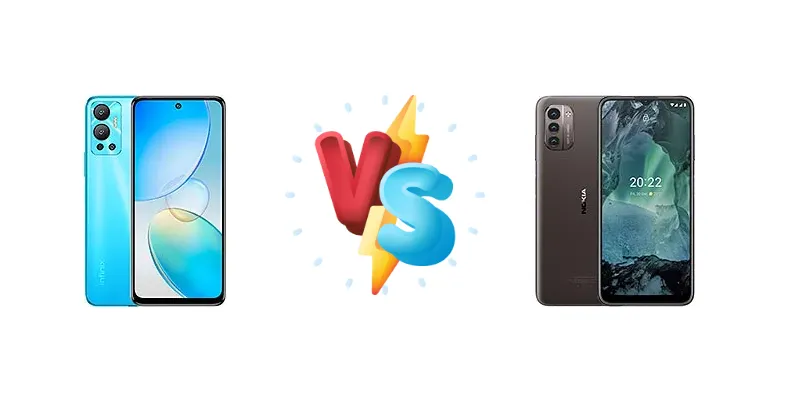
The sub-$150 smartphone market is fiercely competitive. Both the Infinix Hot 12 and Nokia G21 aim to deliver essential features at an accessible price point, but they take different approaches. The Hot 12 prioritizes processing power with its MediaTek Helio G85, while the G21 focuses on longevity and a clean software experience, backed by a substantial endurance rating.
🏆 Quick Verdict
For users prioritizing gaming and responsiveness, the Infinix Hot 12 is the better choice due to its more powerful Helio G85 chipset. However, the Nokia G21 offers comparable battery life with the added benefit of PD3.0 charging, making it ideal for users who value all-day power and fast top-ups.
| Network |
|---|
| 2G bands | GSM 850 / 900 / 1800 / 1900 | GSM 850 / 900 / 1800 / 1900 |
| 3G bands | HSDPA 850 / 900 / 2100 | HSDPA 850 / 900 / 2100 - International |
| 4G bands | 1, 3, 5, 8, 38, 40, 41 | 1, 3, 5, 7, 8, 20, 28, 38, 40, 41 - International |
| Speed | HSPA, LTE | HSPA 42.2/5.76 Mbps, LTE Cat4 150/50 Mbps |
| Technology | GSM / HSPA / LTE | GSM / HSPA / LTE |
| | 1, 3, 7, 8, 20 | 1, 2, 3, 4, 5, 7, 8, 12, 17, 28, 40, 66 - LATAM |
| Launch |
|---|
| Announced | 2022, April 26 | 2022, February 14 |
| Status | Available. Released 2022, April 26 | Available. Released 2022, February 15 |
| Body |
|---|
| Build | Glass front, plastic back, plastic frame | Glass front, plastic frame, plastic back |
| Dimensions | 170.5 x 77.6 x 8.3 mm (6.71 x 3.06 x 0.33 in) | 164.6 x 75.9 x 8.5 mm (6.48 x 2.99 x 0.33 in) |
| SIM | Nano-SIM + Nano-SIM | · Nano-SIM· Nano-SIM + Nano-SIM |
| Weight | 195 g (6.88 oz) | 190 g (6.70 oz) |
| Display |
|---|
| Resolution | 720 x 1612 pixels, 20:9 ratio (~259 ppi density) | 720 x 1600 pixels, 20:9 ratio (~270 ppi density) |
| Size | 6.82 inches, 111.7 cm2 (~84.5% screen-to-body ratio) | 6.5 inches, 102.0 cm2 (~81.6% screen-to-body ratio) |
| Type | IPS LCD, 90Hz | IPS LCD, 90Hz, 400 nits (typ) |
| Platform |
|---|
| CPU | Octa-core (2x2.0 GHz Cortex-A75 & 6x1.8 GHz Cortex-A55) | Octa-core (2x1.6 GHz Cortex-A75 & 6x1.6 GHz Cortex-A55) |
| Chipset | Mediatek MT6769Z Helio G85 (12 nm) | Unisoc T606 (12 nm) |
| GPU | Mali-G52 MC2 | Mali-G57 MP1 |
| OS | Android 12, XOS 10.6 | Android 11, upgradable to Android 13 |
| Memory |
|---|
| Card slot | microSDXC (dedicated slot) | microSDXC (dedicated slot) |
| Internal | 128GB 4GB RAM, 128GB 6GB RAM | 64GB 3GB RAM, 64GB 4GB RAM, 128GB 4GB RAM, 128GB 6GB RAM |
| | - | eMMC 5.1 |
| Main Camera |
|---|
| Features | Dual-LED flash | LED flash, HDR, panorama |
| Single | 8 MP | 8 MP, f/2.0, (wide) |
| Triple | 13 MP, f/1.8, (wide), AF
2 MP
Auxiliary lens | 50 MP, f/1.8, 28mm (wide), 1/2.76", 0.64µm, PDAF
2 MP (macro)
Auxiliary lens |
| Video | 1080p@30fps | 1080p@30fps |
| Selfie camera |
|---|
| Features | Dual-LED flash | - |
| Single | 8 MP | 8 MP, f/2.0, (wide) |
| Video | 1080p@30fps | 1080p@30fps |
| Sound |
|---|
| 3.5mm jack | Yes | Yes |
| 35mm jack | Yes | Yes |
| Loudspeaker | Yes, with dual speakers | Yes |
| Comms |
|---|
| Bluetooth | Yes | 5.0, A2DP, LE |
| NFC | No | Yes (market/region dependent) |
| Positioning | GPS | GPS, GLONASS, GALILEO |
| Radio | FM radio | FM radio, RDS |
| USB | Yes | USB Type-C 2.0, OTG |
| WLAN | Wi-Fi 802.11 a/b/g/n/ac, dual-band | Wi-Fi 802.11 a/b/g/n/ac, dual-band, Wi-Fi Direct |
| Features |
|---|
| Sensors | Fingerprint (side-mounted), accelerometer, proximity, compass | Fingerprint (side-mounted), accelerometer, proximity |
| Battery |
|---|
| Charging | 18W wired | 18W wired, PD3.0 |
| Type | Li-Ion 5000 mAh | Li-Po 5050 mAh |
| Misc |
|---|
| Colors | Racing Black, Legend White, Origin Blue, Lucky Green | Nordic Blue, Dusk |
| Models | X6817, X6817B | TA-1418, TA-1477, TA-1415, TA-1405, TA-1404, TA-1412 |
| Price | About 150 EUR | About 90 EUR |
| SAR | - | 1.00 W/kg (head) 1.10 W/kg (body) |
| SAR EU | - | 0.34 W/kg (head) 1.05 W/kg (body) |
| Tests |
|---|
| Battery life | - |
Endurance rating 126h
|
| Camera | - |
Photo / Video |
| Display | - |
Contrast ratio: 1631:1 (nominal) |
| Loudspeaker | - |
-30.7 LUFS (Below average)
|
| Performance | - |
AnTuTu: 171299 (v9)
GeekBench: 1193 (v5.1)
GFXBench: 8.9fps (ES 3.1 onscreen) |
Infinix Hot 12
- More powerful Helio G85 chipset for better performance
- Potentially better gaming experience
- Faster application loading times
- Likely shorter battery life compared to Nokia G21
- Standard 18W charging (no PD3.0)
Nokia G21
- Excellent battery life (126h endurance rating)
- PD3.0 charging for faster and more versatile charging
- Clean Android experience (typical of Nokia)
- Less powerful Unisoc T606 chipset
- Slower performance in demanding tasks
Display Comparison
Both phones lack detailed display specifications beyond the Nokia G21’s measured 500 nits of brightness and 1631:1 contrast ratio. While the contrast ratio is identical on paper, the actual viewing experience will likely differ based on panel quality and color calibration. The absence of refresh rate information suggests both devices operate at the standard 60Hz, which is typical for this price bracket. The Nokia G21’s brightness is a key advantage for outdoor visibility.
Camera Comparison
Both phones list 'Photo / Video' capabilities, but lack specific details regarding sensor size, aperture, or image processing features. This suggests a focus on basic photography rather than advanced features. Without further information, it’s difficult to assess camera quality. The presence of a 2MP macro lens on either device is unlikely to significantly impact image quality, serving primarily as a marketing feature. Real-world image samples would be necessary to determine which phone delivers better results.
Performance
The Infinix Hot 12’s MediaTek Helio G85, with its octa-core configuration (2x2.0 GHz Cortex-A75 & 6x1.8 GHz Cortex-A55), offers a clear performance advantage over the Nokia G21’s Unisoc T606 (2x1.6 GHz Cortex-A75 & 6x1.6 GHz Cortex-A55). The higher clock speeds of the Cortex-A75 cores in the Helio G85 translate to faster application launches and smoother multitasking. While both chipsets are built on a 12nm process, the G85’s architecture is optimized for gaming, making it the better choice for mobile gamers. The Unisoc T606 prioritizes efficiency, potentially contributing to slightly better battery life under light loads.
Battery Life
The Nokia G21 boasts an endurance rating of 126 hours, indicating excellent battery life. While the Infinix Hot 12’s battery capacity isn’t specified, the more powerful Helio G85 will likely consume more power. However, the Nokia G21’s inclusion of PD3.0 charging offers a faster and more versatile charging experience compared to the Infinix Hot 12’s standard 18W wired charging. PD3.0 allows for negotiation of optimal voltage and current, potentially reducing charging times and improving battery health.
Buying Guide
Buy the Infinix Hot 12 if you need a phone for casual gaming, multitasking, and generally snappy performance. Its Helio G85 provides a noticeable edge in application loading and responsiveness. Buy the Nokia G21 if you prioritize battery life, a clean Android experience, and reliable charging with PD3.0 support – perfect for users who are often away from a power outlet and prefer a streamlined interface.
Frequently Asked Questions
❓ Will the Infinix Hot 12 struggle with graphically intensive games like PUBG Mobile?
While the Helio G85 can handle PUBG Mobile, you'll likely need to lower the graphics settings to achieve a consistently smooth frame rate. The G85 is capable, but it's not a flagship gaming chip, so expect some compromises.
❓ Does the Nokia G21's PD3.0 charging work with all USB-C chargers?
PD3.0 is a standard, but not all USB-C chargers support it. To take full advantage of the Nokia G21's fast charging capabilities, you'll need a USB-C charger that specifically supports the Power Delivery 3.0 protocol. Using a standard charger will still work, but at a slower speed.
❓ How does the software experience differ between the Infinix Hot 12 and Nokia G21?
Nokia is known for its near-stock Android experience, offering a clean and bloatware-free interface. Infinix, on the other hand, typically includes its own custom UI, which may come with pre-installed apps and a different aesthetic. This can impact performance and user preference.
❓ Is the Unisoc T606 chipset in the Nokia G21 sufficient for everyday tasks like browsing and social media?
Yes, the Unisoc T606 is perfectly adequate for everyday tasks like web browsing, social media, and messaging. It won't be the fastest, but it will provide a smooth and responsive experience for these common use cases.