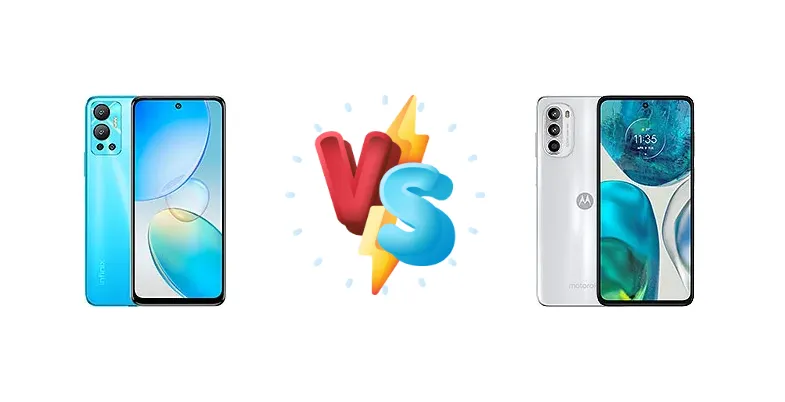
The sub-$200 smartphone market is fiercely competitive. The Infinix Hot 12 and Motorola Moto G52 both aim to deliver a compelling experience without breaking the bank, but they take different approaches. The Hot 12 prioritizes raw processing power with its Helio G85, while the Moto G52 focuses on efficiency and faster charging with the Snapdragon 680. This comparison will dissect their strengths and weaknesses to determine which device offers the best value.
🏆 Quick Verdict
For the average user prioritizing all-day battery life and quicker charging, the Motorola Moto G52 is the better choice. Its Snapdragon 680, built on a more efficient 6nm process, provides adequate performance while the 30W charging significantly reduces downtime. However, gamers or those needing more demanding app performance may find the Infinix Hot 12's Helio G85 slightly more appealing.
| Network |
|---|
| 2G bands | GSM 850 / 900 / 1800 / 1900 | GSM 850 / 900 / 1800 / 1900 |
| 3G bands | HSDPA 850 / 900 / 2100 | HSDPA 850 / 900 / 1700(AWS) / 1900 / 2100 |
| 4G bands | 1, 3, 5, 8, 38, 40, 41 | LTE |
| Speed | HSPA, LTE | HSPA, LTE |
| Technology | GSM / HSPA / LTE | GSM / HSPA / LTE |
| | 1, 3, 7, 8, 20 | - |
| Launch |
|---|
| Announced | 2022, April 26 | 2022, April 12 |
| Status | Available. Released 2022, April 26 | Available. Released 2022, April 20 |
| Body |
|---|
| Build | Glass front, plastic back, plastic frame | - |
| Dimensions | 170.5 x 77.6 x 8.3 mm (6.71 x 3.06 x 0.33 in) | 160.1 x 74.5 x 8 mm (6.30 x 2.93 x 0.31 in) |
| SIM | Nano-SIM + Nano-SIM | Nano-SIM + Nano-SIM |
| Weight | 195 g (6.88 oz) | 169 g (5.96 oz) |
| | - | Water-repellent design |
| Display |
|---|
| Resolution | 720 x 1612 pixels, 20:9 ratio (~259 ppi density) | 1080 x 2400 pixels, 20:9 ratio (~402 ppi density) |
| Size | 6.82 inches, 111.7 cm2 (~84.5% screen-to-body ratio) | 6.6 inches, 103.6 cm2 (~86.9% screen-to-body ratio) |
| Type | IPS LCD, 90Hz | AMOLED, 90Hz |
| Platform |
|---|
| CPU | Octa-core (2x2.0 GHz Cortex-A75 & 6x1.8 GHz Cortex-A55) | Octa-core (4x2.4 GHz Kryo 265 Gold & 4x1.9 GHz Kryo 265 Silver) |
| Chipset | Mediatek MT6769Z Helio G85 (12 nm) | Qualcomm SM6225 Snapdragon 680 4G (6 nm) |
| GPU | Mali-G52 MC2 | Adreno 610 |
| OS | Android 12, XOS 10.6 | Android 12, planned upgrade to Android 13 |
| Memory |
|---|
| Card slot | microSDXC (dedicated slot) | microSDXC (uses shared SIM slot) |
| Internal | 128GB 4GB RAM, 128GB 6GB RAM | 64GB 4GB RAM, 128GB 4GB RAM, 128GB 6GB RAM, 256GB 6GB RAM |
| Main Camera |
|---|
| Features | Dual-LED flash | LED flash, HDR, panorama |
| Single | 8 MP | - |
| Triple | 13 MP, f/1.8, (wide), AF
2 MP
Auxiliary lens | 50 MP, f/1.8 (wide), 1/2.76", 0.64µm, PDAF
8 MP, f/2.2, 118˚ (ultrawide), 1/4.0", 1.12µm
2 MP (macro) |
| Video | 1080p@30fps | 1080p@30fps |
| Selfie camera |
|---|
| Features | Dual-LED flash | - |
| Single | 8 MP | 16 MP, f/2.5, (wide), 1.0µm |
| Video | 1080p@30fps | 1080p@30fps |
| Sound |
|---|
| 3.5mm jack | Yes | Yes |
| 35mm jack | Yes | Yes |
| Loudspeaker | Yes, with dual speakers | Yes, with stereo speakers |
| Comms |
|---|
| Bluetooth | Yes | 5.0, A2DP, LE |
| NFC | No | Yes (market/region dependent) |
| Positioning | GPS | GPS, GLONASS, GALILEO |
| Radio | FM radio | Unspecified |
| USB | Yes | USB Type-C 2.0 |
| WLAN | Wi-Fi 802.11 a/b/g/n/ac, dual-band | Wi-Fi 802.11 a/b/g/n/ac, dual-band, Wi-Fi Direct |
| Features |
|---|
| Sensors | Fingerprint (side-mounted), accelerometer, proximity, compass | Fingerprint (side-mounted), accelerometer, gyro, proximity, compass |
| Battery |
|---|
| Charging | 18W wired | 30W wired |
| Type | Li-Ion 5000 mAh | Li-Po 5000 mAh |
| Misc |
|---|
| Colors | Racing Black, Legend White, Origin Blue, Lucky Green | Charcoal Gray, Porcelain White |
| Models | X6817, X6817B | XT2221-1, XT2221-2 |
| Price | About 150 EUR | About 470 EUR |
Infinix Hot 12
- Potentially better peak CPU performance for demanding tasks.
- May offer slightly better gaming performance due to the higher clocked cores.
- Generally more affordable upfront cost.
- Less power-efficient chipset (12nm process).
- Slower charging speed (18W).
- Likely shorter battery life.
Motorola Moto G52
- More power-efficient chipset (6nm process).
- Faster charging speed (30W).
- Likely longer battery life.
- Smoother overall user experience due to efficient processing.
- Potentially lower peak CPU performance compared to the Helio G85.
- May be slightly more expensive upfront.
Display Comparison
Neither device boasts a standout display. While specific panel details (like peak brightness or color gamut coverage) are unavailable, the focus here is on efficiency. Both likely utilize LCD panels common in this price bracket. The lack of high refresh rates is expected. The real difference lies in the underlying chipset's impact on power draw, indirectly affecting screen-on time.
Camera Comparison
Without detailed camera specs beyond the chipsets, a direct comparison is limited. Both phones likely feature a primary camera and supporting lenses. The image signal processor (ISP) within the Snapdragon 680 generally offers better image processing capabilities, potentially resulting in more detailed and dynamic photos, particularly in challenging lighting conditions. The Helio G85’s ISP is adequate, but likely won’t match the Snapdragon’s refinement. Expect both to struggle with low-light photography.
Performance
The core difference lies in the chipsets. The Motorola Moto G52’s Qualcomm Snapdragon 680 (6nm) is architecturally superior to the Infinix Hot 12’s MediaTek Helio G85 (12nm). The 6nm process inherently offers better power efficiency, translating to less heat generation and sustained performance. While the Helio G85’s Cortex-A75 cores offer a higher peak clock speed (2.0 GHz vs 2.4 GHz on the Snapdragon’s Kryo 265 Gold), the Snapdragon’s more modern architecture and efficient manufacturing process likely provide a smoother overall experience, especially under sustained load. The Snapdragon 680’s 4x2.4 GHz cores will provide a noticeable boost in single-core performance, beneficial for app launch times and responsiveness.
Battery Life
The Motorola Moto G52’s 30W charging is a significant advantage over the Infinix Hot 12’s 18W charging. This translates to a much faster 0-100% charge time, minimizing downtime. While battery capacity isn’t specified, the Snapdragon 680’s superior efficiency means the Moto G52 will likely deliver longer battery life despite potentially having a similar or even slightly smaller battery capacity. The 6nm process allows for more efficient power management, extending screen-on time and reducing standby drain.
Buying Guide
Buy the Infinix Hot 12 if you need a phone primarily for casual gaming and running multiple apps simultaneously, and are willing to compromise on battery life and charging speed. Buy the Motorola Moto G52 if you prioritize long-lasting battery, fast charging, and a smooth, efficient user experience for everyday tasks like browsing, social media, and communication.
Frequently Asked Questions
❓ Will the Snapdragon 680 in the Moto G52 struggle with graphically intensive games like PUBG Mobile?
While not a gaming powerhouse, the Snapdragon 680 is capable of running PUBG Mobile at medium settings with stable frame rates. The 6nm process helps prevent significant throttling during extended gaming sessions, offering a more consistent experience than the Helio G85 might provide under similar conditions.
❓ How much faster is the 30W charging on the Moto G52 compared to the 18W charging on the Hot 12?
The 30W charging on the Moto G52 will significantly reduce charging times. Expect a full charge in approximately 60-75 minutes, compared to potentially 90-120 minutes for the Infinix Hot 12. This difference is particularly noticeable for users who frequently need to top up their battery throughout the day.
❓ Is the difference in chipset architecture noticeable in everyday tasks like browsing and social media?
Yes, the Snapdragon 680’s more modern architecture and efficient process will result in a smoother and more responsive experience during everyday tasks. App launch times will be quicker, scrolling will be more fluid, and the phone will feel generally more snappy compared to the Infinix Hot 12.