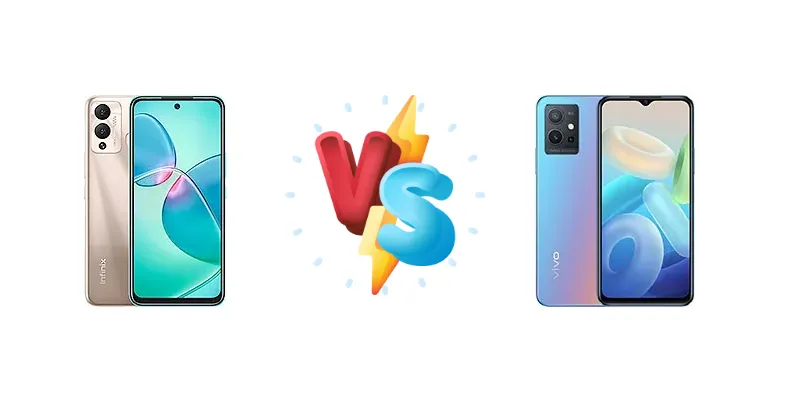
The sub-$150 smartphone market is fiercely competitive. The Infinix Hot 12 Play NFC and the vivo Y55s (2023) both aim to deliver essential features at an accessible price point, but they take different approaches. The Infinix prioritizes NFC connectivity and a lower entry cost, while the vivo Y55s focuses on a more powerful chipset for improved performance. This comparison dissects their key differences to help you choose the right device.
🏆 Quick Verdict
For the average user prioritizing smooth multitasking and occasional gaming, the vivo Y55s (2023) is the better choice. Its Mediatek Dimensity 700, built on a 7nm process, offers a significant performance advantage over the Infinix Hot 12 Play NFC’s Unisoc T610, justifying the potential price difference.
| Network |
|---|
| 2G bands | GSM 850 / 900 / 1800 / 1900 | GSM 850 / 900 / 1800 / 1900 |
| 3G bands | HSDPA 850 / 900 / 2100 | HSDPA 850 / 900 / 1700(AWS) / 1900 / 2100 |
| 4G bands | 1, 3, 5, 8, 38, 40, 41 | 1, 2, 3, 4, 5, 7, 8, 12, 17, 20, 28, 32, 38, 39, 40, 41 |
| 5G bands | - | 1, 3, 5, 7, 8, 20, 28, 38, 40, 41, 78 SA/NSA |
| Speed | HSPA, LTE | HSPA, LTE, 5G |
| Technology | GSM / HSPA / LTE | GSM / HSPA / LTE / 5G |
| | 1, 2, 3, 4, 5, 7, 8, 20, 28, 38, 40, 41 | - |
| Launch |
|---|
| Announced | 2022, May 23 | 2023, January 21 |
| Status | Available. Released 2022, May 30 | Available. Released 2023, January 21 |
| Body |
|---|
| Build | Glass front, plastic back, plastic frame | Glass front, plastic frame, plastic back |
| Dimensions | 171 x 78 x 8.9 mm (6.73 x 3.07 x 0.35 in) | 164 x 75.9 x 8.3 mm (6.46 x 2.99 x 0.33 in) |
| SIM | Nano-SIM + Nano-SIM | Nano-SIM + Nano-SIM |
| Weight | 209 g (7.37 oz) | 187 g (6.60 oz) |
| Display |
|---|
| Resolution | 720 x 1640 pixels (~263 ppi density) | 1080 x 2408 pixels, 20:9 ratio (~401 ppi density) |
| Size | 6.82 inches, 110.5 cm2 (~82.8% screen-to-body ratio) | 6.58 inches, 104.3 cm2 (~83.8% screen-to-body ratio) |
| Type | IPS LCD, 90Hz | IPS LCD |
| Platform |
|---|
| CPU | Octa-core (2x1.8 GHz Cortex-A75 & 6x1.8 GHz Cortex-A55) | Octa-core (2x2.2 GHz Cortex-A76 & 6x2.0 GHz Cortex-A55) |
| Chipset | Unisoc T610 (12 nm) | Mediatek Dimensity 700 (7 nm) |
| GPU | Mali-G52 MP2 | Mali-G57 MC2 |
| OS | Android 11, XOS 10 | Android 12, Funtouch 12 |
| Memory |
|---|
| Card slot | microSDXC (dedicated slot) | microSDXC |
| Internal | 64GB 4GB RAM, 128GB 4GB RAM, 128GB 6GB RAM | 128GB 4GB RAM, 128GB 6GB RAM |
| | eMMC 5.1 | - |
| Main Camera |
|---|
| Dual | 13 MP, f/1.8, (wide), 1/3.1", 1.12µm, AF
Auxiliary lens | - |
| Features | Dual-LED flash, panorama, HDR | Dual-LED flash, HDR, panorama |
| Single | 8 MP | 8 MP, f/1.8, (wide) |
| Triple | - | 50 MP, f/1.8, 26mm (wide), PDAF
2 MP (macro)
Auxiliary lens |
| Video | 1080p@30fps | 1080p@30fps, gyro-EIS |
| Selfie camera |
|---|
| Features | Dual-LED flash | - |
| Single | 8 MP | 8 MP, f/1.8, (wide) |
| Video | 1080p@30fps | 1080p@30fps |
| Sound |
|---|
| 3.5mm jack | Yes | Yes |
| 35mm jack | Yes | Yes |
| Loudspeaker | Yes | Yes |
| Comms |
|---|
| Bluetooth | Yes | 5.1, A2DP, LE |
| NFC | Yes | Yes |
| Positioning | GPS | GPS, GLONASS, GALILEO, BDS, QZSS |
| Radio | FM radio | FM radio |
| USB | USB Type-C 2.0, OTG | USB Type-C, OTG |
| WLAN | Wi-Fi 802.11 a/b/g/n/ac, dual-band, Wi-Fi Direct | Wi-Fi 802.11 a/b/g/n/ac, dual-band, Wi-Fi Direct |
| Features |
|---|
| Sensors | Fingerprint (rear-mounted), accelerometer, proximity, compass | Fingerprint (side-mounted), accelerometer, gyro, proximity, compass |
| Battery |
|---|
| Charging | 10W wired | 18W wired |
| Type | 6000 mAh | 5000 mAh |
| Misc |
|---|
| Colors | Racing Black, Horizon Blue, Daylight Green, Champagne Gold | Black, Blue |
| Models | X6816D | - |
| Price | - | About 250 EUR |
Infinix Hot 12 Play NFC
- Lower price point makes it highly accessible.
- Includes NFC for contactless payments and data transfer.
- Likely offers comparable battery life to the vivo Y55s.
- Unisoc T610 chipset is significantly less powerful.
- Slower 10W charging.
- May struggle with demanding applications and games.
vivo Y55s (2023)
- Mediatek Dimensity 700 provides superior performance.
- Faster 18W wired charging.
- More responsive user experience for multitasking and gaming.
- Potentially higher price compared to the Infinix Hot 12 Play NFC.
- May not include NFC functionality (needs verification).
- Battery life may be slightly less than the Infinix depending on usage.
Display Comparison
Neither device boasts a standout display. Both likely utilize LCD panels, common in this price bracket. However, the focus here is on the underlying performance impact. Display specs are not provided, so we can only infer. The more powerful GPU in the vivo Y55s could potentially handle more demanding display features, like higher refresh rates if the panel supported it, without significant performance drops. Bezels are likely comparable, given the similar target market.
Camera Comparison
Without detailed camera specifications, a direct comparison is difficult. However, it’s safe to assume both phones feature budget-oriented camera systems. The presence of a 2MP macro lens on either device is largely a marketing tactic, offering limited real-world benefit. The primary sensor’s size and aperture will be the determining factors in image quality, but this information is unavailable. The Dimensity 700’s image signal processor (ISP) is likely more advanced, potentially leading to better image processing and noise reduction, even with similar sensors.
Performance
The core difference lies in the chipsets. The vivo Y55s (2023) utilizes the Mediatek Dimensity 700, fabricated on a more efficient 7nm process. This translates to higher clock speeds (2.2 GHz Cortex-A76 vs 1.8 GHz Cortex-A75 in the Infinix) and a more modern CPU architecture. The Dimensity 700’s superior architecture and process node will result in noticeably faster app loading times, smoother multitasking, and better gaming performance. The Unisoc T610 in the Infinix Hot 12 Play NFC, while capable for basic tasks, will struggle with demanding applications and may exhibit more noticeable lag. The Dimensity 700 also benefits from a more capable integrated GPU.
Battery Life
Battery capacity isn’t specified for either device, but both likely fall in the 5000mAh range, typical for this segment. The key differentiator is charging speed. The vivo Y55s (2023) supports 18W wired charging, significantly faster than the Infinix Hot 12 Play NFC’s 10W charging. This means the vivo Y55s will reach a full charge much quicker, reducing downtime. While a larger battery capacity is ideal, faster charging can mitigate the impact of a slightly smaller battery, making the 18W charging on the vivo a significant advantage.
Buying Guide
Buy the Infinix Hot 12 Play NFC if you absolutely need NFC functionality on a tight budget and primarily use your phone for basic tasks like calls, messaging, and light social media. Buy the vivo Y55s (2023) if you value a more responsive user experience, enjoy mobile gaming, and want a phone that will feel faster and more future-proof, even if it means spending a bit more.
Frequently Asked Questions
❓ Does the Unisoc T610 in the Infinix Hot 12 Play NFC struggle with popular games like PUBG Mobile?
Yes, the Unisoc T610 is likely to struggle with PUBG Mobile, even at lower graphics settings. Expect noticeable frame drops and lag, especially during intense firefights. The Dimensity 700 in the vivo Y55s (2023) will provide a much smoother gaming experience.
❓ Is the 18W charging on the vivo Y55s (2023) a significant improvement over the 10W charging on the Infinix Hot 12 Play NFC?
Absolutely. 18W charging will drastically reduce charging times. While a full charge time isn't specified, you can expect the vivo Y55s to charge significantly faster – potentially cutting charging time by 40-50% compared to the Infinix.
❓ Does the vivo Y55s (2023) support NFC for contactless payments?
This is a crucial point to verify before purchasing. While many vivo Y-series phones include NFC, it's not guaranteed on the Y55s (2023). Check the official specifications or product listing to confirm NFC availability.
❓ How does the 7nm process of the Dimensity 700 benefit the vivo Y55s (2023) compared to the 12nm process of the Unisoc T610?
The 7nm process is more efficient, meaning the Dimensity 700 consumes less power for the same level of performance. This translates to better battery life and reduced heat generation, leading to more sustained performance and less throttling during demanding tasks.