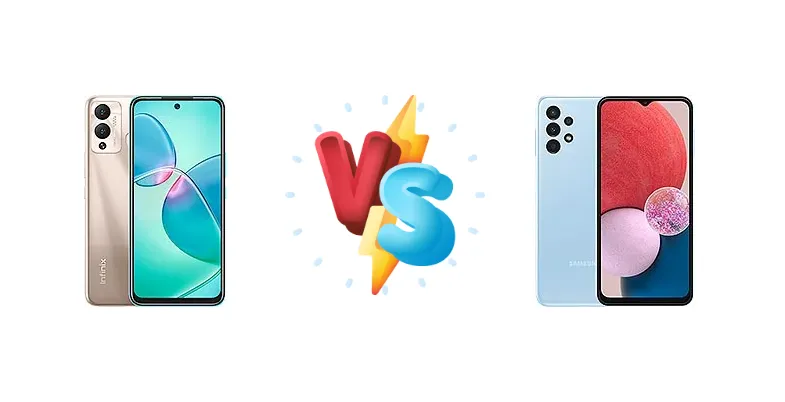
The sub-$150 smartphone market is fiercely competitive. Both the Infinix Hot 12 Play NFC and the Samsung Galaxy A13 (SM-A137) aim to deliver essential smartphone functionality at an accessible price. This comparison dissects their core components – from chipsets to charging – to determine which device offers the best value for budget-conscious consumers.
🏆 Quick Verdict
For most users, the Samsung Galaxy A13 emerges as the slightly better choice. While the Infinix Hot 12 Play NFC offers NFC connectivity, the Galaxy A13’s more powerful Mediatek Helio G80 chipset provides a noticeable performance edge in everyday tasks and light gaming, justifying the small price difference.
| Network |
|---|
| 2G bands | GSM 850 / 900 / 1800 / 1900 | GSM 850 / 900 / 1800 / 1900 |
| 3G bands | HSDPA 850 / 900 / 2100 | HSDPA 850 / 900 / 2100 |
| 4G bands | 1, 3, 5, 8, 38, 40, 41 | 1, 3, 5, 7, 8, 20, 28, 38, 40, 41 |
| Speed | HSPA, LTE | HSPA, LTE |
| Technology | GSM / HSPA / LTE | GSM / HSPA / LTE |
| | 1, 2, 3, 4, 5, 7, 8, 20, 28, 38, 40, 41 | - |
| Launch |
|---|
| Announced | 2022, May 23 | 2022, June |
| Status | Available. Released 2022, May 30 | Available. Released 2022, July |
| Body |
|---|
| Build | Glass front, plastic back, plastic frame | Glass front (Gorilla Glass 5), plastic frame, plastic back |
| Dimensions | 171 x 78 x 8.9 mm (6.73 x 3.07 x 0.35 in) | 165.1 x 76.4 x 8.8 mm (6.5 x 3.01 x 0.35 in) |
| SIM | Nano-SIM + Nano-SIM | · Nano-SIM· Nano-SIM + Nano-SIM |
| Weight | 209 g (7.37 oz) | 195 g (6.88 oz) |
| Display |
|---|
| Protection | - | Corning Gorilla Glass 5 |
| Resolution | 720 x 1640 pixels (~263 ppi density) | 1080 x 2408 pixels, 20:9 ratio (~400 ppi density) |
| Size | 6.82 inches, 110.5 cm2 (~82.8% screen-to-body ratio) | 6.6 inches, 104.9 cm2 (~83.2% screen-to-body ratio) |
| Type | IPS LCD, 90Hz | PLS LCD |
| Platform |
|---|
| CPU | Octa-core (2x1.8 GHz Cortex-A75 & 6x1.8 GHz Cortex-A55) | Octa-core (2x2.0 GHz Cortex-A75 & 6x1.8 GHz Cortex-A55) |
| Chipset | Unisoc T610 (12 nm) | Mediatek MT6769V/CU Helio G80 (12 nm) |
| GPU | Mali-G52 MP2 | Mali-G52 MC2 |
| OS | Android 11, XOS 10 | Android 12, upgradable to Android 14, One UI 6.1 |
| Memory |
|---|
| Card slot | microSDXC (dedicated slot) | microSDXC (dedicated slot) |
| Internal | 64GB 4GB RAM, 128GB 4GB RAM, 128GB 6GB RAM | 32GB 3GB RAM, 32GB 4GB RAM, 64GB 4GB RAM, 128GB 4GB RAM |
| | eMMC 5.1 | eMMC 5.1 |
| Main Camera |
|---|
| Dual | 13 MP, f/1.8, (wide), 1/3.1", 1.12µm, AF
Auxiliary lens | - |
| Features | Dual-LED flash, panorama, HDR | LED flash, panorama, HDR |
| Quad | - | 50 MP, f/1.8, (wide), PDAF
5 MP, f/2.2, 123˚ (ultrawide), 1/5.0", 1.12µm
2 MP (macro)
Auxiliary lens |
| Single | 8 MP | 8 MP, f/2.2, (wide) |
| Video | 1080p@30fps | 1080p@30fps |
| Selfie camera |
|---|
| Features | Dual-LED flash | - |
| Single | 8 MP | 8 MP, f/2.2, (wide) |
| Video | 1080p@30fps | 1080p@30fps |
| Sound |
|---|
| 3.5mm jack | Yes | Yes |
| 35mm jack | Yes | Yes |
| Loudspeaker | Yes | Yes |
| Comms |
|---|
| Bluetooth | Yes | 5.2, A2DP, LE |
| NFC | Yes | Yes |
| Positioning | GPS | GPS, GLONASS, GALILEO, BDS |
| Radio | FM radio | No |
| USB | USB Type-C 2.0, OTG | USB Type-C 2.0, OTG |
| WLAN | Wi-Fi 802.11 a/b/g/n/ac, dual-band, Wi-Fi Direct | Wi-Fi 802.11 a/b/g/n/ac, dual-band, Wi-Fi Direct |
| Features |
|---|
| Sensors | Fingerprint (rear-mounted), accelerometer, proximity, compass | Fingerprint (side-mounted), accelerometer, compass |
| | - | Virtual proximity sensing |
| Battery |
|---|
| Charging | 10W wired | 15W wired |
| Type | 6000 mAh | Li-Po 5000 mAh |
| Misc |
|---|
| Colors | Racing Black, Horizon Blue, Daylight Green, Champagne Gold | Black, White, Blue |
| Models | X6816D | SM-A137F, SM-A137F/DSN, SM-A137F/DS |
| Price | - | About 180 EUR |
| SAR EU | - | 0.35 W/kg (head) 1.22 W/kg (body) |
Infinix Hot 12 Play NFC
- Lower price point makes it highly accessible.
- Includes NFC for contactless payments and pairing.
- Potentially longer battery life due to less demanding chipset.
- Unisoc T610 chipset offers lower performance than the Helio G80.
- Slower 10W charging.
- Likely less refined software experience.
Samsung Galaxy A13 (SM-A137)
- More powerful Mediatek Helio G80 chipset for smoother performance.
- Faster 15W charging.
- Samsung’s established brand and software support.
- Slightly higher price compared to the Infinix Hot 12 Play NFC.
- NFC is not included.
- 2MP macro camera is of limited practical use.
Display Comparison
Neither device boasts a standout display. Both likely utilize LCD panels, common in this price bracket. The focus here isn't on visual fidelity. However, the lack of detailed display specs (resolution, brightness) means a direct comparison is difficult. The real-world impact will likely be similar – adequate for basic consumption but not ideal for extended media viewing. Bezels are expected to be substantial on both.
Camera Comparison
Camera performance is likely to be similar, with both devices relying on budget sensors. Without detailed sensor size information, it’s difficult to make a definitive statement. However, the inclusion of a 2MP macro lens on the Galaxy A13 is largely a marketing gimmick; its utility is limited. The primary sensor’s quality and image processing algorithms will be the deciding factors, and Samsung’s experience in this area likely gives it a slight edge. Expect acceptable results in good lighting conditions, but struggles in low light.
Performance
The core difference lies in the chipsets. The Samsung Galaxy A13’s Mediatek Helio G80, with its 2x2.0 GHz Cortex-A75 cores, offers a slight clock speed advantage over the Infinix Hot 12 Play NFC’s Unisoc T610 (2x1.8 GHz Cortex-A75). While both utilize the same Cortex-A75/A55 architecture, the higher clock speed translates to snappier app launches and smoother multitasking on the Galaxy A13. The Helio G80 also has a more capable GPU, offering a better gaming experience, even if limited to lower settings. Both phones likely feature similar RAM configurations, but the chipset difference is the dominant factor.
Battery Life
Both phones feature modest battery capacities, typical for their price range. The Samsung Galaxy A13’s 15W charging is a clear advantage over the Infinix Hot 12 Play NFC’s 10W charging. This translates to significantly faster charging times, reducing downtime. While the Infinix might offer slightly longer battery life due to the less powerful chipset, the convenience of quicker charging on the Galaxy A13 is a significant benefit for users who rely heavily on their phones throughout the day.
Buying Guide
Buy the Infinix Hot 12 Play NFC if you absolutely require NFC functionality for mobile payments or quick pairing and are prioritizing the lowest possible price. Buy the Samsung Galaxy A13 (SM-A137) if you prioritize smoother performance for social media, streaming, and casual gaming, and value Samsung’s established brand reputation and software support.
Frequently Asked Questions
❓ Does the Unisoc T610 in the Infinix Hot 12 Play NFC struggle with multitasking?
The Unisoc T610 is a capable chipset for basic tasks, but it can exhibit slowdowns when handling numerous apps simultaneously. Users who frequently switch between applications or run demanding apps may experience lag. The Samsung Galaxy A13’s Helio G80 handles multitasking more efficiently.
❓ Is the 15W charging on the Samsung Galaxy A13 a significant improvement over the Infinix Hot 12 Play NFC’s 10W charging?
Yes, the 15W charging on the Galaxy A13 is noticeably faster. While both phones will take several hours to fully charge, the Galaxy A13 will reach a usable charge level much quicker, making it more convenient for users who need to top up their battery quickly.
❓ Can the Samsung Galaxy A13 handle popular games like PUBG Mobile?
The Helio G80 in the Galaxy A13 can run PUBG Mobile, but you’ll likely need to lower the graphics settings to achieve a smooth frame rate. Expect to play at medium or low settings for a playable experience. The Infinix Hot 12 Play NFC will likely require even lower settings.
❓ How important is NFC functionality on the Infinix Hot 12 Play NFC?
NFC is crucial for contactless payments via Google Pay or Samsung Pay, and for quick pairing with Bluetooth devices. If you frequently use these features, the Infinix Hot 12 Play NFC is the only option between these two. Otherwise, it's a less critical feature.