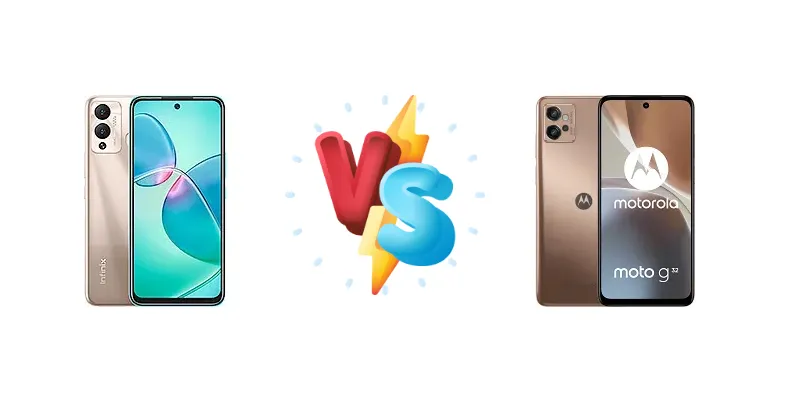
The sub-$200 smartphone market is fiercely competitive. The Infinix Hot 12 Play NFC and Motorola Moto G32 both aim to deliver essential features at an accessible price point, but they take different approaches. The Infinix prioritizes NFC connectivity and a lower entry price, while the Motorola focuses on a more efficient chipset and faster charging. This comparison dissects their key differences to help you choose the right device.
🏆 Quick Verdict
For most users, the Motorola Moto G32 emerges as the better choice. Its Snapdragon 680 chipset, fabricated on a 6nm process, offers superior efficiency and sustained performance compared to the Infinix Hot 12 Play NFC’s Unisoc T610. The 30W charging is a significant advantage, offsetting the slightly smaller battery capacity.
| Network |
|---|
| 2G bands | GSM 850 / 900 / 1800 / 1900 | GSM 850 / 900 / 1800 / 1900 |
| 3G bands | HSDPA 850 / 900 / 2100 | HSDPA 850 / 900 / 1900 / 2100 |
| 4G bands | 1, 3, 5, 8, 38, 40, 41 | 1, 3, 5, 7, 8, 20, 28, 38, 40, 41 |
| Speed | HSPA, LTE | HSPA, LTE |
| Technology | GSM / HSPA / LTE | GSM / HSPA / LTE |
| | 1, 2, 3, 4, 5, 7, 8, 20, 28, 38, 40, 41 | - |
| Launch |
|---|
| Announced | 2022, May 23 | 2022, July 28 |
| Status | Available. Released 2022, May 30 | Available. Released 2022, August 16 |
| Body |
|---|
| Build | Glass front, plastic back, plastic frame | Glass front, plastic frame, plastic back |
| Dimensions | 171 x 78 x 8.9 mm (6.73 x 3.07 x 0.35 in) | 161.8 x 73.8 x 8.5 mm (6.37 x 2.91 x 0.33 in) |
| SIM | Nano-SIM + Nano-SIM | · Nano-SIM· Nano-SIM + Nano-SIM |
| Weight | 209 g (7.37 oz) | 184 g (6.49 oz) |
| | - | Water-repellent design |
| Display |
|---|
| Resolution | 720 x 1640 pixels (~263 ppi density) | 1080 x 2400 pixels, 20:9 ratio (~405 ppi density) |
| Size | 6.82 inches, 110.5 cm2 (~82.8% screen-to-body ratio) | 6.5 inches, 102.0 cm2 (~85.4% screen-to-body ratio) |
| Type | IPS LCD, 90Hz | IPS LCD, 90Hz |
| Platform |
|---|
| CPU | Octa-core (2x1.8 GHz Cortex-A75 & 6x1.8 GHz Cortex-A55) | Octa-core (4x2.4 GHz Kryo 265 Gold & 4x1.9 GHz Kryo 265 Silver) |
| Chipset | Unisoc T610 (12 nm) | Qualcomm SM6225 Snapdragon 680 4G (6 nm) |
| GPU | Mali-G52 MP2 | Adreno 610 |
| OS | Android 11, XOS 10 | Android 12, upgradable to Android 13 |
| Memory |
|---|
| Card slot | microSDXC (dedicated slot) | microSDXC (dedicated slot) |
| Internal | 64GB 4GB RAM, 128GB 4GB RAM, 128GB 6GB RAM | 64GB 4GB RAM, 128GB 4GB RAM, 128GB 6GB RAM, 128GB 8GB RAM, 256GB 8GB RAM |
| | eMMC 5.1 | - |
| Main Camera |
|---|
| Dual | 13 MP, f/1.8, (wide), 1/3.1", 1.12µm, AF
Auxiliary lens | - |
| Features | Dual-LED flash, panorama, HDR | LED flash, HDR, panorama |
| Single | 8 MP | - |
| Triple | - | 50 MP, f/1.8 (wide), 1/2.76", 0.64µm, PDAF
8 MP, f/2.2, 118˚ (ultrawide), 1/4.0", 1.12µm
2 MP, f/2.4, (macro/depth) |
| Video | 1080p@30fps | 1080p@30fps |
| Selfie camera |
|---|
| Features | Dual-LED flash | - |
| Single | 8 MP | 16 MP, f/2.4, (wide), 1.0µm |
| Video | 1080p@30fps | 1080p@30fps |
| Sound |
|---|
| 3.5mm jack | Yes | Yes |
| 35mm jack | Yes | Yes |
| Loudspeaker | Yes | Yes, with stereo speakers |
| Comms |
|---|
| Bluetooth | Yes | 5.2, A2DP, LE |
| NFC | Yes | Yes (market/region dependent) |
| Positioning | GPS | GPS, GLONASS, GALILEO |
| Radio | FM radio | FM radio |
| USB | USB Type-C 2.0, OTG | USB Type-C 2.0 |
| WLAN | Wi-Fi 802.11 a/b/g/n/ac, dual-band, Wi-Fi Direct | Wi-Fi 802.11 a/b/g/n/ac, dual-band, Wi-Fi Direct |
| Features |
|---|
| Sensors | Fingerprint (rear-mounted), accelerometer, proximity, compass | Fingerprint (side-mounted), accelerometer, gyro, proximity, compass |
| Battery |
|---|
| Charging | 10W wired | 30W wired |
| Type | 6000 mAh | Li-Po 5000 mAh |
| Misc |
|---|
| Colors | Racing Black, Horizon Blue, Daylight Green, Champagne Gold | Mineral Grey, Satin Silver, Rose Gold |
| Models | X6816D | XT2235-2, XT2235-3 |
| Price | - | ₹ 8,990 |
Infinix Hot 12 Play NFC
- Lower price point makes it very accessible.
- Includes NFC for contactless payments.
- Potentially larger battery capacity (unconfirmed).
- Unisoc T610 chipset is less efficient and performs slower.
- Slow 10W charging.
- Likely inferior camera performance.
Motorola Moto G32
- More efficient Snapdragon 680 chipset.
- Significantly faster 30W charging.
- Better sustained performance for gaming and multitasking.
- May be slightly more expensive than the Infinix.
- NFC functionality not confirmed (check regional variants).
- Potentially smaller battery capacity (unconfirmed).
Display Comparison
Neither device boasts a standout display. Both likely utilize LCD panels, a common cost-saving measure in this segment. However, details like peak brightness and color gamut coverage are missing. The Moto G32’s display size is likely similar to the Hot 12 Play NFC, but the real difference lies elsewhere. The absence of high refresh rate panels on both devices means scrolling and animations won’t be as fluid as on more expensive phones.
Camera Comparison
Without detailed camera specs, a direct comparison is difficult. However, it’s safe to assume both phones feature budget-oriented camera systems. The main sensor quality will be the most significant factor. Given Motorola’s generally better image processing algorithms, the Moto G32 is likely to produce more pleasing images, even with a similar sensor. The inclusion of a 2MP macro camera on both devices is largely a marketing gimmick and offers limited practical value.
Performance
The core difference lies in the chipsets. The Motorola Moto G32’s Qualcomm Snapdragon 680 (6nm) is a clear upgrade over the Infinix Hot 12 Play NFC’s Unisoc T610 (12nm). The 6nm process node translates to significantly better power efficiency, meaning the Moto G32 will run cooler and maintain performance for longer periods, especially during gaming. The Snapdragon 680’s CPU configuration – 4x2.4 GHz Kryo 265 Gold & 4x1.9 GHz Kryo 265 Silver – also provides a performance advantage over the Unisoc T610’s 2x1.8 GHz Cortex-A75 & 6x1.8 GHz Cortex-A55. While both are octa-core, the Kryo cores are architecturally more advanced. This impacts app loading times, multitasking, and overall system responsiveness.
Battery Life
The Motorola Moto G32’s 30W wired charging is a game-changer in this price bracket. This will drastically reduce charging times compared to the Infinix Hot 12 Play NFC’s slow 10W charging. While the exact battery capacity of both devices isn't specified, the Snapdragon 680’s superior efficiency means the Moto G32 will likely offer comparable or even better real-world battery life despite potentially having a slightly smaller battery. The faster charging speed is a significant convenience factor.
Buying Guide
Buy the Infinix Hot 12 Play NFC if you absolutely need NFC functionality on a very tight budget and are willing to compromise on performance and charging speed. It’s ideal for users who primarily use their phone for basic communication and light tasks. Buy the Motorola Moto G32 if you prioritize a smoother user experience, better battery life due to chipset efficiency, and significantly faster charging. This phone suits users who enjoy occasional gaming, streaming, and want a more responsive device.
Frequently Asked Questions
❓ Will the Snapdragon 680 in the Moto G32 handle demanding games like PUBG Mobile?
The Snapdragon 680 is capable of running PUBG Mobile, but you’ll likely need to stick to medium graphics settings for a smooth experience. The 6nm process helps with thermal throttling, but it’s not a gaming powerhouse. The Infinix Hot 12 Play NFC will struggle more with demanding titles.
❓ How long will it take to fully charge the Motorola Moto G32 with the 30W charger?
While the exact 0-100% charge time isn't officially stated, expect it to take around 60-75 minutes with the included 30W charger. This is a significant improvement over the Infinix Hot 12 Play NFC, which will likely take over 3 hours with its 10W charger.
❓ Does the Infinix Hot 12 Play NFC support Google Pay or other NFC-based payment services?
Yes, the 'NFC' in the name confirms that the Infinix Hot 12 Play NFC supports NFC functionality, allowing you to use Google Pay and other contactless payment methods. However, availability may vary by region.
❓ Is the Unisoc T610 chipset known for overheating during prolonged use?
The Unisoc T610, being a 12nm chip, is more prone to overheating under sustained load compared to the 6nm Snapdragon 680. You may experience performance throttling during extended gaming sessions or heavy multitasking.