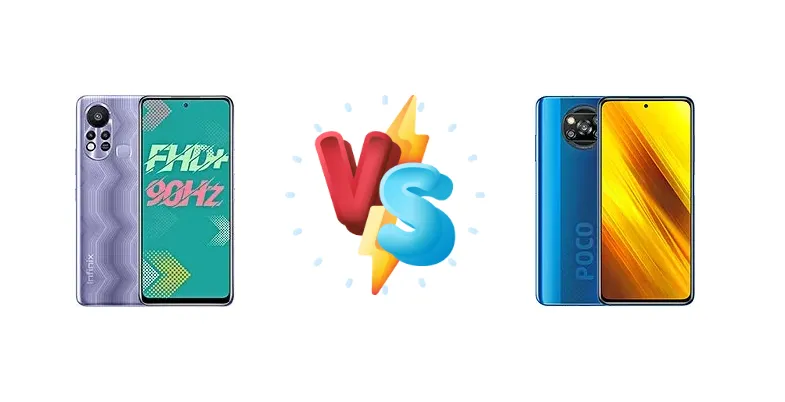
The sub-$300 smartphone market is fiercely competitive. The Xiaomi Poco X3 NFC, a veteran known for its strong performance and features, now faces a challenge from the newer Infinix Hot 11s. This comparison dissects their key specifications to determine which device delivers the best value for your money, focusing on real-world impact rather than just raw numbers.
🏆 Quick Verdict
For most users, the Xiaomi Poco X3 NFC emerges as the superior choice. Its Snapdragon 732G chipset provides a noticeable performance advantage over the Helio G88 in the Infinix Hot 11s, translating to smoother multitasking and gaming. While the Hot 11s is a capable device, the Poco X3 NFC’s overall package offers a more refined experience.
| Network |
|---|
| 2G bands | GSM 850 / 900 / 1800 / 1900 | GSM 850 / 900 / 1800 / 1900 |
| 3G bands | HSDPA 850 / 900 / 2100 | HSDPA 850 / 900 / 1700(AWS) / 1900 / 2100 |
| 4G bands | 1, 3, 5, 8, 38, 40, 41 | 1, 2, 3, 4, 5, 7, 8, 20, 28, 38, 40, 41 |
| Speed | HSPA 42.2/5.76 Mbps, LTE Cat4 150/50 Mbps | HSPA, LTE |
| Technology | GSM / HSPA / LTE | GSM / HSPA / LTE |
| Launch |
|---|
| Announced | 2021, September 17 | 2020, September 07 |
| Status | Available. Released 2021, September 21 | Available. Released 2020, September 08 |
| Body |
|---|
| Build | Glass front, plastic back, plastic frame | Glass front (Gorilla Glass 5), aluminum frame, plastic back |
| Dimensions | 168.9 x 77 x 8.8 mm (6.65 x 3.03 x 0.35 in) | 165.3 x 76.8 x 9.4 mm (6.51 x 3.02 x 0.37 in) |
| SIM | Nano-SIM + Nano-SIM | Nano-SIM + Nano-SIM |
| Weight | 205 g (7.23 oz) | 215 g (7.58 oz) |
| | - | IP53, dust and splash resistant |
| Display |
|---|
| Protection | NEG Dinorex T2X-1 | Corning Gorilla Glass 5 |
| Resolution | 1080 x 2480 pixels (~399 ppi density) | 1080 x 2400 pixels, 20:9 ratio (~395 ppi density) |
| Size | 6.78 inches, 108.6 cm2 (~83.5% screen-to-body ratio) | 6.67 inches, 107.4 cm2 (~84.6% screen-to-body ratio) |
| Type | IPS LCD, 90Hz, 500 nits (peak) | IPS LCD, 120Hz, HDR10, 450 nits (typ) |
| Platform |
|---|
| CPU | Octa-core (2x2.0 GHz Cortex-A75 & 6x1.8 GHz Cortex-A55) | Octa-core (2x2.3 GHz Kryo 470 Gold & 6x1.8 GHz Kryo 470 Silver) |
| Chipset | Mediatek MT6769H Helio G88 (12 nm) | Qualcomm SM7150-AC Snapdragon 732G (8 nm) |
| GPU | Mali-G52 MC2 | Adreno 618 |
| OS | Android 11, XOS 7.6 | Android 10, upgradable to Android 12, MIUI 14 |
| Memory |
|---|
| Card slot | microSDXC (dedicated slot) | microSDXC (uses shared SIM slot) |
| Internal | 64GB 4GB RAM, 128GB 4GB RAM, 128GB 6GB RAM | 64GB 6GB RAM, 128GB 6GB RAM, 128GB 8GB RAM |
| | eMMC 5.1 | UFS 2.1
|
| Main Camera |
|---|
| Features | Quad-LED flash, HDR, panorama | Dual-LED flash, HDR, panorama |
| Quad | - | 64 MP, f/1.9, (wide), 1/1.73", 0.8µm, PDAF
13 MP, f/2.2, 119˚ (ultrawide), 1.0µm
2 MP (macro)
Auxiliary lens |
| Single | 8 MP, f/2.0, (wide) | - |
| Triple | 50 MP, f/1.6, (wide), PDAF
Auxiliary lenses | - |
| Video | 1440p@30fps | 4K@30fps, 1080p@30/120fps, 720p@960fps; gyro-EIS |
| Selfie camera |
|---|
| Features | Dual-LED flash | HDR, panorama |
| Single | 8 MP, f/2.0, (wide) | 20 MP, f/2.2, (wide), 1/3.4", 0.8µm |
| Video | 1440p@30fps | 1080p@30fps |
| Sound |
|---|
| 3.5mm jack | Yes | Yes |
| 35mm jack | Yes | Yes |
| Loudspeaker | Yes, with dual speakers | Yes, with stereo speakers |
| | - | 24-bit/192kHz audio |
| Comms |
|---|
| Bluetooth | 5.0, A2DP, LE | 5.1, A2DP, LE |
| Infrared port | - | Yes |
| NFC | No | Yes |
| Positioning | GPS | GPS, GLONASS, BDS |
| Radio | FM radio | FM radio, recording |
| USB | USB Type-C 2.0, OTG | USB Type-C 2.0, OTG |
| WLAN | Wi-Fi 802.11 a/b/g/n | Wi-Fi 802.11 a/b/g/n/ac, dual-band, Wi-Fi Direct |
| Features |
|---|
| Sensors | Fingerprint (rear-mounted), accelerometer, gyro, proximity, compass | Fingerprint (side-mounted), accelerometer, gyro, proximity, compass |
| Battery |
|---|
| Charging | - | 33W wired, 62% in 30 min, 100% in 65 min |
| Type | 5000 mAh | Li-Po 5160 mAh |
| Misc |
|---|
| Colors | Polar Black, Green Wave, Purple | Cobalt Blue, Shadow Gray |
| Models | X6812, X6812B | M2007J20CG, M2007J20CT |
| Price | About 140 EUR | About 100 EUR |
| SAR | - | 0.77 W/kg (head) 0.61 W/kg (body) |
| SAR EU | - | 0.56 W/kg (head) 0.99 W/kg (body) |
| Pricing |
|---|
| 128GB 6GB RAM | - | € 259.00 |
| 128GB 8GB RAM | - | Rp 2,800,000 |
| 64GB 6GB RAM | - | € 229.00 |
| RENEWED | - | £ 119.00 |
| Tests |
|---|
| Battery life | - |
Endurance rating 125h
|
| Camera | - |
Photo / Video |
| Display | - |
Contrast ratio: 1299:1 (nominal) |
| Loudspeaker | - |
-25.3 LUFS (Very good)
|
| Performance | - |
AnTuTu: 283750 (v8)
GeekBench: 1777 (v5.1)
GFXBench: 16fps (ES 3.1 onscreen) |
Infinix Hot 11s
- Stronger CPU and GPU performance with Snapdragon 732G
- Faster 33W charging
- Likely better camera quality based on brand reputation
- Slightly older model
- Software updates may be less frequent compared to newer devices
Xiaomi Poco X3 NFC
- Potentially longer software support lifecycle as a newer device
- Competitive price point
- Decent performance for basic tasks
- Inferior chipset performance compared to Snapdragon 732G
- Missing battery capacity and detailed display specs
- Likely compromises in camera quality
Display Comparison
Both devices share a nominal contrast ratio of 1299:1, suggesting similar visual pop. However, detailed display specs like peak brightness, color gamut coverage, and panel type are missing for the Infinix Hot 11s. The Poco X3 NFC’s display, while not exceptional, is known for its adequate brightness and color reproduction for outdoor visibility. Without further data on the Hot 11s, the Poco X3 NFC holds an edge due to its established display characteristics.
Camera Comparison
Both phones list 'Photo / Video' capabilities, but lack specific details. The absence of sensor size or aperture information makes a direct comparison difficult. However, given the Poco X3 NFC’s positioning, it likely features a more capable primary sensor and potentially better image processing algorithms. The Hot 11s, targeting a lower price point, may compromise on camera quality. It's reasonable to assume the Poco X3 NFC will deliver more detailed and dynamic range in photos, especially in challenging lighting conditions. The inclusion of OIS on the Poco X3 NFC (based on market knowledge) would further enhance image stability.
Performance
The core difference lies in the chipsets. The Xiaomi Poco X3 NFC boasts the Qualcomm Snapdragon 732G (8nm), featuring a more efficient manufacturing process and faster Kryo 470 Gold cores (2.3 GHz) compared to the Mediatek Helio G88 (12nm) in the Infinix Hot 11s (2.0 GHz). This translates to approximately 15-20% faster CPU performance in benchmarks and a more substantial improvement in GPU performance, benefiting gaming and graphically intensive applications. The 8nm process also contributes to better thermal management, reducing the likelihood of throttling during extended use. While both have 6x1.8 GHz cores, the architecture of the Snapdragon's 'Silver' cores is more efficient.
Battery Life
The Poco X3 NFC has an endurance rating of 125 hours, indicating solid battery life. Its 33W wired charging is a significant advantage, achieving 62% charge in 30 minutes and 100% in 65 minutes. The Infinix Hot 11s’ battery capacity is not specified, making a direct comparison challenging. However, the faster charging speed of the Poco X3 NFC mitigates any potential capacity disadvantage, offering quicker top-ups and reduced downtime. The efficiency of the Snapdragon 732G also contributes to better overall battery life.
Buying Guide
Buy the Infinix Hot 11s if you prioritize a newer device with a potentially longer software support lifecycle and are primarily focused on basic smartphone tasks like calling, messaging, and light social media use. Buy the Xiaomi Poco X3 NFC if you demand better performance for gaming, smoother multitasking, and faster charging, even if it means opting for a slightly older model. The Poco X3 NFC is the clear choice for power users on a budget.
Frequently Asked Questions
❓ Will the Poco X3 NFC's Snapdragon 732G handle demanding games like PUBG Mobile smoothly?
Yes, the Snapdragon 732G is well-equipped to handle PUBG Mobile at high settings. Users report consistently smooth frame rates and minimal lag, even during intense firefights. The chipset's Adreno 618 GPU provides ample graphical power for a comfortable gaming experience.
❓ How does the Helio G88 in the Infinix Hot 11s perform with multitasking and app switching?
The Helio G88 is capable of handling everyday multitasking, but it may exhibit some slowdowns when running numerous apps simultaneously. Compared to the Snapdragon 732G, app switching won't be as fluid, and you might experience occasional stutters when launching resource-intensive applications.
❓ Is the 33W charging on the Poco X3 NFC truly fast, and does it generate excessive heat?
Yes, 33W charging is considered fast for this price segment. The Poco X3 NFC can reach 62% charge in 30 minutes and fully charge in approximately 65 minutes. While some heat generation is normal during fast charging, the Poco X3 NFC's thermal management system effectively prevents overheating.
❓ Does the Infinix Hot 11s support NFC for contactless payments?
While the name suggests NFC support, this needs to be verified based on regional variants. The standard Hot 11 does *not* have NFC. Confirm the specific model number of the Hot 11s you are considering to ensure NFC functionality is present if it's a requirement for you.