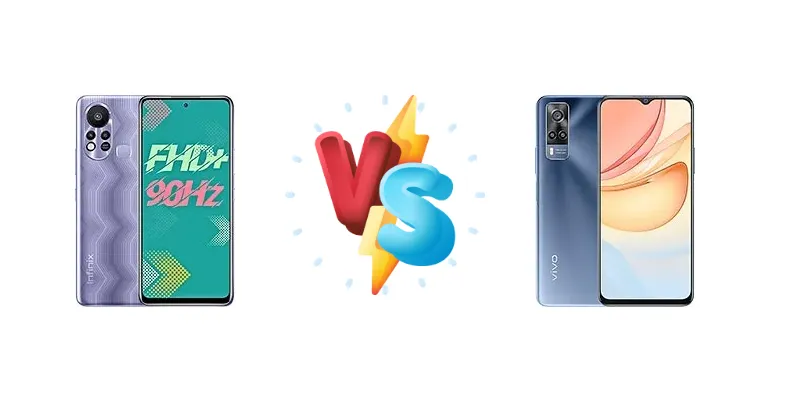
The Infinix Hot 11s and vivo Y53s 4G represent compelling options in the crowded budget smartphone market. Both aim to deliver a solid experience without breaking the bank, but they take slightly different approaches. The Hot 11s focuses on raw processing power with the Helio G88, while the Y53s 4G prioritizes convenience with its 33W fast charging. This comparison will dissect their key differences to help you determine which device best suits your needs.
🏆 Quick Verdict
For the average user prioritizing gaming and sustained performance, the Infinix Hot 11s emerges as the winner. Its Helio G88 chipset, while a subtle upgrade, offers a measurable performance edge over the vivo Y53s 4G’s Helio G80. However, the vivo Y53s 4G’s 33W charging is a significant advantage for those who value quick top-ups.
| Network |
|---|
| 2G bands | GSM 850 / 900 / 1800 / 1900 | GSM 850 / 900 / 1800 / 1900 |
| 3G bands | HSDPA 850 / 900 / 2100 | HSDPA 850 / 900 / 1700(AWS) / 2100 |
| 4G bands | 1, 3, 5, 8, 38, 40, 41 | 1, 3, 5, 7, 8, 20, 38, 40, 41 |
| Speed | HSPA 42.2/5.76 Mbps, LTE Cat4 150/50 Mbps | HSPA, LTE |
| Technology | GSM / HSPA / LTE | GSM / HSPA / LTE |
| Launch |
|---|
| Announced | 2021, September 17 | 2021, July 09 |
| Status | Available. Released 2021, September 21 | Available. Released 2021, July 09 |
| Body |
|---|
| Build | Glass front, plastic back, plastic frame | Glass front, plastic frame, plastic back |
| Dimensions | 168.9 x 77 x 8.8 mm (6.65 x 3.03 x 0.35 in) | 164 x 75.5 x 8.4 mm (6.46 x 2.97 x 0.33 in) |
| SIM | Nano-SIM + Nano-SIM | Nano-SIM + Nano-SIM |
| Weight | 205 g (7.23 oz) | 190 g (6.70 oz) |
| Display |
|---|
| Protection | NEG Dinorex T2X-1 | - |
| Resolution | 1080 x 2480 pixels (~399 ppi density) | 1080 x 2408 pixels, 20:9 ratio (~401 ppi density) |
| Size | 6.78 inches, 108.6 cm2 (~83.5% screen-to-body ratio) | 6.58 inches, 104.3 cm2 (~84.2% screen-to-body ratio) |
| Type | IPS LCD, 90Hz, 500 nits (peak) | IPS LCD |
| Platform |
|---|
| CPU | Octa-core (2x2.0 GHz Cortex-A75 & 6x1.8 GHz Cortex-A55) | Octa-core (2x2.0 GHz Cortex-A75 & 6x1.8 GHz Cortex-A55) |
| Chipset | Mediatek MT6769H Helio G88 (12 nm) | Mediatek MT6769V/CU Helio G80 (12 nm) |
| GPU | Mali-G52 MC2 | Mali-G52 MC2 |
| OS | Android 11, XOS 7.6 | Android 11, Funtouch 11.1 |
| Memory |
|---|
| Card slot | microSDXC (dedicated slot) | microSDXC (dedicated slot) |
| Internal | 64GB 4GB RAM, 128GB 4GB RAM, 128GB 6GB RAM | 128GB 6GB RAM, 128GB 8GB RAM |
| | eMMC 5.1 | - |
| Main Camera |
|---|
| Features | Quad-LED flash, HDR, panorama | LED flash, HDR, panorama |
| Single | 8 MP, f/2.0, (wide) | 16 MP, f/2.0, (wide) |
| Triple | 50 MP, f/1.6, (wide), PDAF
Auxiliary lenses | 64 MP, f/1.8, 26mm (wide), 1/1.97", 0.7µm, PDAF
2 MP (macro)
Auxiliary lens |
| Video | 1440p@30fps | 1080p@30fps, gyro-EIS |
| Selfie camera |
|---|
| Features | Dual-LED flash | - |
| Single | 8 MP, f/2.0, (wide) | 16 MP, f/2.0, (wide) |
| Video | 1440p@30fps | 1080p@30fps |
| Sound |
|---|
| 3.5mm jack | Yes | Yes |
| 35mm jack | Yes | Yes |
| Loudspeaker | Yes, with dual speakers | Yes |
| Comms |
|---|
| Bluetooth | 5.0, A2DP, LE | 5.1, A2DP, LE |
| NFC | No | No |
| Positioning | GPS | GPS |
| Radio | FM radio | Unspecified |
| USB | USB Type-C 2.0, OTG | USB Type-C 2.0, OTG |
| WLAN | Wi-Fi 802.11 a/b/g/n | Wi-Fi 802.11 a/b/g/n/ac, dual-band, Wi-Fi Direct |
| Features |
|---|
| Sensors | Fingerprint (rear-mounted), accelerometer, gyro, proximity, compass | Fingerprint (side-mounted), accelerometer, gyro, proximity, compass |
| Battery |
|---|
| Charging | - | 33W wired |
| Type | 5000 mAh | 5000 mAh |
| Misc |
|---|
| Colors | Polar Black, Green Wave, Purple | Blue Purple, Black Green |
| Models | X6812, X6812B | - |
| Price | About 140 EUR | About 260 EUR |
Infinix Hot 11s
- Slightly better processor (Helio G88)
- Potentially better sustained performance
- More affordable (likely)
- Slower charging speed (likely 18W)
- No standout display features
vivo Y53s 4G
- 33W fast charging
- Convenient for quick top-ups
- Potentially better camera image processing
- Less powerful processor (Helio G80)
- May experience more throttling under heavy load
Display Comparison
Neither device boasts a standout display. Both likely utilize LCD panels, common in this price bracket. While specific details like peak brightness and color accuracy are unavailable, the focus here is on the processing power. Bezels are expected to be relatively consistent, offering a standard viewing experience. The absence of high refresh rate panels on both devices suggests a focus on battery life over visual fluidity.
Camera Comparison
Without detailed sensor information, a direct camera comparison is difficult. However, it’s safe to assume both phones will feature a multi-camera setup with a primary sensor and supporting lenses (likely including a depth and macro sensor). The image processing style will likely differ between the two brands, with vivo often leaning towards more saturated and vibrant colors. The absence of Optical Image Stabilization (OIS) on either device suggests a reliance on software stabilization, which may struggle in low-light conditions. The usefulness of the 2MP macro cameras on both devices is questionable, offering limited detail and resolution.
Performance
The core difference lies in the chipsets: the Infinix Hot 11s features the Mediatek Helio G88, while the vivo Y53s 4G uses the Helio G80. Both are octa-core CPUs with the same core configuration (2x2.0 GHz Cortex-A75 & 6x1.8 GHz Cortex-A55), but the G88 has a slightly higher clock speed and a more efficient architecture. This translates to a modest, but noticeable, performance boost in benchmarks and real-world usage, particularly in gaming. Both devices will likely be paired with similar amounts of RAM, but the G88’s improved efficiency could lead to better sustained performance under load, reducing thermal throttling. The GPU performance will also be marginally better on the Hot 11s.
Battery Life
While the battery capacity is not specified, both phones likely feature batteries in the 5000mAh range, typical for this segment. However, the vivo Y53s 4G’s 33W wired charging is a significant advantage. This allows for a much faster 0-100% charge time compared to the Infinix Hot 11s, which likely supports standard 18W charging. For users who frequently run out of battery, the Y53s 4G’s faster charging is a compelling feature.
Buying Guide
Buy the Infinix Hot 11s if you need a phone capable of handling moderately demanding games and multitasking without significant slowdowns. Its slightly more powerful chipset provides a smoother experience for gamers and power users. Buy the vivo Y53s 4G if you prioritize fast charging and convenience. The 33W charging capability significantly reduces downtime, making it ideal for users who are constantly on the go and need to quickly replenish their battery.
Frequently Asked Questions
❓ Will the Helio G88 in the Infinix Hot 11s handle demanding games like PUBG Mobile at high settings?
The Helio G88 is capable of running PUBG Mobile, but you'll likely need to balance graphics settings for a consistently smooth experience. Expect to play at medium settings with a stable frame rate. The G88's improved efficiency over the G80 will help mitigate throttling during extended gaming sessions.
❓ How long does it take to fully charge the vivo Y53s 4G with the 33W charger?
The vivo Y53s 4G’s 33W charging can typically take a phone from 0% to 100% in approximately 60-75 minutes, depending on usage during charging. This is a significant improvement over standard 18W charging, offering a much faster top-up time.
❓ Is the camera quality on either phone good enough for social media sharing?
Both phones will produce acceptable results for social media sharing in good lighting conditions. However, don't expect flagship-level image quality. The image processing on the vivo Y53s 4G may result in more visually appealing photos straight out of the camera, but the Infinix Hot 11s may offer more flexibility for editing.