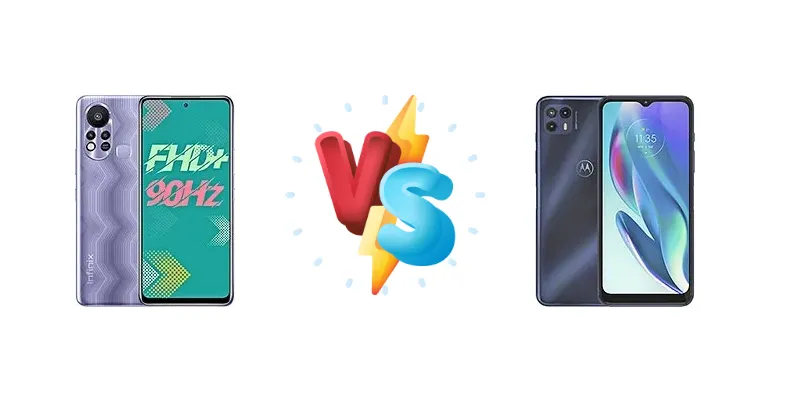
The sub-$200 5G smartphone market is heating up, and the Motorola Moto G50 5G and Infinix Hot 11s are two strong contenders. While both aim to deliver affordable 5G connectivity, they take different approaches to achieving that goal, primarily through their chipset choices. This comparison dissects those differences and determines which phone offers the best overall experience.
🏆 Quick Verdict
For most users, the Motorola Moto G50 5G emerges as the better choice. Its Dimensity 700 chipset, built on a more efficient 7nm process, provides a noticeable performance advantage over the Infinix Hot 11s’ Helio G88, especially in sustained workloads. While the Hot 11s may offer a slightly more refined software experience in some regions, the G50’s superior processing power and 5G capabilities make it the more future-proof option.
| Network |
|---|
| 2G bands | GSM 850 / 900 / 1800 / 1900 | GSM 850 / 900 / 1800 / 1900 |
| 3G bands | HSDPA 850 / 900 / 2100 | HSDPA 850 / 900 / 1700(AWS) / 1900 / 2100 - Australia |
| 4G bands | 1, 3, 5, 8, 38, 40, 41 | 1, 2, 3, 4, 5, 7, 8, 12, 13, 17, 18, 19, 20, 26, 28, 38, 40, 41, 42, 43, 66 - Australia |
| 5G bands | - | 1, 3, 5, 7, 8, 20, 28, 38, 40, 41, 77, 78 SA/NSA - Australia |
| Speed | HSPA 42.2/5.76 Mbps, LTE Cat4 150/50 Mbps | HSPA, LTE, 5G |
| Technology | GSM / HSPA / LTE | GSM / HSPA / LTE / 5G |
| Launch |
|---|
| Announced | 2021, September 17 | 2021, August 25 |
| Status | Available. Released 2021, September 21 | Available. Released 2021, August 25 |
| Body |
|---|
| Build | Glass front, plastic back, plastic frame | Glass front, plastic back, plastic frame |
| Dimensions | 168.9 x 77 x 8.8 mm (6.65 x 3.03 x 0.35 in) | 167 x 76.4 x 9.3 mm (6.57 x 3.01 x 0.37 in) |
| SIM | Nano-SIM + Nano-SIM | Nano-SIM + Nano-SIM |
| Weight | 205 g (7.23 oz) | 206 g (7.27 oz) |
| | - | Water-repellent design |
| Display |
|---|
| Protection | NEG Dinorex T2X-1 | - |
| Resolution | 1080 x 2480 pixels (~399 ppi density) | 720 x 1600 pixels, 20:9 ratio (~269 ppi density) |
| Size | 6.78 inches, 108.6 cm2 (~83.5% screen-to-body ratio) | 6.5 inches, 102.8 cm2 (~80.5% screen-to-body ratio) |
| Type | IPS LCD, 90Hz, 500 nits (peak) | IPS LCD, 90Hz |
| Platform |
|---|
| CPU | Octa-core (2x2.0 GHz Cortex-A75 & 6x1.8 GHz Cortex-A55) | Octa-core (2x2.2 GHz Cortex-A76 & 6x2.0 GHz Cortex-A55) |
| Chipset | Mediatek MT6769H Helio G88 (12 nm) | Mediatek Dimensity 700 (7 nm) |
| GPU | Mali-G52 MC2 | Mali-G57 MC2 |
| OS | Android 11, XOS 7.6 | Android 11 |
| Memory |
|---|
| Card slot | microSDXC (dedicated slot) | microSDXC (uses shared SIM slot) |
| Internal | 64GB 4GB RAM, 128GB 4GB RAM, 128GB 6GB RAM | 64GB 4GB RAM, 128GB 4GB RAM |
| | eMMC 5.1 | - |
| Main Camera |
|---|
| Features | Quad-LED flash, HDR, panorama | LED flash, HDR, panorama |
| Single | 8 MP, f/2.0, (wide) | - |
| Triple | 50 MP, f/1.6, (wide), PDAF
Auxiliary lenses | 48 MP, f/1.7, 26mm (wide), 1/2.0", 0.8µm, PDAF
2 MP (macro)
Auxiliary lens |
| Video | 1440p@30fps | 1080p@30/60fps |
| Selfie camera |
|---|
| Features | Dual-LED flash | HDR |
| Single | 8 MP, f/2.0, (wide) | 13 MP, f/2.0, (wide), 1/3.1", 1.12µm |
| Video | 1440p@30fps | 1080p@30/60fps |
| Sound |
|---|
| 3.5mm jack | Yes | Yes |
| 35mm jack | Yes | Yes |
| Loudspeaker | Yes, with dual speakers | Yes |
| Comms |
|---|
| Bluetooth | 5.0, A2DP, LE | 5.0, A2DP, LE |
| NFC | No | Yes |
| Positioning | GPS | GPS |
| Radio | FM radio | Unspecified |
| USB | USB Type-C 2.0, OTG | USB Type-C 2.0, OTG |
| WLAN | Wi-Fi 802.11 a/b/g/n | Wi-Fi 802.11 a/b/g/n/ac, dual-band, Wi-Fi Direct |
| Features |
|---|
| Sensors | Fingerprint (rear-mounted), accelerometer, gyro, proximity, compass | Fingerprint (side-mounted), accelerometer, gyro, proximity |
| Battery |
|---|
| Charging | - | 15W wired |
| Type | 5000 mAh | Li-Po 5000 mAh |
| Misc |
|---|
| Colors | Polar Black, Green Wave, Purple | Meteorite Grey |
| Models | X6812, X6812B | XT2149-1 |
| Price | About 140 EUR | About 170 EUR |
Infinix Hot 11s
- More powerful Dimensity 700 chipset
- Superior 5G modem for better connectivity
- Better thermal efficiency for sustained performance
- Software updates may be slower than Infinix
- 15W charging is relatively slow
Motorola Moto G50 5G
- Potentially smoother software experience (region-dependent)
- Competitive pricing
- Likely similar battery capacity to G50
- Less powerful Helio G88 chipset
- Less efficient 12nm process
- May struggle with demanding tasks
Display Comparison
Neither device boasts a standout display. Both likely utilize LCD panels, a common cost-saving measure in this price bracket. The key difference lies under the hood: display driver efficiency. While specific display specs (resolution, brightness) are missing, the G50’s more efficient chipset can contribute to better power management even with a similar display, potentially extending screen-on time. Bezels are expected to be comparable, reflecting the budget nature of both phones.
Camera Comparison
Camera performance is likely to be similar, with both phones relying on budget sensors and image processing. Without specific sensor details, it’s difficult to make a definitive judgment. However, the G50’s more powerful chipset could enable slightly faster image processing and potentially better low-light performance. The prevalence of 2MP macro/depth sensors on both devices suggests these are largely marketing features and won’t significantly impact image quality. Focus should be on the main sensor’s capabilities, which are currently unknown.
Performance
The performance gap is the most significant differentiator. The Motorola Moto G50 5G’s Mediatek Dimensity 700 (7nm) features Cortex-A76 cores clocked at 2.2 GHz, offering a substantial architectural advantage over the Infinix Hot 11s’ Helio G88 (12nm) with its Cortex-A75 cores at 2.0 GHz. The 7nm process node of the Dimensity 700 translates to better thermal efficiency, meaning the G50 is less likely to throttle under sustained load – crucial for gaming or video editing. The G50’s CPU cores are also clocked higher, further boosting performance. While both phones likely feature similar RAM configurations, the Dimensity 700’s superior memory controller will contribute to faster data access speeds.
Battery Life
The Moto G50 5G includes 15W wired charging, while the Hot 11s’ charging speed is unspecified but likely similar. While battery capacity isn’t provided, the Dimensity 700’s 7nm efficiency gives the G50 an edge in battery life. The more efficient chipset consumes less power during both active use and standby, resulting in longer runtimes. The 15W charging on the G50, while not fast, is adequate for overnight charging and topping up throughout the day.
Buying Guide
Buy the Infinix Hot 11s if you prioritize a potentially smoother software experience (depending on your region) and are primarily focused on basic smartphone tasks like social media and light web browsing. Buy the Motorola Moto G50 5G if you need a phone capable of handling more demanding applications, enjoy mobile gaming, or want a device with a more robust 5G modem for faster download speeds and better network compatibility.
Frequently Asked Questions
❓ Will the Motorola Moto G50 5G overheat during prolonged gaming sessions?
The Dimensity 700’s 7nm process is designed for efficiency, minimizing heat generation. While it won’t match flagship-level cooling, the G50 is less prone to throttling than the Infinix Hot 11s due to its more efficient chipset. Expect playable frame rates for most games, but extended sessions at maximum settings may still lead to some performance reduction.
❓ Is the 5G connectivity on the Moto G50 5G reliable and compatible with all 5G networks?
The Dimensity 700 includes an integrated 5G modem supporting a wide range of 5G bands. However, 5G compatibility ultimately depends on your carrier and region. The G50 generally offers broader 5G band support than phones using older 5G modems, increasing the likelihood of a stable connection where 5G is available.
❓ Does the Infinix Hot 11s offer a significantly better software experience than the Moto G50 5G?
Infinix’s XOS skin, while feature-rich, can be more heavily customized than Motorola’s near-stock Android experience. Whether this is 'better' is subjective. Some users prefer the added features and customization options of XOS, while others appreciate the cleaner, faster interface of Motorola’s software. Software update frequency is also typically faster on Motorola devices.