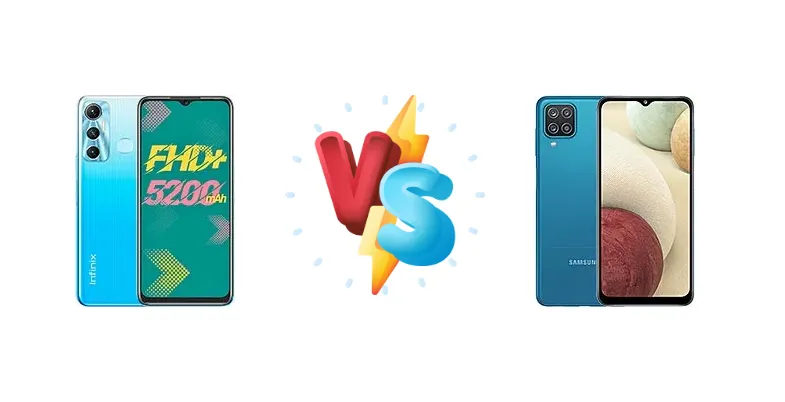
The sub-₹10,000 (approximately $120 USD) smartphone segment in India is fiercely competitive. The Infinix Hot 11 and Samsung Galaxy A12 both aim to deliver essential smartphone functionality at an accessible price point, but they take different approaches to achieving this. The Hot 11 prioritizes processing power with its Helio G70, while the Galaxy A12 leans on Samsung’s brand recognition and a more efficient, though less powerful, Exynos 850.
🏆 Quick Verdict
For users prioritizing gaming and demanding tasks, the Infinix Hot 11 offers a noticeable performance edge thanks to its Helio G70 chipset. However, the Samsung Galaxy A12 (India) provides a more balanced experience with potentially better power efficiency and Samsung’s established software ecosystem, making it the better choice for everyday users.
| Network |
|---|
| 2G bands | GSM 850 / 900 / 1800 / 1900 | GSM 850 / 900 / 1800 / 1900 |
| 3G bands | HSDPA 850 / 900 / 2100 | HSDPA 850 / 900 / 2100 |
| 4G bands | 1, 3, 5, 8, 38, 40, 41 | 1, 3, 5, 7, 8, 20, 28, 38, 40, 41 |
| Speed | HSPA 42.2/5.76 Mbps, LTE Cat4 150/50 Mbps | HSPA 42.2/5.76 Mbps, LTE Cat4 150/50 Mbps |
| Technology | GSM / HSPA / LTE | GSM / HSPA / LTE |
| Launch |
|---|
| Announced | 2021, September 17 | 2021, August 12 |
| Status | Available. Released 2021, September 21 | Available. Released 2021, August 12 |
| Body |
|---|
| Build | Glass front, plastic back, plastic frame | Glass front, plastic back, plastic frame |
| Dimensions | 164.7 x 76.2 x 8.9 mm (6.48 x 3.00 x 0.35 in) | 164 x 75.8 x 8.9 mm (6.46 x 2.98 x 0.35 in) |
| SIM | Nano-SIM + Nano-SIM | · Nano-SIM· Nano-SIM + Nano-SIM |
| Weight | 201 g (7.09 oz) | 205 g (7.23 oz) |
| Display |
|---|
| Resolution | 1080 x 2408 pixels, 20:9 ratio (~400 ppi density) | 720 x 1600 pixels, 20:9 ratio (~270 ppi density) |
| Size | 6.6 inches, 104.9 cm2 (~83.6% screen-to-body ratio) | 6.5 inches, 102.0 cm2 (~82.1% screen-to-body ratio) |
| Type | IPS LCD, 500 nits (peak) | PLS LCD |
| Platform |
|---|
| CPU | Octa-core (2x2.0 GHz Cortex-A75 & 6x1.7 GHz Cortex-A55) | Octa-core (4x2.0 GHz Cortex-A55 & 4x2.0 GHz Cortex-A55) |
| Chipset | Mediatek MT6769V/CB Helio G70 (12 nm) | Exynos 850 (8 nm) |
| GPU | Mali-G52 2EEMC2 | Mali-G52 |
| OS | Android 11, XOS 7.6 | Android 11, upgradable to Android 13, One UI 5.1 |
| Memory |
|---|
| Card slot | microSDXC (dedicated slot) | microSDXC (dedicated slot) |
| Internal | 64GB 4GB RAM, 128GB 4GB RAM | 64GB 4GB RAM, 128GB 4GB RAM, 128GB 6GB RAM |
| | eMMC 5.1 | eMMC 5.1 |
| Main Camera |
|---|
| Dual | 13 MP, f/1.8, (wide), PDAF
Auxiliary lens | - |
| Features | Quad-LED flash, HDR, panorama | LED flash, panorama, HDR |
| Quad | - | 48 MP, f/2.0, 26mm (wide), AF
5 MP, f/2.2, 123˚ (ultrawide)
2 MP (macro)
Auxiliary lens |
| Single | 8 MP, f/2.0, (wide) | - |
| Video | 1440p@30fps | 1080p@30fps |
| Selfie camera |
|---|
| Features | Dual-LED flash | - |
| Single | 8 MP, f/2.0, (wide) | 8 MP, f/2.2 |
| Video | 1440p@30fps | 1080p@30fps |
| Sound |
|---|
| 3.5mm jack | Yes | Yes |
| 35mm jack | Yes | Yes |
| Loudspeaker | Yes, with dual speakers | Yes |
| Comms |
|---|
| Bluetooth | 5.0, A2DP, LE | 5.0, A2DP, LE |
| NFC | No | No |
| Positioning | GPS | GPS, GLONASS, GALILEO, BDS |
| Radio | FM radio | FM radio, RDS, recording |
| USB | USB Type-C 2.0, OTG | USB Type-C 2.0 |
| WLAN | Wi-Fi 802.11 a/b/g/n | Wi-Fi 802.11 b/g/n, Wi-Fi Direct |
| Features |
|---|
| Sensors | Fingerprint (rear-mounted), accelerometer, gyro, proximity, compass | Fingerprint (side-mounted), accelerometer |
| | - | Virtual proximity sensing |
| Battery |
|---|
| Charging | - | 15W wired |
| Type | 5200 mAh | Li-Po 5000 mAh |
| Misc |
|---|
| Colors | Silver Wave, Purple, Emerald Green, Polar Black | Black, Blue, White |
| Models | X662, X662B, X689F | SM-A127F, SM-A127F/DS |
| Price | About 110 EUR | About 160 EUR |
| SAR | - | 0.79 W/kg (head) |
Infinix Hot 11
- Stronger CPU for gaming and multitasking
- Potentially better performance in demanding apps
- More aggressive pricing (likely)
- Less power-efficient chipset
- Potentially shorter battery life
- Less established brand reputation
Samsung Galaxy A12 (India)
- Better power efficiency with Exynos 850
- Samsung’s established software and brand reliability
- 15W charging for potentially faster top-ups
- Weaker CPU performance for gaming
- May struggle with demanding multitasking
- Potentially higher price
Display Comparison
Neither device boasts a standout display. Both likely feature LCD panels, a common trait in this price bracket. The key difference lies under the hood: processing power impacts UI smoothness. While specific display specs (resolution, brightness) are missing, the Hot 11’s more powerful CPU could translate to slightly smoother scrolling and animations. The Galaxy A12’s 15W charging suggests a larger battery, potentially impacting overall device weight and thickness, which could affect the perceived display quality due to viewing angles.
Camera Comparison
Without detailed camera specs, a direct comparison is difficult. However, both phones likely feature a primary camera accompanied by several lower-resolution sensors (often 2MP macro/depth). The focus should be on the main sensor’s quality and image processing. Samsung’s image processing is generally known for vibrant, saturated colors, while Infinix tends towards a more natural look. The Exynos 850’s ISP (Image Signal Processor) may offer slightly better noise reduction in low-light conditions, but the Helio G70’s processing power could allow for faster image capture. The usefulness of the 2MP macro cameras on both devices is questionable, offering limited detail and resolution.
Performance
The core of the difference lies in the chipsets. The Infinix Hot 11’s MediaTek Helio G70, built on a 12nm process, features a dual-core Cortex-A75 setup alongside six Cortex-A55 cores, geared towards gaming. This contrasts with the Samsung Galaxy A12’s Exynos 850 (8nm), which utilizes eight Cortex-A55 cores. The 8nm process of the Exynos 850 *should* offer better power efficiency, but the A75 cores in the Helio G70 provide a significant advantage in raw processing power. This means the Hot 11 will likely handle demanding games and multitasking more effectively, though potentially at the cost of battery life. The lack of LPDDR5x RAM specification on either device suggests both likely use LPDDR4x, limiting memory bandwidth.
Battery Life
The Samsung Galaxy A12’s 15W wired charging suggests a larger battery capacity than the Infinix Hot 11 (spec not provided). While the Hot 11’s Helio G70 is more power-hungry, the Exynos 850’s 8nm process offers better efficiency. This means the A12 is likely to provide longer screen-on time for typical usage. However, the Hot 11’s faster processing power could offset some of this advantage during intensive tasks like gaming, where the A12 might throttle performance to conserve battery.
Buying Guide
Buy the Infinix Hot 11 if you need a phone primarily for gaming, video streaming, or running multiple apps simultaneously. Its Helio G70 chipset provides a performance boost over the A12. Buy the Samsung Galaxy A12 (India) if you prioritize battery life, a familiar user interface, and a reliable brand experience for everyday tasks like calling, messaging, and social media. The Exynos 850 offers a more efficient, if less powerful, experience.
Frequently Asked Questions
❓ Does the Exynos 850 in the Galaxy A12 overheat during prolonged gaming sessions?
The Exynos 850 is designed for efficiency, not peak performance. While it won't overheat dramatically, it *will* likely throttle performance to manage temperatures during extended gaming, resulting in lower frame rates and a less smooth experience compared to the Infinix Hot 11.
❓ Is the 2MP macro camera on either phone actually useful for taking detailed close-up photos?
Unfortunately, no. 2MP macro cameras typically lack the resolution and optics to capture truly detailed close-up shots. They are often included as a marketing feature but deliver underwhelming results. Expect soft, blurry images.
❓ Can the Infinix Hot 11 reliably run PUBG Mobile at 60fps?
The Helio G70 in the Infinix Hot 11 is capable of running PUBG Mobile, but achieving a consistent 60fps will depend on the graphics settings. Lowering the settings to 'Smooth' or 'Balanced' is recommended for a playable experience. Expect some frame drops during intense firefights.
❓ How does Samsung's One UI compare to Infinix's XOS in terms of bloatware and software updates?
Samsung's One UI generally offers a cleaner software experience with fewer pre-installed apps (bloatware) than Infinix's XOS. However, Samsung's update schedule for the A12 is likely to be slower than what Infinix provides for the Hot 11, though both are not known for rapid updates in this price segment.