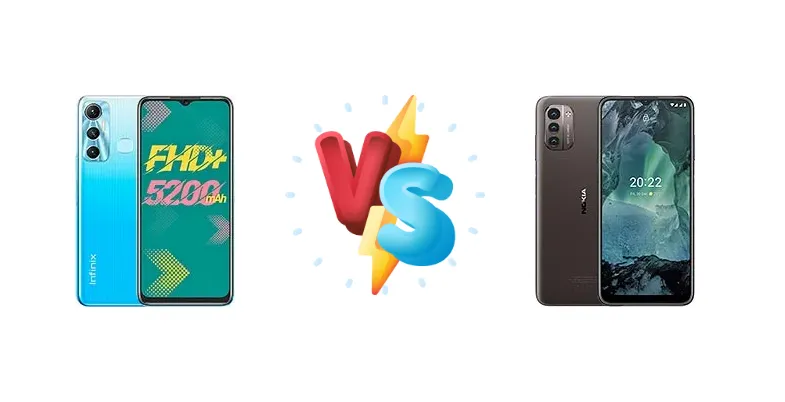
The Infinix Hot 11 and Nokia G21 represent compelling options in the ultra-budget smartphone segment. Both aim to deliver essential features at a low price point, but they take different approaches. The Hot 11 prioritizes processing power with its MediaTek Helio G70, while the G21 focuses on longevity with its 126-hour endurance rating and 18W PD3.0 charging. This comparison will dissect their key differences to determine which device best suits your needs.
🏆 Quick Verdict
For users prioritizing gaming and responsiveness, the Infinix Hot 11 emerges as the better choice due to its more powerful Helio G70 chipset. However, the Nokia G21 is the superior option for those who value extended battery life and reliable, albeit slower, charging, making it ideal for minimal users.
| Network |
|---|
| 2G bands | GSM 850 / 900 / 1800 / 1900 | GSM 850 / 900 / 1800 / 1900 |
| 3G bands | HSDPA 850 / 900 / 2100 | HSDPA 850 / 900 / 2100 - International |
| 4G bands | 1, 3, 5, 8, 38, 40, 41 | 1, 3, 5, 7, 8, 20, 28, 38, 40, 41 - International |
| Speed | HSPA 42.2/5.76 Mbps, LTE Cat4 150/50 Mbps | HSPA 42.2/5.76 Mbps, LTE Cat4 150/50 Mbps |
| Technology | GSM / HSPA / LTE | GSM / HSPA / LTE |
| | - | 1, 2, 3, 4, 5, 7, 8, 12, 17, 28, 40, 66 - LATAM |
| Launch |
|---|
| Announced | 2021, September 17 | 2022, February 14 |
| Status | Available. Released 2021, September 21 | Available. Released 2022, February 15 |
| Body |
|---|
| Build | Glass front, plastic back, plastic frame | Glass front, plastic frame, plastic back |
| Dimensions | 164.7 x 76.2 x 8.9 mm (6.48 x 3.00 x 0.35 in) | 164.6 x 75.9 x 8.5 mm (6.48 x 2.99 x 0.33 in) |
| SIM | Nano-SIM + Nano-SIM | · Nano-SIM· Nano-SIM + Nano-SIM |
| Weight | 201 g (7.09 oz) | 190 g (6.70 oz) |
| Display |
|---|
| Resolution | 1080 x 2408 pixels, 20:9 ratio (~400 ppi density) | 720 x 1600 pixels, 20:9 ratio (~270 ppi density) |
| Size | 6.6 inches, 104.9 cm2 (~83.6% screen-to-body ratio) | 6.5 inches, 102.0 cm2 (~81.6% screen-to-body ratio) |
| Type | IPS LCD, 500 nits (peak) | IPS LCD, 90Hz, 400 nits (typ) |
| Platform |
|---|
| CPU | Octa-core (2x2.0 GHz Cortex-A75 & 6x1.7 GHz Cortex-A55) | Octa-core (2x1.6 GHz Cortex-A75 & 6x1.6 GHz Cortex-A55) |
| Chipset | Mediatek MT6769V/CB Helio G70 (12 nm) | Unisoc T606 (12 nm) |
| GPU | Mali-G52 2EEMC2 | Mali-G57 MP1 |
| OS | Android 11, XOS 7.6 | Android 11, upgradable to Android 13 |
| Memory |
|---|
| Card slot | microSDXC (dedicated slot) | microSDXC (dedicated slot) |
| Internal | 64GB 4GB RAM, 128GB 4GB RAM | 64GB 3GB RAM, 64GB 4GB RAM, 128GB 4GB RAM, 128GB 6GB RAM |
| | eMMC 5.1 | eMMC 5.1 |
| Main Camera |
|---|
| Dual | 13 MP, f/1.8, (wide), PDAF
Auxiliary lens | - |
| Features | Quad-LED flash, HDR, panorama | LED flash, HDR, panorama |
| Single | 8 MP, f/2.0, (wide) | 8 MP, f/2.0, (wide) |
| Triple | - | 50 MP, f/1.8, 28mm (wide), 1/2.76", 0.64µm, PDAF
2 MP (macro)
Auxiliary lens |
| Video | 1440p@30fps | 1080p@30fps |
| Selfie camera |
|---|
| Features | Dual-LED flash | - |
| Single | 8 MP, f/2.0, (wide) | 8 MP, f/2.0, (wide) |
| Video | 1440p@30fps | 1080p@30fps |
| Sound |
|---|
| 3.5mm jack | Yes | Yes |
| 35mm jack | Yes | Yes |
| Loudspeaker | Yes, with dual speakers | Yes |
| Comms |
|---|
| Bluetooth | 5.0, A2DP, LE | 5.0, A2DP, LE |
| NFC | No | Yes (market/region dependent) |
| Positioning | GPS | GPS, GLONASS, GALILEO |
| Radio | FM radio | FM radio, RDS |
| USB | USB Type-C 2.0, OTG | USB Type-C 2.0, OTG |
| WLAN | Wi-Fi 802.11 a/b/g/n | Wi-Fi 802.11 a/b/g/n/ac, dual-band, Wi-Fi Direct |
| Features |
|---|
| Sensors | Fingerprint (rear-mounted), accelerometer, gyro, proximity, compass | Fingerprint (side-mounted), accelerometer, proximity |
| Battery |
|---|
| Charging | - | 18W wired, PD3.0 |
| Type | 5200 mAh | Li-Po 5050 mAh |
| Misc |
|---|
| Colors | Silver Wave, Purple, Emerald Green, Polar Black | Nordic Blue, Dusk |
| Models | X662, X662B, X689F | TA-1418, TA-1477, TA-1415, TA-1405, TA-1404, TA-1412 |
| Price | About 110 EUR | About 90 EUR |
| SAR | - | 1.00 W/kg (head) 1.10 W/kg (body) |
| SAR EU | - | 0.34 W/kg (head) 1.05 W/kg (body) |
| Tests |
|---|
| Battery life | - |
Endurance rating 126h
|
| Camera | - |
Photo / Video |
| Display | - |
Contrast ratio: 1631:1 (nominal) |
| Loudspeaker | - |
-30.7 LUFS (Below average)
|
| Performance | - |
AnTuTu: 171299 (v9)
GeekBench: 1193 (v5.1)
GFXBench: 8.9fps (ES 3.1 onscreen) |
Infinix Hot 11
- More powerful processor for gaming and multitasking
- Potentially better app loading speeds
- Likely better suited for demanding applications
- Likely shorter battery life due to more powerful processor
- Unknown display specifications
- Camera details are vague
Nokia G21
- Exceptional battery life (126h endurance)
- 18W PD3.0 charging for wider compatibility
- Measured 500 nits brightness for outdoor visibility
- Less powerful processor for gaming and multitasking
- Unisoc T606 may struggle with demanding apps
- Camera details are vague
Display Comparison
Both devices lack detailed display specifications beyond the Nokia G21’s measured 500 nits of brightness and 1631:1 contrast ratio. While the contrast ratio is nominal for both, the G21’s measured brightness suggests a more visible screen outdoors. Without knowing the panel type or resolution of the Hot 11, it’s difficult to assess its color accuracy or viewing angles. The Nokia G21’s brightness provides a tangible advantage for outdoor visibility, a common pain point in this price bracket.
Camera Comparison
Both phones list 'Photo / Video' capabilities, but lack specific details regarding sensor size, aperture, or image processing. This suggests both rely on software optimization rather than superior hardware. Without further information, it’s impossible to determine a clear winner. The absence of details points to a focus on affordability over camera quality, meaning users shouldn’t expect flagship-level image performance from either device. The lack of mention of OIS on either device suggests image stabilization will be limited.
Performance
The Infinix Hot 11’s MediaTek Helio G70, with its 2x2.0 GHz Cortex-A75 and 6x1.7 GHz Cortex-A55 cores, offers a clear performance advantage over the Nokia G21’s Unisoc T606 (2x1.6 GHz Cortex-A75 & 6x1.6 GHz Cortex-A55). The higher clock speeds of the G70’s prime cores translate to faster app loading times and smoother multitasking. While both chipsets are 12nm, the G70’s architecture is optimized for gaming, making it the better choice for mobile gamers. The Unisoc T606 in the G21 is adequate for basic tasks, but will struggle with demanding applications.
Battery Life
The Nokia G21 boasts an impressive endurance rating of 126 hours, indicating exceptional battery life. Coupled with its 18W wired charging and PD3.0 support, it offers a reliable charging experience. While the Infinix Hot 11’s battery capacity is unknown, its more powerful processor will likely consume more power, potentially offsetting any capacity advantage. The G21’s PD3.0 support is a welcome addition, ensuring compatibility with a wider range of chargers and potentially faster charging speeds with compatible adapters.
Buying Guide
Buy the Infinix Hot 11 if you need a phone capable of handling moderate gaming and multitasking without significant lag. It’s best for younger users or those who frequently consume media. Buy the Nokia G21 if you prioritize battery life above all else, and primarily use your phone for calls, texts, and light browsing. It’s ideal for users who want a dependable device that won’t require daily charging.
Frequently Asked Questions
❓ Will the Unisoc T606 in the Nokia G21 struggle with popular social media apps like TikTok and Instagram?
While the Unisoc T606 can handle basic social media browsing, prolonged use of apps like TikTok and Instagram, especially with video recording, may result in noticeable lag and slowdowns. The processor is designed for efficiency, not intensive tasks.
❓ Does the Infinix Hot 11 get noticeably hot during extended gaming sessions?
The MediaTek Helio G70 is known to generate some heat under sustained load. While not extreme, the Infinix Hot 11 may become warm to the touch during extended gaming sessions. Thermal throttling could occur, potentially reducing performance over time.
❓ Is the 18W charging on the Nokia G21 fast enough to quickly top up the battery during a short break?
18W charging is relatively slow by modern standards. While it will charge the phone overnight, a quick top-up during a short break will only provide a limited amount of additional battery life. Expect a full charge to take around 2-3 hours.
❓ What type of storage does the Nokia G21 use, and is it expandable?
Unfortunately, the storage type and expandability of the Nokia G21 are not specified in the provided data. However, given its budget positioning, it likely uses eMMC storage and includes a microSD card slot for expandable storage, but this is not confirmed.