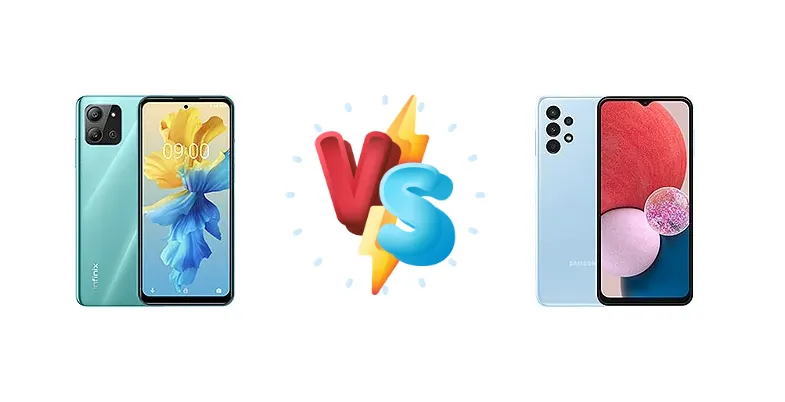
The sub-$150 smartphone market is fiercely competitive. Both the Infinix Hot 11 2022 and the Samsung Galaxy A13 (SM-A137) aim to deliver essential smartphone functionality at an accessible price point. However, they take different approaches to achieving this, primarily through chipset selection and charging capabilities. This comparison dissects those differences to help you choose the right device.
🏆 Quick Verdict
For the average user prioritizing slightly better performance and a marginally faster charging experience, the Samsung Galaxy A13 emerges as the winner. Its Helio G80 chipset offers a small but noticeable edge in CPU and GPU performance, while the 15W charging is a step up from the Infinix's 10W. However, the Infinix remains a viable option for those on a tighter budget.
| Network |
|---|
| 2G bands | GSM 850 / 900 / 1800 / 1900 | GSM 850 / 900 / 1800 / 1900 |
| 3G bands | HSDPA 850 / 900 / 2100 | HSDPA 850 / 900 / 2100 |
| 4G bands | 1, 3, 5, 8, 38, 40, 41 | 1, 3, 5, 7, 8, 20, 28, 38, 40, 41 |
| Speed | HSPA 42.2/5.76 Mbps, LTE Cat4 150/50 Mbps | HSPA, LTE |
| Technology | GSM / HSPA / LTE | GSM / HSPA / LTE |
| | eMMC 5.1 | - |
| Launch |
|---|
| Announced | 2022, April 15 | 2022, June |
| Status | Available. Released 2022, April 21 | Available. Released 2022, July |
| Body |
|---|
| Build | Glass front, plastic back, plastic frame | Glass front (Gorilla Glass 5), plastic frame, plastic back |
| Dimensions | 166.8 x 76.6 x 9.1 mm (6.57 x 3.02 x 0.36 in) | 165.1 x 76.4 x 8.8 mm (6.5 x 3.01 x 0.35 in) |
| SIM | Nano-SIM + Nano-SIM | · Nano-SIM· Nano-SIM + Nano-SIM |
| Weight | 199.6 g (7.05 oz) | 195 g (6.88 oz) |
| Display |
|---|
| Protection | - | Corning Gorilla Glass 5 |
| Resolution | 1080 x 2400 pixels, 20:9 ratio (~393 ppi density) | 1080 x 2408 pixels, 20:9 ratio (~400 ppi density) |
| Size | 6.7 inches, 108.4 cm2 (~84.8% screen-to-body ratio) | 6.6 inches, 104.9 cm2 (~83.2% screen-to-body ratio) |
| Type | IPS LCD, 550 nits (peak) | PLS LCD |
| Platform |
|---|
| CPU | Octa-core (2x1.8 GHz Cortex-A75 & 6x1.8 GHz Cortex-A55) | Octa-core (2x2.0 GHz Cortex-A75 & 6x1.8 GHz Cortex-A55) |
| Chipset | Unisoc T610 (12 nm) | Mediatek MT6769V/CU Helio G80 (12 nm) |
| GPU | Mali-G52 MP2 | Mali-G52 MC2 |
| OS | Android 11, XOS 7.6 | Android 12, upgradable to Android 14, One UI 6.1 |
| Memory |
|---|
| Card slot | microSDXC (dedicated slot) | microSDXC (dedicated slot) |
| Internal | 64GB 4GB RAM | 32GB 3GB RAM, 32GB 4GB RAM, 64GB 4GB RAM, 128GB 4GB RAM |
| | - | eMMC 5.1 |
| Main Camera |
|---|
| Dual | 13 MP, f/2.0, (wide), PDAF
Auxiliary lens | - |
| Features | LED flash, HDR | LED flash, panorama, HDR |
| Quad | - | 50 MP, f/1.8, (wide), PDAF
5 MP, f/2.2, 123˚ (ultrawide), 1/5.0", 1.12µm
2 MP (macro)
Auxiliary lens |
| Single | 8 MP, f/2.0, (wide) | 8 MP, f/2.2, (wide) |
| Video | 1080p@30fps | 1080p@30fps |
| Selfie camera |
|---|
| Single | 8 MP, f/2.0, (wide) | 8 MP, f/2.2, (wide) |
| Video | 1080p@30fps | 1080p@30fps |
| Sound |
|---|
| 3.5mm jack | Yes | Yes |
| 35mm jack | Yes | Yes |
| Loudspeaker | Yes, with dual speakers | Yes |
| Comms |
|---|
| Bluetooth | 5.1, A2DP, LE | 5.2, A2DP, LE |
| NFC | No | Yes |
| Positioning | GPS | GPS, GLONASS, GALILEO, BDS |
| Radio | Unspecified | No |
| USB | USB Type-C 2.0, OTG | USB Type-C 2.0, OTG |
| WLAN | Wi-Fi 802.11 a/b/g/n | Wi-Fi 802.11 a/b/g/n/ac, dual-band, Wi-Fi Direct |
| Features |
|---|
| Sensors | Fingerprint (side-mounted), accelerometer, proximity | Fingerprint (side-mounted), accelerometer, compass |
| | - | Virtual proximity sensing |
| Battery |
|---|
| Charging | 10W wired | 15W wired |
| Type | 5000 mAh | Li-Po 5000 mAh |
| Misc |
|---|
| Colors | Aurora Green, Polar Black, Sunset Gold | Black, White, Blue |
| Models | X675 | SM-A137F, SM-A137F/DSN, SM-A137F/DS |
| Price | About 110 EUR | About 180 EUR |
| SAR EU | - | 0.35 W/kg (head) 1.22 W/kg (body) |
Infinix Hot 11 2022
- Potentially lower price point
- Functional for basic smartphone tasks
- Likely similar battery life to the A13
- Slower processor (Unisoc T610)
- Slower charging speed (10W)
- Less capable GPU for gaming
Samsung Galaxy A13 (SM-A137)
- More powerful processor (Helio G80)
- Faster charging speed (15W)
- Better GPU for gaming
- Slightly higher price
- May not offer significantly better battery life despite faster charging
- Still a budget device with inherent limitations
Display Comparison
Neither device boasts a standout display. Both likely utilize LCD panels, common in this price bracket. While specific details like peak brightness and color gamut coverage are unavailable, the focus here is on processing power, not visual fidelity. Bezels are expected to be relatively thick on both, and color accuracy will likely be standard for budget devices. The display is not a differentiating factor.
Camera Comparison
Both phones are expected to feature multi-camera setups, but image quality will be heavily reliant on software processing. Without specific sensor details beyond the likely inclusion of a main sensor and depth/macro lenses, it’s difficult to make a definitive judgment. The 2MP macro cameras found on many phones in this segment offer limited practical benefit. The Helio G80’s ISP (Image Signal Processor) may offer slightly better image processing capabilities, potentially resulting in marginally improved photos and videos on the Galaxy A13, but this is speculative without detailed camera samples.
Performance
The core difference lies in the chipsets. The Samsung Galaxy A13 features the MediaTek Helio G80 (12nm), with a CPU configuration of 2x2.0 GHz Cortex-A75 and 6x1.8 GHz Cortex-A55 cores. The Infinix Hot 11 2022 utilizes the Unisoc T610 (12nm), with a CPU configuration of 2x1.8 GHz Cortex-A75 and 6x1.8 GHz Cortex-A55 cores. While both employ the same core architecture, the slightly higher clock speed of the Helio G80’s Cortex-A75 cores translates to a marginal performance advantage in CPU-intensive tasks. This difference will be most noticeable when multitasking or launching applications. The Helio G80 also has a more capable Mali-G52 MC2 GPU, offering a better gaming experience than the Unisoc T610’s integrated GPU. Thermal management is unlikely to be a significant concern on either device given the modest processing power.
Battery Life
Battery capacity is not specified, but both devices likely house batteries in the 5000mAh range, typical for this price point. However, charging speeds differ significantly. The Samsung Galaxy A13 supports 15W wired charging, while the Infinix Hot 11 2022 is limited to 10W. This means the Galaxy A13 will charge noticeably faster, reducing downtime. While a larger battery capacity is ideal, the faster charging speed of the Galaxy A13 mitigates the impact of a potentially slightly smaller battery.
Buying Guide
Buy the Infinix Hot 11 2022 if you need a functional smartphone for basic tasks like calling, texting, and light social media use, and are prioritizing the absolute lowest price. Buy the Samsung Galaxy A13 (SM-A137) if you prefer a slightly more responsive experience for everyday tasks and occasional gaming, and value the convenience of faster charging, even if it comes at a small price premium.
Frequently Asked Questions
❓ Will the Helio G80 in the Samsung Galaxy A13 handle popular games like PUBG Mobile?
The Helio G80 is capable of running PUBG Mobile, but you'll likely need to stick to medium graphics settings and moderate frame rates for a smooth experience. It's not a gaming powerhouse, but it's a step up from the Unisoc T610 in the Infinix Hot 11 2022.
❓ How long will it take to fully charge the Samsung Galaxy A13 with the 15W charger?
While a precise time is unavailable, expect a full charge from 0-100% to take approximately 2.5 to 3 hours with the included 15W charger. This is significantly faster than the Infinix Hot 11 2022's 10W charging, which could take upwards of 4 hours.
❓ Is the Unisoc T610 chipset in the Infinix Hot 11 2022 sufficient for everyday tasks like browsing and social media?
Yes, the Unisoc T610 is perfectly adequate for basic smartphone tasks like web browsing, social media, and messaging. However, you may experience some lag when multitasking or opening multiple apps simultaneously.
❓ Does either phone support fast charging protocols beyond the standard wattage?
Neither device is expected to support advanced fast charging protocols like USB Power Delivery or Quick Charge. They are limited to the standard 10W and 15W charging speeds respectively.