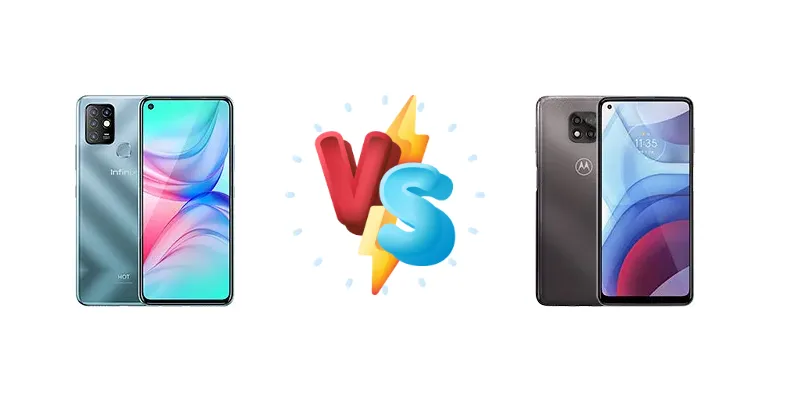
The sub-$200 smartphone market is fiercely competitive. The Infinix Hot 10 and Motorola Moto G Power (2021) both aim to deliver essential features and reliable performance without breaking the bank. However, they take different approaches: the Hot 10 prioritizes processing power with its Helio G70, while the Moto G Power focuses on maximizing battery life with a more efficient Snapdragon 662. This comparison will dissect their strengths and weaknesses to help you choose the right device.
🏆 Quick Verdict
For the average user prioritizing all-day battery life and a consistently smooth experience, the Motorola Moto G Power (2021) is the better choice. While the Infinix Hot 10 boasts a more powerful processor on paper, the Snapdragon 662’s efficiency and Motorola’s software optimization deliver a more refined user experience.
| Network |
|---|
| 2G bands | GSM 850 / 900 / 1800 / 1900 | GSM 850 / 900 / 1800 / 1900 |
| 3G bands | HSDPA 850 / 900 / 1700(AWS) / 1900 / 2100 | HSDPA 850 / 900 / 1700(AWS) / 1900 / 2100 |
| 4G bands | 1, 2, 3, 4, 5, 7, 8, 20, 38, 40, 41 | 1, 2, 3, 4, 5, 7, 8, 12, 13, 14, 17, 25, 26, 29, 30, 38, 41, 66, 71 |
| Speed | HSPA 42.2/5.76 Mbps, LTE Cat4 150/50 Mbps | HSPA, LTE |
| Technology | GSM / HSPA / LTE | GSM / CDMA / HSPA / EVDO / LTE |
| | - | CDMA2000 1xEV-DO |
| Launch |
|---|
| Announced | 2020, September 17. Released 2020, October 17 | 2021, January 08 |
| Status | Discontinued | Available. Released 2021, January 14 |
| Body |
|---|
| Build | Glass front, plastic back, plastic frame | Glass front, plastic back, plastic frame |
| Dimensions | 171.1 x 77.6 x 8.9 mm (6.74 x 3.06 x 0.35 in) | 165.3 x 75.9 x 9.5 mm (6.51 x 2.99 x 0.37 in) |
| SIM | Nano-SIM + Nano-SIM | Nano-SIM |
| Weight | 195 g (6.88 oz) | 206.5 g (7.30 oz) |
| | - | Water-repellent coating |
| Display |
|---|
| Resolution | 720 x 1640 pixels (~264 ppi density) | 720 x 1600 pixels, 20:9 ratio (~266 ppi density) |
| Size | 6.78 inches, 109.2 cm2 (~82.2% screen-to-body ratio) | 6.6 inches, 105.2 cm2 (~83.8% screen-to-body ratio) |
| Type | IPS LCD | IPS LCD |
| Platform |
|---|
| CPU | Octa-core (2x2.0 GHz Cortex-A75 & 6x1.7 GHz Cortex-A55) | Octa-core (4x2.0 GHz Kryo 260 Gold & 4x1.8 GHz Kryo 260 Silver) |
| Chipset | Mediatek MT6769V/CB Helio G70 (12 nm) | Qualcomm SM6115 Snapdragon 662 (11 nm) |
| GPU | Mali-G52 2EEMC2 | Adreno 610 |
| OS | Android 10, XOS 6.0 | Android 10 |
| Memory |
|---|
| Card slot | microSDXC (dedicated slot) | microSDXC (dedicated slot) |
| Internal | 64GB 3GB RAM, 64GB 4GB RAM, 128GB 4GB RAM, 128GB 6GB RAM | 32GB 3GB RAM, 64GB 4GB RAM |
| | eMMC 5.1 | eMMC 5.1 |
| Main Camera |
|---|
| Features | Quad-LED flash, HDR, panorama | LED flash, HDR, panorama |
| Quad | 16 MP, (wide), PDAF
2 MP (macro)
Auxiliary lenses | - |
| Triple | - | 48 MP, f/1.7, (wide), 1/2.0", 0.8µm, PDAF
2 MP (macro)
Auxiliary lens |
| Video | 1080p@30fps | 1080p@30/60fps, gyro-EIS |
| Selfie camera |
|---|
| Features | - | HDR |
| Single | 8 MP, (wide) | 8 MP, f/2.0, 1.12µm |
| Video | 1080p@30fps | 1080p@30fps, gyro-EIS |
| Sound |
|---|
| 3.5mm jack | Yes | Yes |
| 35mm jack | Yes | Yes |
| Loudspeaker | Yes | Yes |
| Comms |
|---|
| Bluetooth | 5.0, A2DP, LE | 5.0, A2DP, LE |
| NFC | No | No |
| Positioning | GPS | GPS, GLONASS, GALILEO |
| Radio | FM radio | FM radio |
| USB | microUSB 2.0, OTG | USB Type-C 2.0 |
| WLAN | Wi-Fi 802.11 a/b/g/n/ac, dual-band, Wi-Fi Direct | Wi-Fi 802.11 a/b/g/n/ac, dual-band, Wi-Fi Direct |
| Features |
|---|
| Sensors | Fingerprint (rear-mounted), accelerometer, gyro, proximity, compass | Fingerprint (side-mounted), accelerometer, gyro, proximity, compass, barometer |
| Battery |
|---|
| Charging | - | 15W wired |
| Type | 5200 mAh | Li-Po 5000 mAh |
| Misc |
|---|
| Colors | Obsidian Black, Amber Red, Moonlight Jade, Ocean Wave | Flash Gray, Polar Silver |
| Models | X682B, X682C, MZ-Infinix X682B, MZ-Infinix X682C | - |
| Price | About 120 EUR | About 60 EUR |
Infinix Hot 10
- More powerful processor for gaming
- Potentially faster app loading times
- Aggressive pricing may offer more RAM/storage
- Less efficient processor, impacting battery life
- Potential for more aggressive bloatware
- Software updates may be less frequent
Motorola Moto G Power (2021)
- Exceptional battery life
- Clean Android experience with minimal bloatware
- More efficient processor for sustained performance
- Less powerful processor for demanding tasks
- Slower charging speed (15W)
- Camera performance may be less impressive in low light
Display Comparison
Neither device is a display standout. Both likely feature LCD panels, common in this price bracket. The key difference lies under the hood. While specific display specs are unavailable for the Hot 10, the Moto G Power’s focus is on practicality rather than visual fidelity. The absence of high refresh rates on either device suggests a focus on power conservation. Bezels are expected to be noticeable on both, typical for budget phones.
Camera Comparison
Camera performance is likely to be similar, with both phones targeting basic photography needs. Without detailed sensor information, it’s difficult to make definitive claims. However, Motorola generally emphasizes image processing for natural colors, while Infinix often leans towards more vibrant, saturated images. The presence of multiple cameras on both devices is standard, but the utility of 2MP macro lenses is questionable. Expect acceptable results in good lighting conditions, but struggles in low-light scenarios.
Performance
The core of the comparison lies in the chipsets. The Infinix Hot 10’s MediaTek Helio G70 (12nm) utilizes a dual-cluster CPU design – two Cortex-A75 cores for peak performance and six Cortex-A55 cores for efficiency. This contrasts with the Motorola Moto G Power’s Qualcomm Snapdragon 662 (11nm), which employs a Kryo 260 Gold/Silver configuration. The 11nm process node of the Snapdragon 662 generally translates to better power efficiency compared to the 12nm Helio G70. While the G70’s A75 cores offer higher clock speeds (2.0 GHz vs 2.0 GHz Kryo Gold), the Snapdragon 662’s optimized architecture and software integration often result in smoother, more consistent performance in real-world usage. The G70 is geared towards bursts of power, while the 662 prioritizes sustained performance.
Battery Life
The Motorola Moto G Power (2021) truly shines in the battery department. While the exact capacity isn’t specified, Motorola’s ‘Power’ branding signifies a large battery, likely exceeding 5000mAh. Coupled with the Snapdragon 662’s efficiency and 15W charging, this translates to multi-day battery life for moderate users. The Infinix Hot 10, with its more power-hungry Helio G70, will likely require more frequent charging. The 15W charging on the Moto G Power is relatively slow, but the large battery capacity mitigates this drawback.
Buying Guide
Buy the Infinix Hot 10 if you frequently engage in demanding tasks like mobile gaming or video editing and are willing to trade some battery life for raw processing power. Buy the Motorola Moto G Power (2021) if your primary needs are reliable performance for everyday tasks, exceptional battery endurance, and a clean, bloatware-free Android experience. It’s the ideal phone for users who prioritize longevity and simplicity.
Frequently Asked Questions
❓ Will the Infinix Hot 10 overheat during extended gaming sessions?
The Helio G70 is capable of handling gaming, but its 12nm process and higher power draw mean it's more prone to thermal throttling than the Snapdragon 662. Expect performance to dip after prolonged gaming, and the phone may become noticeably warm.
❓ How long will the Motorola Moto G Power (2021) realistically last on a single charge with moderate use?
With moderate use – including browsing, social media, and occasional video streaming – the Moto G Power (2021) can easily last two full days, and potentially even three, on a single charge. This is thanks to the Snapdragon 662’s efficiency and the phone’s large battery capacity.
❓ Does the Motorola Moto G Power (2021) have a lot of bloatware?
Motorola is known for providing a relatively clean Android experience. The Moto G Power (2021) includes a minimal amount of pre-installed apps, and most can be easily uninstalled if desired. This contrasts with some other budget brands that heavily load their devices with bloatware.