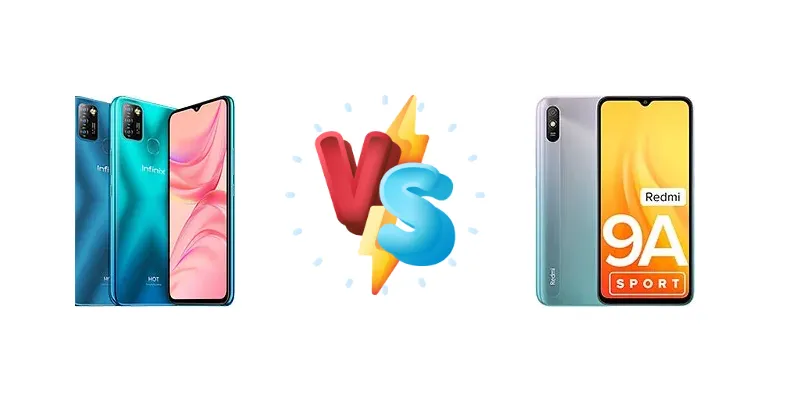
The Infinix Hot 10 Lite and Xiaomi Redmi 9A Sport represent the fiercely competitive sub-$150 smartphone market. Both aim to deliver essential smartphone functionality at an incredibly accessible price point. However, key differences in their chipsets and CPU configurations dictate which device offers a smoother, more responsive user experience. This comparison dissects those differences to help you choose the right phone for your needs.
🏆 Quick Verdict
For most users, the Xiaomi Redmi 9A Sport emerges as the better choice. Its Helio G25 chipset, featuring an octa-core CPU, provides a noticeable performance uplift over the Infinix Hot 10 Lite’s quad-core Helio A20. While both offer similar battery life and charging speeds, the Redmi 9A Sport’s extra processing power translates to a more fluid daily experience.
| Network |
|---|
| 2G bands | GSM 850 / 900 / 1800 / 1900 | GSM 850 / 900 / 1800 / 1900 |
| 3G bands | HSDPA 850 / 900 / 2100 | HSDPA 850 / 900 / 2100 |
| 4G bands | 1, 2, 3, 4, 5, 7, 8, 20, 28 | 1, 3, 5, 8, 40, 41 |
| Speed | HSPA 42.2/5.76 Mbps, LTE Cat4 150/50 Mbps | HSPA, LTE |
| Technology | GSM / HSPA / LTE | GSM / HSPA / LTE |
| | 3, 7, 20 | - |
| Launch |
|---|
| Announced | 2020, September 29. Released 2020, October 26 | 2021, September 28 |
| Status | Discontinued | Available. Released 2021, September 28 |
| Body |
|---|
| Dimensions | 165.5 x 76.4 x 8.8 mm (6.52 x 3.01 x 0.35 in) | 164.9 x 77.1 x 9 mm (6.49 x 3.04 x 0.35 in) |
| SIM | Nano-SIM + Nano-SIM | Nano-SIM + Nano-SIM |
| Weight | - | 194 g (6.84 oz) |
| | - | Water-repellent coating |
| Display |
|---|
| Resolution | 720 x 1600 pixels, 20:9 ratio (~266 ppi density) | 720 x 1600 pixels, 20:9 ratio (~269 ppi density) |
| Size | 6.6 inches, 105.2 cm2 (~83.2% screen-to-body ratio) | 6.53 inches, 102.9 cm2 (~81.0% screen-to-body ratio) |
| Type | IPS LCD | IPS LCD, 400 nits (typ) |
| Platform |
|---|
| CPU | Quad-core 1.8 GHz Cortex-A53 | Octa-core (4x2.0 GHz Cortex-A53 & 4x1.5 GHz Cortex-A53) |
| Chipset | Mediatek MT6761D Helio A20 (12 nm) | Mediatek MT6762G Helio G25 (12 nm) |
| GPU | PowerVR GE8320 | PowerVR GE8320 |
| OS | Android 10 (Go edition) | Android 10, MIUI 12 |
| Memory |
|---|
| Card slot | microSDXC (dedicated slot) | microSDXC (dedicated slot) |
| Internal | 32GB 2GB RAM, 64GB 3GB RAM | 32GB 2GB RAM, 32GB 3GB RAM |
| | eMMC 5.1 | eMMC 5.1 |
| Main Camera |
|---|
| Features | Triple-LED flash | LED flash, HDR |
| Single | 3.2 MP | 13 MP, f/2.2, 28mm (wide), 1.0µm, PDAF |
| Triple | 13 MP, (wide), AF
Auxiliary lenses | - |
| Video | 1080p@30fps | 1080p@30/60fps |
| Selfie camera |
|---|
| Features | Dual-LED flash | HDR |
| Single | 8 MP, (wide) | 5 MP, f/2.2, (wide), 1.12µm |
| Video | 1080p@30fps | 1080p@30fps |
| Sound |
|---|
| 3.5mm jack | Yes | Yes |
| 35mm jack | Yes | Yes |
| Loudspeaker | Yes | Yes |
| Comms |
|---|
| Bluetooth | 5.0, A2DP, LE | 5.0, A2DP, LE |
| NFC | No | No |
| Positioning | GPS | GPS, GLONASS, BDS |
| Radio | FM radio | FM radio |
| USB | microUSB 2.0, OTG | microUSB 2.0, OTG |
| WLAN | Wi-Fi 802.11 a/b/g/n/ac, dual-band, Wi-Fi Direct | Wi-Fi 802.11 a/b/g/n, Wi-Fi Direct |
| Features |
|---|
| Sensors | Fingerprint (rear-mounted), accelerometer, proximity | Accelerometer, proximity |
| Battery |
|---|
| Charging | 10W wired | 10W wired |
| Stand-by | Up to 713 h (2G) / Up to 428 h (3G) | - |
| Talk time | Up to 15 h (2G) / Up to 6 h 30 min (3G) | - |
| Type | 5000 mAh | Li-Po 5000 mAh |
| Misc |
|---|
| Colors | Black, Red, Blue, Green | Carbon Black, Coral Green, Metallic Blue |
| Models | X657B | - |
| Price | About 100 EUR | About 100 EUR |
Infinix Hot 10 Lite
- Potentially lower price point.
- Functional for basic smartphone tasks.
- Simple and straightforward user experience.
- Significantly weaker performance compared to the Redmi 9A Sport.
- Struggles with multitasking and demanding apps.
- Likely limited gaming capabilities.
Xiaomi Redmi 9A Sport
- More powerful Helio G25 chipset for smoother performance.
- Octa-core CPU enables better multitasking.
- Improved gaming experience compared to the Hot 10 Lite.
- May be slightly more expensive than the Hot 10 Lite.
- Still limited by its budget price point.
- 10W charging is relatively slow.
Display Comparison
Neither device boasts a standout display. Both likely utilize LCD panels, typical for this price bracket. The focus here isn't on visual fidelity, but on basic usability. Without specific display specs, we can assume similar resolutions and brightness levels. The real differentiator will be software optimizations for color accuracy, which are difficult to assess without direct comparison.
Camera Comparison
Both phones likely feature basic camera setups, and detailed sensor information is lacking. It's safe to assume both will include a primary camera and potentially a depth sensor. Given the price point, image quality will be heavily reliant on software processing. Without knowing sensor sizes or apertures, it’s difficult to declare a clear winner. However, the Redmi 9A Sport’s slightly more powerful chipset *could* allow for faster image processing, potentially resulting in marginally better photos. The inclusion of a 2MP macro lens on either device is largely a marketing gimmick and unlikely to deliver significant improvements in image quality.
Performance
The core difference lies in the chipsets. The Xiaomi Redmi 9A Sport’s MediaTek Helio G25 is a significant upgrade over the Infinix Hot 10 Lite’s Helio A20. The G25’s octa-core configuration (4x2.0 GHz Cortex-A53 & 4x1.5 GHz Cortex-A53) provides substantially more processing power than the A20’s quad-core 1.8 GHz Cortex-A53. This translates to faster app loading times, smoother multitasking, and a more responsive user interface. While neither is a gaming powerhouse, the G25 will handle less demanding games with greater ease. The A20 will struggle with even moderately complex titles.
Battery Life
Both devices feature 10W wired charging, indicating similar charging speeds. Without knowing the battery capacity of the Infinix Hot 10 Lite, it’s difficult to make a definitive statement about battery life. However, given the similar chipsets (both 12nm process), and the Redmi 9A Sport’s more efficient CPU configuration, it’s reasonable to expect comparable real-world battery performance. Users should anticipate a full charge taking around 2.5-3 hours.
Buying Guide
Buy the Infinix Hot 10 Lite if your primary needs are extremely basic – calls, texts, and light social media – and you prioritize minimizing cost above all else. It's a functional device for first-time smartphone users. Buy the Xiaomi Redmi 9A Sport if you want a more responsive experience for multitasking, occasional gaming, and smoother app usage. The extra cores and higher clock speeds offer a tangible benefit for a small price premium.
Frequently Asked Questions
❓ Will the Redmi 9A Sport handle popular games like PUBG Mobile?
While the Redmi 9A Sport won't deliver a high-end gaming experience, the Helio G25 chipset allows for playable frame rates in PUBG Mobile at lower graphics settings. Expect to adjust settings to achieve a smooth experience, and don't anticipate consistently high frame rates.
❓ Is the difference in performance between the Helio A20 and Helio G25 noticeable in everyday use?
Yes, the difference is quite noticeable. The Helio G25’s octa-core CPU provides a significant boost in multitasking, app loading times, and overall responsiveness. The Infinix Hot 10 Lite with the Helio A20 will feel sluggish in comparison, especially when switching between apps.
❓ How long will it take to fully charge both phones?
With both phones supporting 10W charging, expect a full charge to take approximately 2.5 to 3 hours from 0% to 100%. This is typical for budget smartphones with slower charging capabilities.
❓ Which phone is better for someone who primarily uses WhatsApp and Facebook?
The Xiaomi Redmi 9A Sport is still the better choice, even for basic social media use. The smoother performance will make scrolling through feeds and using apps like WhatsApp more enjoyable. The Hot 10 Lite will function, but may exhibit noticeable lag.