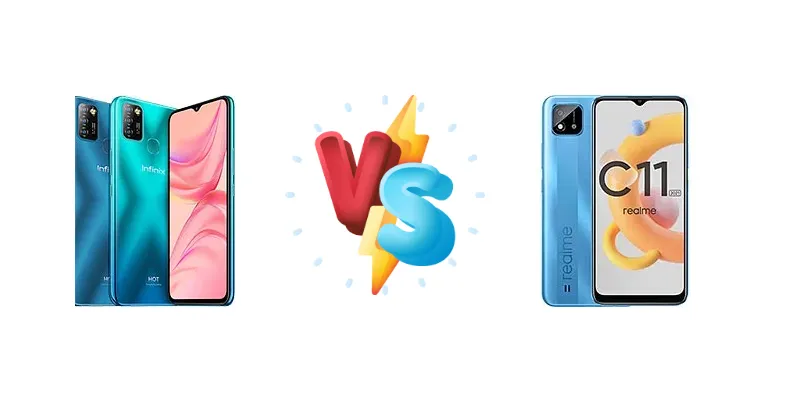
The sub-$150 smartphone market is fiercely competitive. Both the Infinix Hot 10 Lite and the Realme C11 (2021) aim to deliver essential smartphone functionality at an incredibly accessible price point. However, they take different approaches to achieving this, primarily in their chipset choices, impacting performance and efficiency. This comparison dissects those differences to determine which device offers the best value.
🏆 Quick Verdict
For the average user prioritizing multitasking and smoother app experiences, the Realme C11 (2021) is the better choice. Its Unisoc SC9863A octa-core processor provides a noticeable performance uplift over the Infinix Hot 10 Lite’s MediaTek Helio A20 quad-core, despite the latter’s more efficient manufacturing process.
| Network |
|---|
| 2G bands | GSM 850 / 900 / 1800 / 1900 | GSM 850 / 900 / 1800 / 1900 |
| 3G bands | HSDPA 850 / 900 / 2100 | HSDPA 850 / 900 / 1900 / 2100 |
| 4G bands | 1, 2, 3, 4, 5, 7, 8, 20, 28 | 1, 3, 5, 8, 38, 40, 41 |
| Speed | HSPA 42.2/5.76 Mbps, LTE Cat4 150/50 Mbps | HSPA, LTE |
| Technology | GSM / HSPA / LTE | GSM / HSPA / LTE |
| | 3, 7, 20 | - |
| Launch |
|---|
| Announced | 2020, September 29. Released 2020, October 26 | 2021, June 28 |
| Status | Discontinued | Available. Released 2021, June 28 |
| Body |
|---|
| Build | - | Glass front, plastic frame, plastic back |
| Dimensions | 165.5 x 76.4 x 8.8 mm (6.52 x 3.01 x 0.35 in) | 165.2 x 76.4 x 8.9 mm (6.50 x 3.01 x 0.35 in) |
| SIM | Nano-SIM + Nano-SIM | Nano-SIM + Nano-SIM |
| Weight | - | 190 g (6.70 oz) |
| | - | Splash resistant design |
| Display |
|---|
| Resolution | 720 x 1600 pixels, 20:9 ratio (~266 ppi density) | 720 x 1600 pixels, 20:9 ratio (~269 ppi density) |
| Size | 6.6 inches, 105.2 cm2 (~83.2% screen-to-body ratio) | 6.52 inches, 102.6 cm2 (~81.3% screen-to-body ratio) |
| Type | IPS LCD | IPS LCD, 400 nits (typ) |
| Platform |
|---|
| CPU | Quad-core 1.8 GHz Cortex-A53 | Octa-core (4x1.6 GHz Cortex-A55 & 4x1.2 GHz Cortex-A55) |
| Chipset | Mediatek MT6761D Helio A20 (12 nm) | Unisoc SC9863A (28 nm) |
| GPU | PowerVR GE8320 | IMG8322 |
| OS | Android 10 (Go edition) | Android 11, Realme Go UI |
| Memory |
|---|
| Card slot | microSDXC (dedicated slot) | microSDXC (dedicated slot) |
| Internal | 32GB 2GB RAM, 64GB 3GB RAM | 32GB 2GB RAM, 64GB 4GB RAM |
| | eMMC 5.1 | eMMC 5.1 |
| Main Camera |
|---|
| Features | Triple-LED flash | LED flash, HDR, panorama |
| Single | 3.2 MP | 8 MP, f/2.0, (wide), AF |
| Triple | 13 MP, (wide), AF
Auxiliary lenses | - |
| Video | 1080p@30fps | 1080p@30fps |
| Selfie camera |
|---|
| Features | Dual-LED flash | HDR, panorama |
| Single | 8 MP, (wide) | 5 MP, f/2.2, (wide) |
| Video | 1080p@30fps | 1080p@30fps |
| Sound |
|---|
| 3.5mm jack | Yes | Yes |
| 35mm jack | Yes | Yes |
| Loudspeaker | Yes | Yes |
| Comms |
|---|
| Bluetooth | 5.0, A2DP, LE | 4.2, A2DP |
| NFC | No | No |
| Positioning | GPS | GPS, GLONASS, GALILEO, BDS |
| Radio | FM radio | Unspecified |
| USB | microUSB 2.0, OTG | microUSB 2.0, OTG |
| WLAN | Wi-Fi 802.11 a/b/g/n/ac, dual-band, Wi-Fi Direct | Wi-Fi 802.11 b/g/n |
| Features |
|---|
| Sensors | Fingerprint (rear-mounted), accelerometer, proximity | Accelerometer, gyro, proximity, compass |
| Battery |
|---|
| Charging | 10W wired | 10W wired
Reverse wired |
| Stand-by | Up to 713 h (2G) / Up to 428 h (3G) | - |
| Talk time | Up to 15 h (2G) / Up to 6 h 30 min (3G) | - |
| Type | 5000 mAh | 5000 mAh |
| Misc |
|---|
| Colors | Black, Red, Blue, Green | Cool Blue, Cool Grey |
| Models | X657B | RMX3231 |
| Price | About 100 EUR | About 80 EUR |
Infinix Hot 10 Lite
- Potentially better power efficiency due to 12nm process.
- Simple and straightforward user experience.
- Lower price point (potentially).
- Quad-core processor limits multitasking capabilities.
- Less responsive user interface.
- No reverse charging.
Realme C11 (2021)
- Octa-core processor offers smoother performance.
- Reverse wired charging adds versatility.
- More modern CPU architecture (Cortex-A55).
- Less efficient 28nm manufacturing process.
- Potentially shorter battery life under heavy load.
- May be slightly more expensive.
Display Comparison
Neither device boasts a standout display. Both likely feature basic LCD panels with resolutions around 720p+, typical for this price bracket. Without specific brightness data, it’s difficult to declare a winner, but the Realme C11’s slightly larger screen size (typically 6.5 inches vs. the Hot 10 Lite’s 6.52 inches) may offer a marginally more immersive viewing experience. Bezels are expected to be substantial on both, and color accuracy will likely be standard for budget displays.
Camera Comparison
Both phones are expected to feature modest camera setups. Details are scarce, but both likely include a primary camera and potentially a depth sensor. Without specific sensor sizes or aperture information, a direct comparison is difficult. However, the focus should be on the primary sensor’s quality, as any secondary sensors (like the often-included 2MP macro) will offer limited practical benefit. Image processing will likely be basic on both, prioritizing speed over advanced features.
Performance
The core difference lies in the chipsets. The Infinix Hot 10 Lite’s MediaTek Helio A20, built on a 12nm process, features a quad-core Cortex-A53 CPU clocked at 1.8 GHz. This is a basic processor designed for minimal tasks. Conversely, the Realme C11 (2021) utilizes the Unisoc SC9863A, fabricated on a less efficient 28nm node, but compensates with an octa-core configuration (4x1.6 GHz Cortex-A55 & 4x1.2 GHz Cortex-A55). The octa-core design allows for better multitasking and handling of more demanding applications. While the 12nm process of the Helio A20 *should* offer better power efficiency, the performance gap created by the additional cores in the SC9863A is likely more impactful for most users. The Cortex-A55 cores in the Realme C11 are also a more modern architecture than the A53 cores in the Infinix, contributing to improved performance per watt.
Battery Life
Both devices feature 10W wired charging, indicating similar charging speeds. The Realme C11 (2021) adds the convenience of reverse wired charging, allowing it to act as a power bank for other devices – a feature absent on the Infinix Hot 10 Lite. While battery capacity isn’t specified, the more efficient Helio A20 in the Infinix Hot 10 Lite *could* translate to slightly longer battery life under light usage, but the performance demands of the Unisoc chip in the Realme C11 will likely negate this advantage with moderate to heavy use.
Buying Guide
Buy the Infinix Hot 10 Lite if you primarily need a phone for basic communication – calls, texts, and light social media – and prioritize a potentially longer battery life due to the more efficient, albeit less powerful, Helio A20 chipset. Buy the Realme C11 (2021) if you anticipate heavier usage, including running multiple apps simultaneously, occasional gaming, or simply prefer a more responsive user experience, and value the convenience of reverse wired charging.
Frequently Asked Questions
❓ Will the Realme C11 (2021) struggle with popular apps like WhatsApp and Facebook?
While not a powerhouse, the Realme C11 (2021)'s octa-core processor and more modern CPU architecture should handle apps like WhatsApp and Facebook without significant issues. You might experience some slowdown with multiple apps open simultaneously, but for typical social media usage, it's sufficient.
❓ Is the Infinix Hot 10 Lite suitable for playing mobile games?
The Infinix Hot 10 Lite is not ideal for gaming. The Helio A20 is a basic processor and will struggle with most modern mobile games, even at low settings. Expect low frame rates and potential lag. The Realme C11 (2021) will offer a slightly better gaming experience, but still isn't designed for demanding titles.
❓ How long does it take to fully charge both phones?
With both phones supporting only 10W charging, expect a full charge to take approximately 3-4 hours from 0%. The charging speed is relatively slow compared to modern fast-charging technologies.
❓ Can the Realme C11 (2021) charge my wireless earbuds?
Yes, the Realme C11 (2021)'s reverse wired charging feature allows you to charge other devices, including wireless earbuds (using a USB cable, of course). It's a convenient feature for topping up accessories when you're away from a power outlet.